


What Is a Profit and Loss Only Mortgage Loan?
A Profit and Loss (P&L) only mortgage loan is a powerful financing tool designed specifically for self-employed individuals and business owners. It falls under the category of a non-qualified mortgage (non-QM), which means it doesn't have to meet the strict income verification standards set by government agencies for conventional loans.
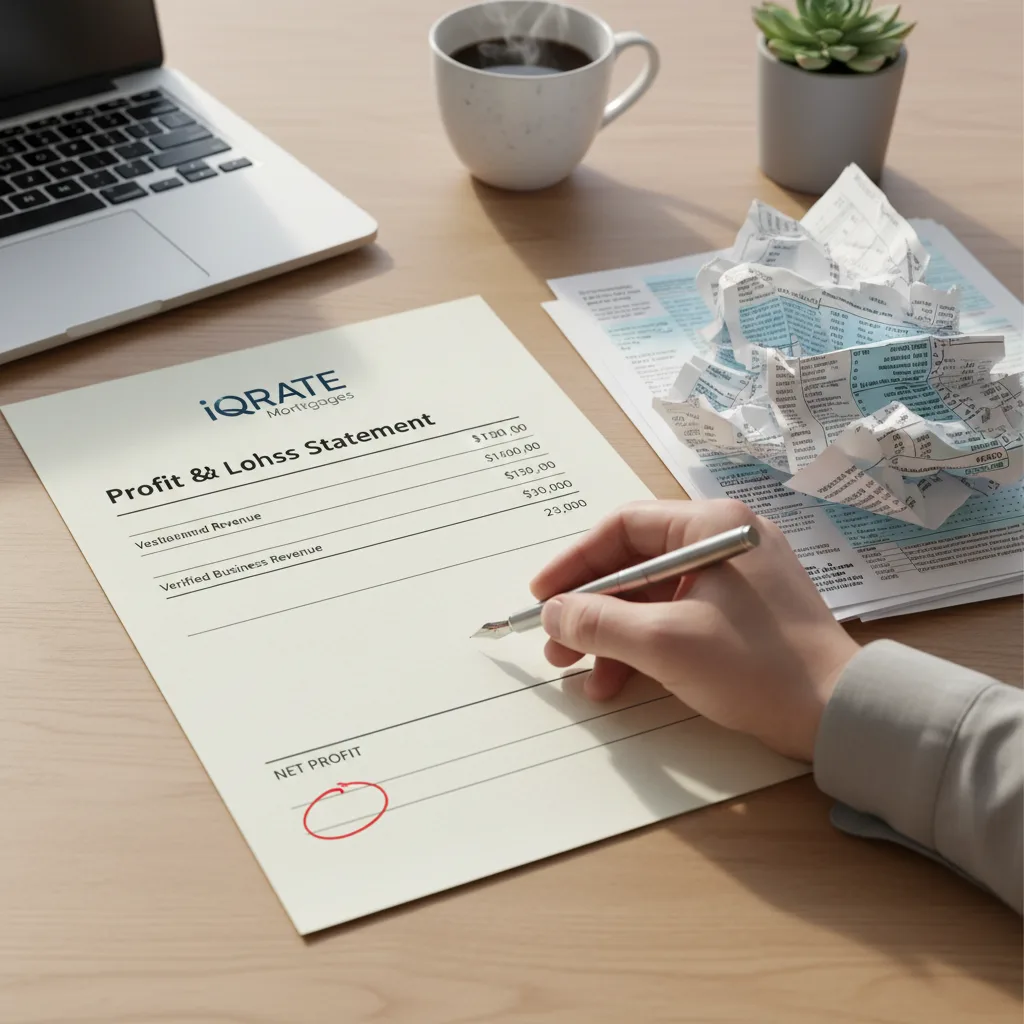
Instead of scrutinizing your tax returns (like a Form 1040 with a Schedule C), which are often filled with legitimate business deductions that lower your net taxable income, a lender uses your business's P&L statement to determine your eligibility. This document showcases your gross revenue, lists your expenses, and arrives at a net profit that often presents a much stronger financial picture.
For example, a freelance graphic designer in Los Angeles might have a gross annual revenue of $250,000. After writing off software subscriptions, marketing costs, a home office, and equipment, their taxable net income might only be $75,000. A traditional lender sees only the $75,000, limiting their borrowing power significantly. A P&L loan program, however, allows a lender to evaluate the business's actual profitability and cash flow, potentially using a much higher income figure for qualification.
Who Is the Ideal Candidate for a P&L Only Loan in Los Angeles?
A P&L only loan is not for everyone. It's a specialized product built for a specific type of borrower who is common in California's entrepreneurial hubs. The ideal candidate typically fits the following profile:
- Established Business Owners: You have been self-employed or running your business for at least two years, demonstrating a history of stability.
- High-Deduction Professionals: You are a consultant, real estate agent, contractor, freelancer, or small business owner in a field with significant, legitimate business expenses.
- Strong Credit History: Lenders will still look for a solid credit score, often starting in the mid-600s, to offset the alternative income documentation. (The data, information, or policy mentioned here may vary over time.)
- Sufficient Liquid Assets: You have the funds available for a larger down payment and possess cash reserves (typically enough to cover several months of mortgage payments).
- Frustrated by Traditional Underwriting: You have strong, consistent business revenue but have been turned down for a conventional loan because your tax returns don't reflect your true ability to afford a home in competitive markets like Los Angeles or San Diego.

How Is a P&L Statement Loan Different From a Bank Statement Loan?
While both are non-QM loans for the self-employed, they use fundamentally different methods to calculate your qualifying income. Understanding the distinction is key to choosing the right path.
Income Calculation Method
A P&L loan focuses on profitability. A lender analyzes a detailed Profit and Loss statement, usually prepared by a Certified Public Accountant (CPA), to understand your revenue streams and itemized expenses. The net profit shown on this statement becomes the basis for your qualifying income. Bank statements are used primarily to corroborate the revenue figures on the P&L.
A bank statement loan focuses on cash flow. The lender analyzes 12 or 24 months of business bank statements to calculate your average monthly deposits. They then apply a standard 'expense factor' (often 50%, but it can vary by industry) to the deposits to estimate your net income. This method does not require a P&L statement.
Documentation Focus
With a P&L loan, the star of the show is the P&L statement itself. Its accuracy, detail, and professional preparation are critical. For a bank statement loan, the focus is entirely on the deposits flowing through your business accounts.
Borrower Suitability
A P&L loan is often better for businesses with clear, well-documented financials and profitability, even if cash flow is inconsistent. For example, a contractor in San Francisco who receives large, infrequent payments for completed projects would benefit more from a P&L loan that shows the profitability of each job.
A bank statement loan may be more suitable for a business with very high and consistent monthly deposits but less formal bookkeeping, such as an e-commerce store owner.
What Documentation Does a San Francisco Lender Need for a P&L Loan?
Lenders in competitive markets like San Francisco need to be confident in your business's financial health. While requirements vary, you should be prepared to provide the following core documents:
- Profit & Loss Statement: This should cover the most recent 12 or 24 months, plus a year-to-date statement for the current year. It needs to be detailed, not just a one-page summary.
- Business Bank Statements: You will likely need to provide 2 to 12 months of statements to verify the revenue reported on your P&L.
- Proof of Business: A business license, articles of incorporation, or other state registration documents proving your business has been active for at least two years.
- CPA or Tax Preparer Letter: Many lenders require a letter from a licensed accounting professional who can verify that they are aware of your business and that the P&L statement is a reasonable reflection of its financial activity.
- Standard Loan Application Documents: This includes a valid photo ID, authorization to pull your credit report, and statements for any asset accounts you'll use for the down payment and closing costs.
Do I Need a Certified Public Accountant to Prepare My Profit and Loss Statement?
While a few lenders may accept a self-prepared P&L, it is highly recommended and often a firm requirement to have it prepared by a CPA or licensed tax preparer. A professionally prepared statement provides a crucial layer of third-party validation that underwriters value immensely.
- Credibility: A CPA's signature on your P&L tells the lender that the figures have been reviewed and compiled according to standard accounting principles. This instantly boosts the lender's confidence.
- Accuracy: A CPA ensures the document is formatted correctly and that calculations are accurate, preventing needless delays or rejections due to simple errors.
- Smoother Process: Submitting a CPA-prepared P&L from the start can significantly speed up the underwriting process, as it answers many of the questions an underwriter would have about a self-prepared document.
Attempting to use a self-prepared P&L will invite much deeper scrutiny of your bank statements and business operations, potentially slowing down or jeopardizing your loan approval.
Are Interest Rates Higher on These Types of Mortgages?
Yes, interest rates for P&L loans are typically higher than those for conventional loans. This rate difference is a direct trade-off for the flexible income verification the loan offers.
Because non-QM loans don't conform to the government-backed standards that protect lenders from risk, the lender assumes more risk themselves. To compensate for this, they charge a higher interest rate. The premium you pay could be anywhere from 0.5% to 1.5% higher than a comparable conventional mortgage, depending on factors like your credit score, loan-to-value ratio, and the size of your down payment. (The data, information, or policy mentioned here may vary over time.) For many self-employed buyers in Los Angeles, this slightly higher rate is a small price to pay for the ability to secure a mortgage that would otherwise be out of reach.
What Are the Typical Down Payment Requirements for P&L Loans?
Down payment requirements for P&L loans are more substantial than for FHA or some conventional loans. Lenders need to see that you have significant 'skin in the game'. You should expect a minimum down payment of 15% to 20%. (The data, information, or policy mentioned here may vary over time.)
Putting 20% or more down is ideal, as it lowers the loan-to-value (LTV) ratio and reduces the lender's risk, which can help you secure a better interest rate. For a $1.5 million home purchase in San Francisco, a 20% down payment would be $300,000. This demonstrates strong financial health and a serious commitment to the investment. While some niche programs may exist for 10% down, they often come with stricter credit requirements and higher rates.
Can I Use a Profit and Loss Loan for a Jumbo Home Purchase?
Absolutely. In fact, P&L loans are one of the most common and effective ways for self-employed individuals to finance jumbo home purchases in high-cost-of-living areas across California.
A jumbo loan is any mortgage that exceeds the conforming loan limits set by the Federal Housing Finance Agency (FHFA). In areas like Los Angeles and San Francisco, where home prices are high, many purchases fall into the jumbo category. Business owners pursuing these properties often have complex finances and massive tax write-offs, making them prime candidates for a P&L loan.
This financing allows an entrepreneur who wants to buy a $3 million home in San Diego to qualify based on their company's multi-million dollar gross revenue, rather than the much lower income figure reported to the IRS after deductions.
If your tax returns don't reflect the true strength of your business, a P&L loan could be your key to homeownership. Don't let traditional underwriting hold you back. Take the next step to see if a loan structured for your entrepreneurial success is the right fit. Apply now to have a mortgage strategist analyze your unique financial situation.
Author Bio
David Ghazaryan is the expert mortgage strategist and founder behind iQRATE Mortgages. With a mission to fund home loans that traditional banks won't touch, David specializes in helping clients with unique financial situations, including those recovering from foreclosure or bankruptcy. He expertly crafts smart, strategic, and stress-free mortgages by leveraging a vast network of over 100 lenders to secure competitive rates for investors and homebuyers alike. Praised for exceptional customer service, David has helped hundreds of families with a 97% satisfaction rate, guiding them to the mortgage they deserve.
References
Consumer Financial Protection Bureau - What is a qualified mortgage?
Fannie Mae - Underwriting Factors for a Self-Employed Borrower









