


The Core Decision: Selling vs. Renting Your Texas Home
For homeowners in Texas looking to buy their next property, a significant question arises: what should you do with your current home? Selling it frees up equity and simplifies your financial profile. Renting it out, however, turns your first home into an income-producing asset and a stepping stone toward building a real estate portfolio. This choice is more than a personal preference; it fundamentally changes how a mortgage lender evaluates your application for your new home. Your debt-to-income (DTI) ratio, cash requirements, and overall loan approval hinge on this decision. Whether you're moving from a starter home in Austin to a larger one in the suburbs or relocating from Houston to Frisco, understanding the mortgage implications is the first step toward making a smart financial move.
How Lenders View Your Existing Home in Mortgage Underwriting
Mortgage lenders focus on one primary metric to assess risk: your debt-to-income (DTI) ratio. This percentage shows how much of your gross monthly income goes toward paying your monthly debt obligations. Keeping your current home adds its mortgage payment to your DTI calculation, which can make it harder to qualify for a new loan. However, if you convert it to a rental, the potential income can work in your favor.
Scenario 1: Selling Your Current Home
This is the most straightforward path. When you sell your home, the mortgage associated with it is paid off. That debt is completely removed from your DTI ratio. The proceeds from the sale can then be used for the down payment and closing costs on your new home.

- DTI Impact: Your existing mortgage payment is eliminated, significantly lowering your DTI.
- Cash Position: You gain access to your home's equity, potentially allowing for a larger down payment on the next property, which could help you avoid private mortgage insurance (PMI) and secure a better interest rate.
- Simplicity: The transaction is clean. You have one mortgage application to focus on without the complexities of property management or rental income verification.
Scenario 2: Converting Your Home to a Rental in Austin
Choosing to keep your home and rent it out makes you a real estate investor. From a lender's perspective, your existing mortgage payment remains a debt. However, they can use a portion of the projected rental income to offset that debt. This can neutralize or even positively impact your DTI ratio.
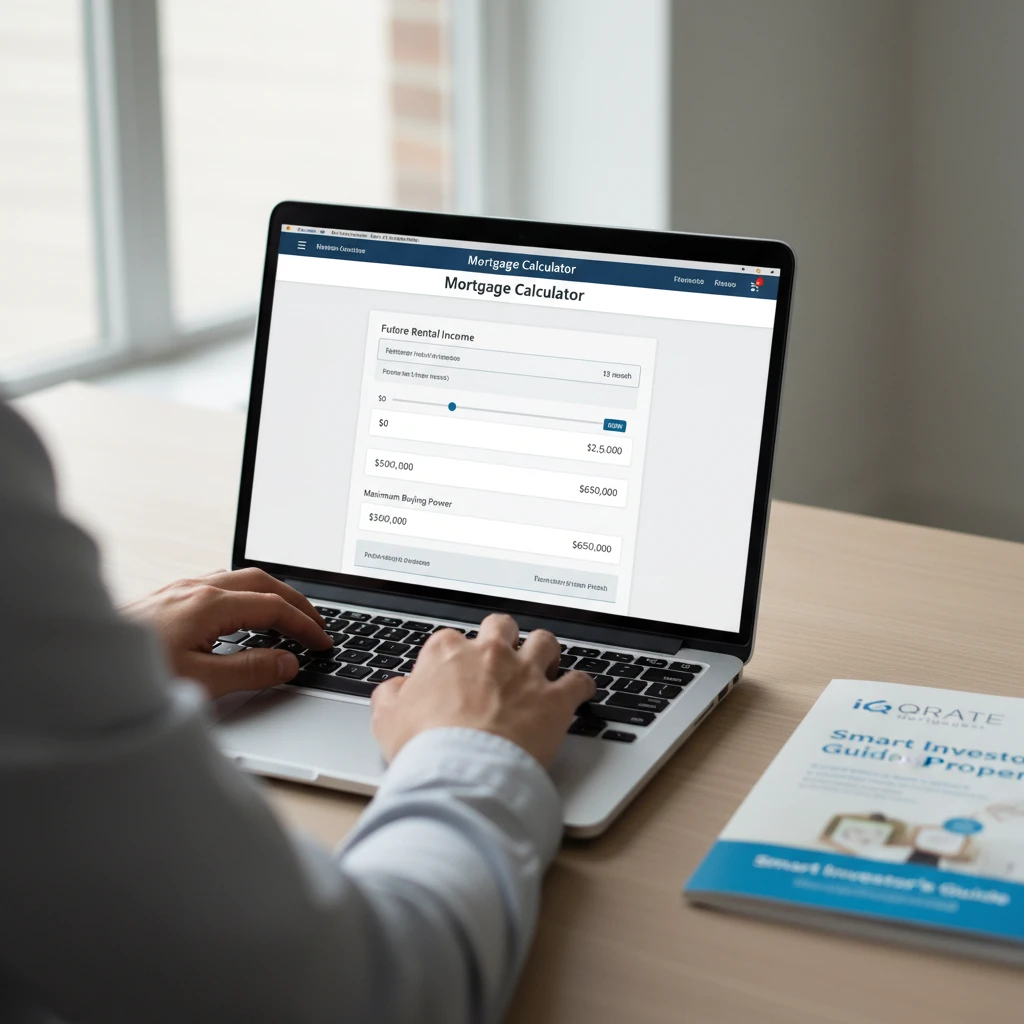
- DTI Impact: The existing mortgage payment stays, but is counteracted by the qualifying rental income. For example, if your mortgage on your Austin home is $2,200 per month, and the lender calculates qualifying rental income at $2,100, only a net of $100 is added to your monthly debt.
- Cash Position: You will need to source the down payment for your new home from savings, investments, or other accounts, as your equity remains tied up in the rental property.
- Complexity: This path requires more documentation and meets specific lender guidelines regarding rental income.
Qualifying with Future Rental Income: The Lender's Math
If you decide to become a landlord, you can't just tell a lender you plan to rent out your old house. You must prove the potential income through specific documentation, and lenders will only use a percentage of that gross rent in their calculations.
Can You Use Future Rental Income to Qualify?
Yes, conventional loans backed by Fannie Mae and Freddie Mac allow the use of prospective rental income from a departing residence. This is a crucial rule for move-up buyers. To be eligible, you typically need to provide documentation showing the property is ready to be rented and what the fair market rent is.
Some government-backed loans, like FHA loans, have stricter rules and may require you to have a history as a landlord or significant equity in the departing residence before they will count rental income. It's essential to confirm the specific guidelines for the loan program you are using. The data, information, or policy mentioned here may vary over time.
The 75% Rule: Calculating Usable Rental Income
Lenders do not use 100% of the gross monthly rent in their DTI calculations. Instead, they apply a 'vacancy factor' to account for potential periods without a tenant, repairs, and other property management costs. The industry standard for conventional loans is to use 75% of the gross monthly rent as qualifying income. The data, information, or policy mentioned here may vary over time.
Here’s a practical example for a home in Frisco, Texas:
- Estimated Monthly Rent: An appraiser determines the fair market rent for your property is $3,000 per month.
- Vacancy Factor Deduction (25%): $3,000 x 0.25 = $750
- Qualifying Rental Income: $3,000 - $750 = $2,250
This $2,250 is the amount the lender will use. Let's see how it impacts your DTI:
- Existing Mortgage Payment (PITI): $2,500
- Net Impact on DTI: $2,500 (Debt) - $2,250 (Qualifying Income) = $250
In this case, the lender adds only $250 to your monthly debt obligations for DTI purposes, not the full $2,500 mortgage payment. If your qualifying rental income was higher than your mortgage payment, it would create positive cash flow that could help you qualify for an even larger new mortgage.
Required Documentation for Proving Rental Income
To use future rent, you must provide proof to the lender. The two most common documents required are:
- A Fully Executed Lease Agreement: If you have already secured a tenant, a signed lease agreement detailing the rental amount and term, along with proof of the security deposit, is powerful evidence.
- Appraisal Rent Schedule (Form 1007): If you don't have a tenant yet, the appraiser for your new home purchase can complete a 'Comparable Rent Schedule'. This official form analyzes rental rates for similar properties in your area to establish a fair market rent. This is the figure the lender will use for the 75% calculation.
Financial Implications: Cash, Approvals, and Long-Term Growth
Your decision has ripple effects across your finances, from the cash you need at closing to your ability to build long-term wealth.
Down Payment and Cash-to-Close Differences
The most significant financial difference is the source of your down payment.
- Selling: If you sell your home in Houston for $400,000 and have a $250,000 mortgage balance, you could walk away with nearly $150,000 in equity (before closing costs). This cash can be used for a 20% down payment on a $600,000 new home, eliminating PMI.
- Renting: If you rent out that same Houston home, your $150,000 in equity is not liquid. You must have the $120,000 down payment for the new $600,000 home available in your savings, 401(k) loan, or other accounts. This often means buyers who rent out their old home may make a smaller down payment on the new one.
Is It Harder to Get Approved with Two Mortgages?
It is not inherently harder, but it is more complex. The underwriting process will have more moving parts. Lenders will scrutinize the rental documentation carefully. You may also be required to have cash reserves—typically a few months of mortgage payments for both properties—in the bank after closing. The data, information, or policy mentioned here may vary over time. As long as your DTI ratio (with the net rental calculation) and your credit score fall within the lender's guidelines, and you have sufficient assets for the down payment and reserves, you can be approved.
Impact on Your Long-Term Financial Goals
This decision aligns with different long-term strategies:
- Selling favors financial simplicity and liquidity. You consolidate your wealth into one primary residence and reduce your debt load. This is a lower-risk strategy favored by those who do not want the responsibilities of being a landlord.
- Renting favors wealth building through assets. You begin building a real estate portfolio. Your tenant pays down your mortgage, and the property can appreciate over time. This strategy involves more risk and work but offers a greater potential for long-term financial growth through equity and cash flow.
Which Option Offers a Better Return on Investment (ROI)?
There is no single answer. The better ROI depends on market conditions, your property, and your financial goals.
- Renting ROI: The return comes from three sources: monthly cash flow (rent minus all expenses), property appreciation, and tax benefits (like deducting mortgage interest and depreciation). In a strong rental market like Austin, this can be highly profitable over a decade.
- Selling ROI: The return is immediate. You realize your appreciation gains today. You can then invest that money into a larger primary residence or the stock market. This avoids the risks of bad tenants, unexpected repairs, and market downturns.
To make the right choice, you should analyze your local rental market, calculate potential cash flow, and honestly assess if you are prepared for the duties of being a landlord. Comparing that potential long-term gain to the immediate benefit of cashing out your equity is the key to a smart decision.
Weighing the pros and cons of selling versus renting can be complex. To understand exactly how this choice will impact your next home purchase and get a clear financial picture tailored to your goals in Texas, let's connect. Apply now for a detailed mortgage analysis and make your decision with confidence.
Author Bio
David Ghazaryan is the expert mortgage strategist and founder behind iQRATE Mortgages. With a mission to fund home loans that traditional banks won't touch, David specializes in helping clients with unique financial situations, including those recovering from foreclosure or bankruptcy. He expertly crafts smart, strategic, and stress-free mortgages by leveraging a vast network of over 100 lenders to secure competitive rates for investors and homebuyers alike. Praised for exceptional customer service, David has helped hundreds of families with a 97% satisfaction rate, guiding them to the mortgage they deserve.
References
Consumer Financial Protection Bureau (CFPB): What is a debt-to-income ratio?









