


Two-Year History: Myth vs. Reality for Multiple Gigs
A common misconception among gig workers in Nevada is that you need a two-year history from each source of 1099 income. This isn't true. Lenders are primarily concerned with your history of being self-employed in the same line of work for at least two years.
What they want to see is consistency and stability in your chosen field. If you drove for one rideshare company for 18 months and then switched to a competitor for the last six months, an underwriter sees that as two continuous years of experience as a rideshare driver. The switch between platforms is less important than the continuity of the work itself.
Key takeaway: Lenders combine the income from all your gigs. They will typically average your total self-employment income over the most recent 24-month period, as documented on your tax returns. (The data, information, or policy mentioned here may vary over time.) It's the total time in your field that matters most.
Navigating Seasonal Income Dips in Reno
The Reno and Sparks area experiences economic ebbs and flows, which directly impacts gig work like tourism-related services or construction. Lenders understand this. They don't disqualify you for a slow January after a busy August. Instead, they use a process of averaging to smooth out these peaks and valleys.
Here's how it works:
- Year 1 Total Net Income: $50,000
- Year 2 Total Net Income: $62,000
- Total Two-Year Income: $112,000
- Divide by 24 Months: $112,000 / 24 = $4,666.67

In this scenario, the lender qualifies you using a monthly income of $4,666.67, even if some months you earned $7,000 and others you only earned $2,500. This averaging provides a predictable figure for calculating your debt-to-income (DTI) ratio. If your most recent year's income is lower than the previous year's, the lender may use only the lower income or require a letter of explanation for the decline. (The data, information, or policy mentioned here may vary over time.)
1099s vs. Bank Statements: What's the Best Proof?
Both 1099s and bank statements are crucial, but they tell different parts of your financial story. You can't simply choose one over the other; a lender will require a complete package.
- Form 1099-NEC/1099-K: These forms show your gross earnings from each platform or client before any expenses are deducted. They are essential for proving the total revenue your gig work generates.
- Federal Tax Returns (with Schedule C): This is where you report your gross income and, more importantly, deduct your business expenses. The final number on your Schedule C, the net profit or loss, is the primary figure lenders use for qualification.
- Bank Statements: These act as supporting evidence. They corroborate the deposits from your 1099s and show the flow of money. Using a dedicated business account makes this process much cleaner for an underwriter to follow.
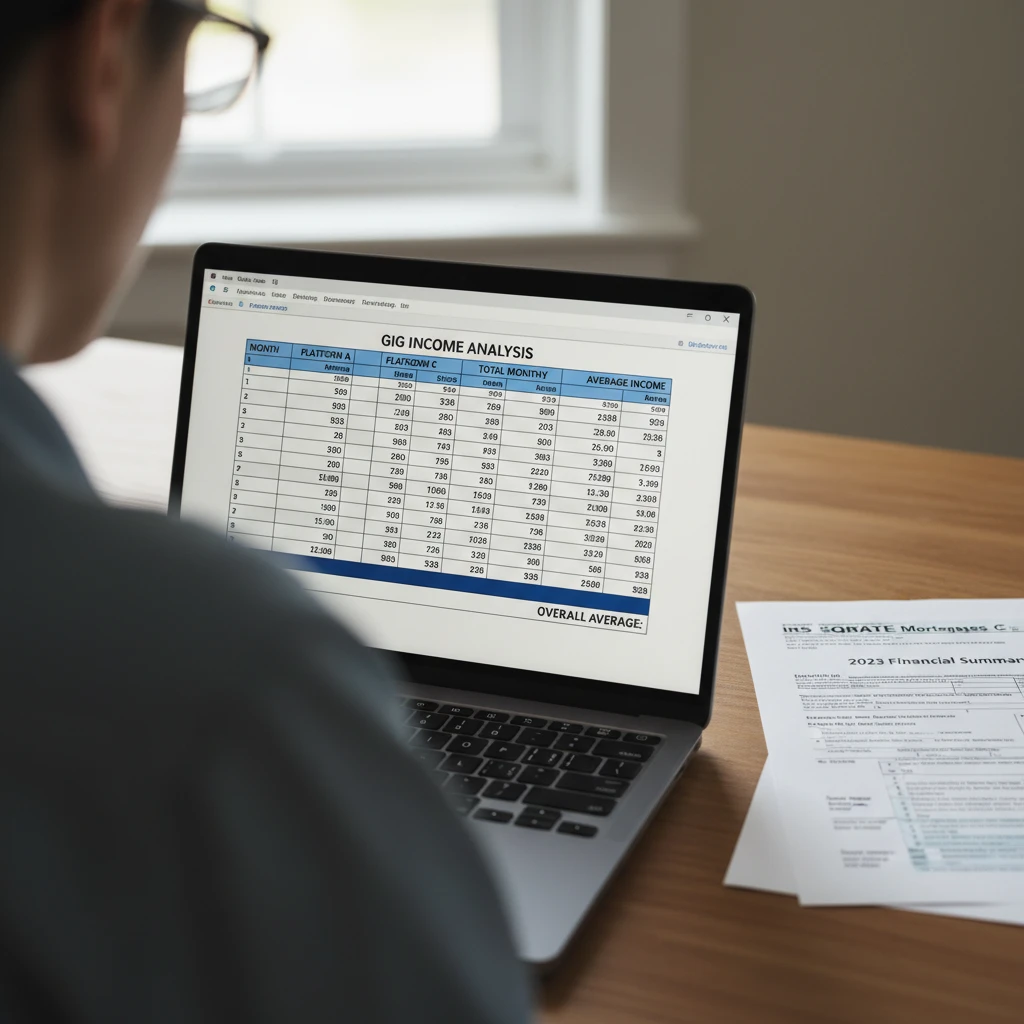
Think of it this way: 1099s show your potential, but your tax returns show the reality of what you take home after expenses. Both are non-negotiable for a loan application.
Understanding Your Schedule C and Business Expense Deductions
Your Schedule C, 'Profit or Loss from Business', is the most critical document for a self-employed borrower. It's where you list all your business-related write-offs, such as mileage, supplies, cell phone bills, and home office expenses. While these deductions are great for lowering your tax bill, they directly reduce your qualifying income for a mortgage.
Example: A freelance graphic designer in Sparks has the following finances:
- Gross Income (from all 1099s): $90,000
- Business Expenses on Schedule C (software, hardware, marketing): $25,000
- Net Profit (Qualifying Income): $65,000
The lender will use the $65,000 figure (or $5,416 per month) to determine how much you can borrow, not the $90,000 gross. It's vital to strike a balance between maximizing tax deductions and showing sufficient income to qualify for the home you want.
The Power of a Profit and Loss (P&L) Statement
While tax returns look backward, a Profit and Loss (P&L) statement can provide a more current view of your business health. If your income has been trending upward in the current year, a year-to-date P&L prepared by you or an accountant can strengthen your application.
A strong P&L should include:
- A clear breakdown of monthly gross revenues.
- A categorized list of monthly business expenses.
- The resulting net income for each month.
This document helps an underwriter see positive momentum that your last tax return might not reflect. (The data, information, or policy mentioned here may vary over time.) It shows that your business is growing, which can help offset concerns about income stability. It's particularly useful if you're applying early in the year before your most recent, highest-earning year has been filed.
Why a Separate Business Bank Account Is a Game-Changer
Commingling funds, or mixing personal and business transactions in one bank account, is a major headache for underwriters. It makes it incredibly difficult to verify your business income and expenses. Opening a separate business bank account is one of the simplest and most effective things you can do to prepare for a mortgage application.
Benefits include:
- Clarity: It creates a clean, easy-to-follow record of all business-related deposits and withdrawals.
- Professionalism: It signals to the lender that you treat your gig work as a serious business.
- Simplified Documentation: You can provide just the business account statements instead of forcing an underwriter to sift through personal spending to find your business transactions.
This simple step can significantly reduce requests for additional documentation and speed up your loan approval process.
Managing Income Transitions Between Gig Platforms
What if you stopped working for one delivery app because you started with a new, more lucrative one? As mentioned earlier, lenders are looking for continuity in your line of work. A transition like this is perfectly acceptable, provided you can document it properly.
The key is to demonstrate that the change was beneficial and that your income remains stable or is increasing. You would continue to file a Schedule C for your business (e.g., 'Delivery Services'), and the income from the old and new gigs would be combined. A letter of explanation detailing the switch and highlighting the increased income potential can be a helpful addition to your loan file.
Finding a Gig-Savvy Lender in Sparks
Not all lenders or loan officers are experienced with the nuances of the gig economy. Many are accustomed to traditional W-2 borrowers and may struggle to properly analyze and approve a loan file with multiple 1099s and a Schedule C. This is especially true in growing markets like Sparks, where the workforce is diversifying quickly.
Working with a mortgage broker or a lender who explicitly advertises experience with self-employed borrowers is critical. These professionals know how to:
- Structure your income correctly for the underwriter.
- Anticipate documentation requests.
- Present your complete financial picture in the most favorable light.
They understand that variable income is normal for a gig worker and can guide you on how to best prepare your tax returns and financial statements long before you apply.
Ready to see how your gig-work income can become your key to a new home? Let's clarify the process and explore your personalized mortgage options. Find out where you stand and apply now to take the first step.
Author Bio
David Ghazaryan is the expert mortgage strategist and founder behind iQRATE Mortgages. With a mission to fund home loans that traditional banks won't touch, David specializes in helping clients with unique financial situations, including those recovering from foreclosure or bankruptcy. He expertly crafts smart, strategic, and stress-free mortgages by leveraging a vast network of over 100 lenders to secure competitive rates for investors and homebuyers alike. Praised for exceptional customer service, David has helped hundreds of families with a 97% satisfaction rate, guiding them to the mortgage they deserve.
References









