


Why Miami Condos Struggle with FHA Approval
Buying a condo in Miami with an FHA loan can be challenging, not because of your personal qualifications, but because of the building itself. The Federal Housing Administration (FHA) insures loans to protect lenders, and to do so, it imposes strict requirements on the entire condominium project. Many buildings in Miami, especially older ones, fail to get on the FHA-approved list for several common reasons.
- Investor Concentration: FHA requires that at least 50% of the units in a project are owner-occupied. In a market like Miami, where investment properties are common, many buildings exceed this investor limit.
- Single Investor Ownership: No single investor or entity can own more than 10% of the units in a condo project. This rule prevents a single owner from having too much control over the association.
- HOA Financial Health: The homeowners association (HOA) must have adequate reserve funds set aside for future repairs and capital expenditures, typically requiring at least 10% of its annual income to be allocated to a reserve account. The FHA will also review the budget for any history of special assessments or delinquencies.
- Commercial Space Limits: The total square footage of commercial or non-residential space in the building cannot exceed 35% of the total project square footage. This can be an issue for mixed-use buildings popular in urban areas.
- Litigation: The HOA cannot be involved in active litigation, particularly lawsuits related to the safety, structural soundness, or functional use of the project.
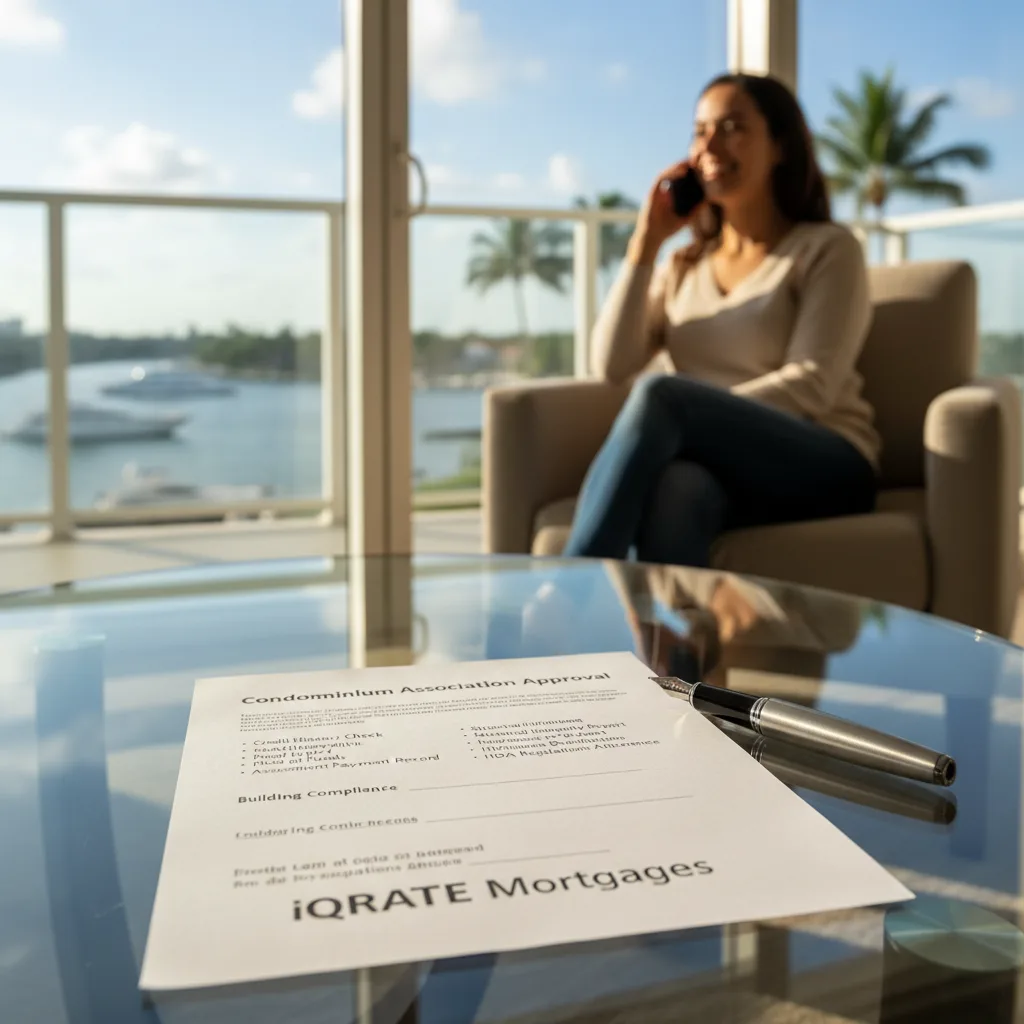
Because of these stringent rules, a significant portion of the condo inventory in Miami is not FHA-approved, forcing many buyers to look exclusively at conventional financing.
What is a Limited Review, and Can It Help My Conventional Loan Application?
A limited review is a streamlined appraisal and approval process available for conventional loans underwritten by Fannie Mae and Freddie Mac. It is a significant advantage over the FHA's full project review because it requires far less documentation from the HOA, making the process faster and smoother. A lender can use a limited review when the borrower's finances are strong.
To qualify for a limited review on a condo purchase in Fort Lauderdale or Miami, you generally need to meet these criteria:
- Loan-to-Value (LTV) Ratio: For a primary residence, you must make a down payment of at least 10%, resulting in a 90% LTV or lower.
- Occupancy: The property must be a primary residence or a second home. Investment properties typically require a full review.
- Control of the HOA: The developer must have turned over control of the HOA to the unit owners.
With a limited review, the lender focuses on a few key items instead of the entire health of the project. They will verify that the project isn't a timeshare, doesn't have pending litigation related to structural issues, and that the insurance coverage is adequate. This bypasses the deep dive into budgets, reserves, and investor concentrations that trips up FHA applications.
Impact of High HOA Fees on Your DTI Ratio
South Florida is known for its amenity-rich condo buildings, which often come with high HOA fees. These fees, which can easily range from $600 to over $1,200 per month in Miami and Fort Lauderdale, are a critical component of your debt-to-income (DTI) ratio calculation for both FHA and conventional loans.
Your DTI ratio compares your total monthly debt payments to your gross monthly income. Lenders use it to assess your ability to manage your monthly payments and repay your mortgage. The HOA fee is added directly to your proposed monthly housing payment (PITI: principal, interest, taxes, and insurance).
Let's look at an example:
- Gross Monthly Income: $8,000
- Other Monthly Debts (car loan, student loan): $700
- Proposed Mortgage (PITI): $2,500
- Miami Condo HOA Fee: $800
Total Monthly Debt: $700 (other debts) + $2,500 (PITI) + $800 (HOA) = $4,000
DTI Ratio: ($4,000 / $8,000) * 100 = 50%

FHA loans are generally more lenient with DTI, sometimes allowing ratios up to 56.9%. Conventional loans typically cap DTI around 45%, though some lenders may go to 50% for well-qualified borrowers. (The data, information, or policy mentioned here may vary over time.) In this example, the high HOA fee pushes the DTI to a level that might be acceptable for FHA but could lead to a denial for a conventional loan. It's crucial to factor in the specific HOA fee for any condo you're considering early in your home search.
FHA Mortgage Insurance vs. Conventional PMI for Condos
When you make a down payment of less than 20% on a home, you are required to pay mortgage insurance. The type of insurance depends on your loan.
FHA Mortgage Insurance Premium (MIP): FHA loans require two forms of MIP:
- Upfront MIP (UFMIP): A one-time premium of 1.75% of the loan amount, which is typically rolled into your total loan balance.
- Annual MIP: Paid monthly as part of your mortgage payment. For most borrowers putting down less than 10%, this premium is paid for the entire life of the loan. The annual rate is typically 0.55% of the loan amount.
Conventional Private Mortgage Insurance (PMI): PMI is required for conventional loans with less than 20% down. Unlike FHA MIP, PMI rates vary based on your credit score, LTV, and DTI. A key advantage is that PMI is not permanent. It can be requested for removal once you reach 20% equity, and it automatically terminates once you reach 22% equity in your home.
For a condo buyer with a good credit score, conventional PMI is often significantly cheaper than FHA MIP over the long term because it can be eliminated. While FHA allows for lower down payments and credit scores, the lifetime MIP can add tens of thousands of dollars to the cost of the loan.
Navigating Pending HOA Litigation in Fort Lauderdale
Finding a condo in Fort Lauderdale is competitive, and discovering the perfect unit only to learn the HOA is involved in a lawsuit can be a major roadblock. How this issue is handled depends heavily on your loan type.
- FHA Loans: The FHA has a zero-tolerance policy for most pending litigation. If the HOA is a named party in a lawsuit, the project is almost always ineligible for FHA financing until the litigation is resolved. This applies to lawsuits concerning structural integrity, property disputes, or financial mismanagement.
- Conventional Loans: Conventional financing offers more flexibility, especially under a limited review. An underwriter will assess the nature of the lawsuit. For example, a minor 'slip-and-fall' case that is fully covered by the HOA's insurance policy may not be an issue. However, litigation involving structural defects or special assessments to cover legal fees will likely result in a loan denial. The lender's legal team will review the case to determine the risk to their collateral (your condo).
In short, you have a much better chance of securing financing for a condo with minor, non-structural litigation if you are using a conventional loan.
Condo Reserve Requirements: FHA vs. Conventional
An HOA's reserve fund is a savings account used to pay for major, non-routine maintenance and repairs, such as roof replacement, elevator modernization, or repainting the building. Lenders for both FHA and conventional loans want to see a healthy reserve fund because it indicates a financially stable association that is unlikely to levy large, unexpected special assessments on homeowners.
- FHA Requirement: FHA mandates that the condo association allocates at least 10% of its annual operating budget to the reserve fund. There are very few exceptions to this rule, and it's a common reason for FHA project denial.
- Conventional Requirement: Conventional loans also require a 10% reserve allocation for a full project review. However, under a limited review, the reserve requirement is waived. The lender does not need to verify the budget or the percentage going to reserves. This is a massive advantage in markets like Miami and Fort Lauderdale, where older buildings may not have historically maintained a 10% reserve contribution.
How to Check if a Condo Project is FHA-Approved
You don't have to wait for a lender to tell you if a building is approved. You can check the status yourself by visiting the Department of Housing and Urban Development (HUD) website.
- Go to the HUD Condominiums search page.
- Enter the state (Florida), county, and the legal name of the condominium project.
- Review the status. It will show 'Approved', 'Expired', or 'Withdrawn'. If the name doesn't appear, it is not currently approved.
If a project's approval has 'Expired', it is possible for a lender to pursue recertification, but this process can take time and is not guaranteed. It is best to work with a mortgage professional who can help navigate this process or confirm a building's status early on.
Your Options for a Non-Warrantable Condo
If a condo project fails to meet the guidelines of FHA, Fannie Mae, or Freddie Mac, it is deemed 'non-warrantable'. This can happen for many of the reasons already discussed: high investor concentration, pending litigation, or insufficient reserves. While you cannot use a standard FHA or conventional loan to buy a unit in a non-warrantable building, you are not entirely out of options.
Your primary alternative is a portfolio loan. These are loans that a bank or lender keeps on its own books ('portfolio') instead of selling them on the secondary market. Because they are not bound by FHA or Fannie Mae rules, portfolio lenders can create their own guidelines. They may be willing to finance a non-warrantable condo, but they typically require:
- A larger down payment (often 20-25% or more).
- A higher credit score.
- A slightly higher interest rate to compensate for the increased risk.
Finding a lender who offers portfolio loans for non-warrantable condos requires working with a knowledgeable mortgage broker who has relationships with various local and national banks that provide this specialized financing. The complexities of the Florida condo market mean that choosing the right loan is about more than just the interest rate. To ensure your financing is approved, partner with a mortgage expert who understands the nuances of FHA project approvals, limited reviews, and non-warrantable condos. A specialist can assess your chosen property and financial profile to identify the best path to ownership.
The Florida condo market is complex, but your financing doesn't have to be. A mortgage expert can review your situation and find the best path to ownership by navigating FHA approvals, limited reviews, and non-warrantable properties. Ready for clear guidance? Apply now to connect with a specialist.
Author Bio
David Ghazaryan is the expert mortgage strategist and founder behind iQRATE Mortgages. With a mission to fund home loans that traditional banks won't touch, David specializes in helping clients with unique financial situations, including those recovering from foreclosure or bankruptcy. He expertly crafts smart, strategic, and stress-free mortgages by leveraging a vast network of over 100 lenders to secure competitive rates for investors and homebuyers alike. Praised for exceptional customer service, David has helped hundreds of families with a 97% satisfaction rate, guiding them to the mortgage they deserve.
References









