


Why Conventional Lenders Avoid Fix-and-Flip Properties
If you have ever applied for a traditional mortgage, you know the process is detailed and slow. Lenders scrutinize your finances and the property's condition with a fine-tooth comb. This cautious approach is precisely why conventional loans, like those from major banks, are a poor fit for fix-and-flip investors in Nevada.
First, there is the issue of property condition. Conventional and government-backed loans (like FHA or VA) have strict minimum property standards. A home must be safe, structurally sound, and fully functional to qualify. A classic fix-and-flip candidate with a leaky roof, outdated electrical systems, or a non-working kitchen will be immediately flagged by an appraiser and deemed ineligible for financing. The lender’s goal is to finance a move-in ready home, not a construction project.
Second, the timeline is incompatible with the fast-paced real estate investment market. A conventional loan can take 30 to 60 days to close. In competitive markets like Las Vegas or Henderson, investors need to act quickly to secure a deal. Waiting for a traditional bank’s underwriting process means you will likely lose the property to a cash buyer or an investor with faster financing already in place. Lenders specializing in investor loans, on the other hand, can often close in as little as 7 to 14 days.
Finally, conventional appraisals are based on the property's current market value, not its potential future value. An appraiser will value a distressed property in its 'as-is' state, which is often far below the purchase price an investor is willing to pay. This creates a large appraisal gap that kills the deal. Fix-and-flip financing works differently, focusing on what the property will be worth after renovations are complete.
Hard Money Loans vs. Traditional Mortgages
The key to financing a fix-and-flip project is understanding the tool designed for the job: the hard money loan. Also known as a bridge loan, this type of short-term financing is fundamentally different from the 30-year mortgage you would get for a primary residence.
Funding Source and Speed
- Traditional Mortgage: Funded by large depository institutions like banks and credit unions. They use the money from their customers' savings and checking accounts and must follow strict federal regulations. This results in a slow, bureaucratic process.
- Hard Money Loan: Funded by private investors or a group of investors. These lenders use their own capital and have more flexibility in their decision-making. Since the approval process is streamlined and focused on the property's value, they can approve and fund a loan in a matter of days, not months.
Approval Criteria
- Traditional Mortgage: Approval is primarily based on the borrower’s qualifications. Lenders analyze your credit score, debt-to-income ratio (DTI), employment history, and income stability. The property is important, but your personal financial health is the main focus.
- Hard Money Loan: Approval is primarily based on the property's merits as an investment. The lender is most concerned with the asset itself. They analyze the deal's potential profit, focusing on the purchase price, renovation budget, and the After-Repair Value (ARV). While the borrower’s experience and liquidity are considered, a low credit score is often not a deal-breaker if the property is a great investment.

Loan Term and Purpose
- Traditional Mortgage: Designed for long-term ownership. These are typically 15 or 30-year amortizing loans where you slowly build equity over decades. They are meant for homeowners who plan to live in the property.
- Hard Money Loan: Designed for a short-term project with a clear exit strategy. Loan terms usually range from 6 to 24 months. These are interest-only loans, meaning your monthly payments only cover the interest, keeping carrying costs low during the renovation phase. The full principal balance is due at the end of the term, which is typically paid off by selling the property or refinancing into a long-term rental loan.
How Lenders Calculate After-Repair Value (ARV) in Nevada
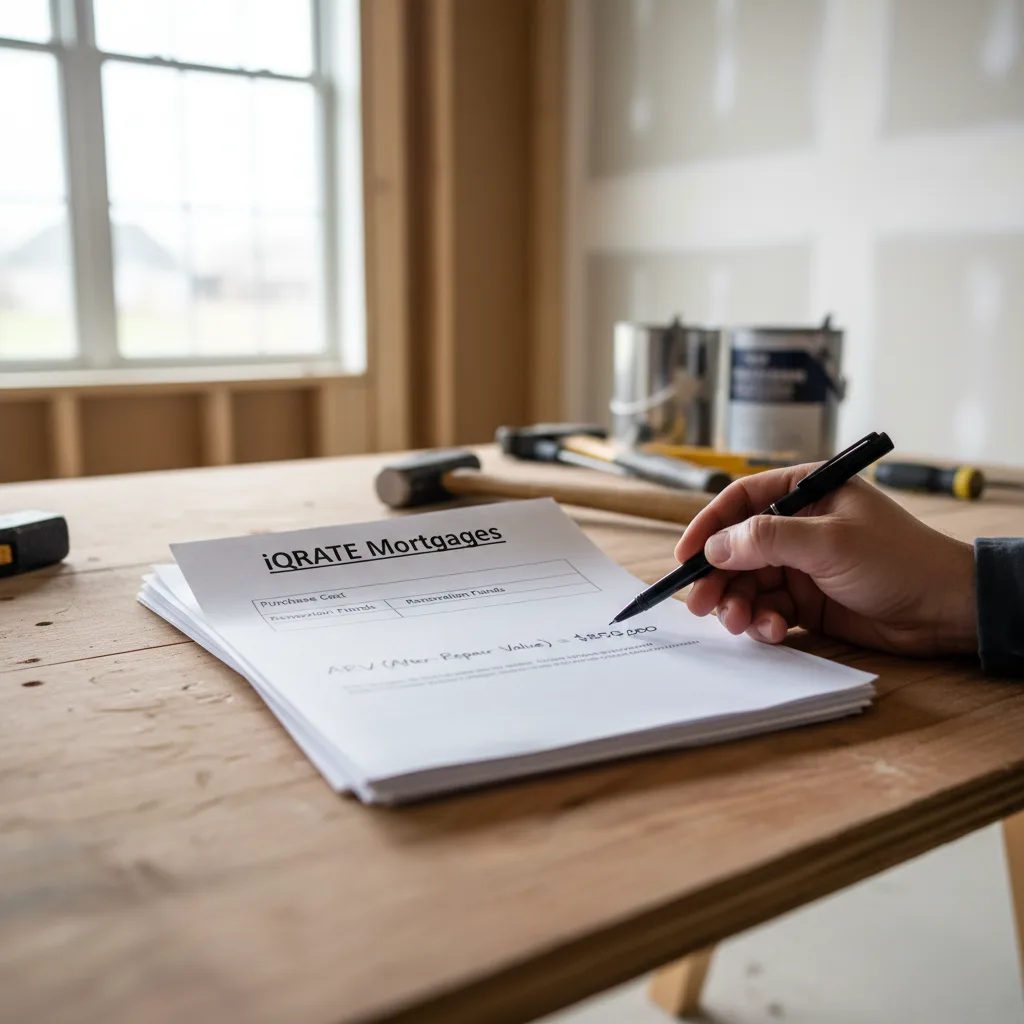
The After-Repair Value, or ARV, is the most critical metric in fix-and-flip financing. It is an estimate of what the property will be worth on the open market after all your planned renovations are completed. Lenders use the ARV to determine how much they are willing to lend you for the project.
The calculation is not a simple guess; it is a formal appraisal process. Here is how it works:
- You Provide a Detailed Plan: You submit your complete renovation plan, often called a Scope of Work (SOW), to the lender. This document lists every planned upgrade, from new flooring and kitchen cabinets to landscaping and paint colors, along with cost estimates from your contractor.
- An Appraiser is Hired: The hard money lender hires an appraiser who is experienced in valuation for investment properties in the specific Nevada neighborhood, whether it's Summerlin in Las Vegas or Green Valley in Henderson.
- Finding Comparables (Comps): The appraiser finds recently sold properties in the immediate vicinity that are similar in size, style, and bed/bath count to your property as if it were already renovated. They look for homes that have the modern finishes and features you plan to install.
- Value Adjustment and Finalization: The appraiser adjusts the value based on differences between your future-renovated property and the comps, ultimately arriving at a professional opinion of the ARV.
Example ARV Calculation:
- You find a distressed property in Henderson for a Purchase Price of $320,000.
- Your contractor provides a detailed Renovation Budget of $60,000.
- The appraiser finds three similar, fully renovated homes in the same neighborhood that have sold in the last 90 days for $505,000, $515,000, and $510,000.
- Based on these comps and your SOW, the appraiser determines the ARV is $510,000.
Down Payments and Interest Rates for Fix-and-Flip Loans
Because hard money loans are higher risk for lenders, their terms are different from conventional loans. Expect to bring more cash to the table and pay a higher interest rate.
The down payment for a fix-and-flip loan is typically calculated based on the Total Project Cost (Purchase Price + Renovation Costs). Most Nevada hard money lenders require investors to contribute 10% to 25% of the total cost.
Example Down Payment:
- Purchase Price: $320,000
- Renovation Costs: $60,000
- Total Project Cost: $380,000
- Lender's Requirement: 20% down payment
- Your Required Cash-to-Close: $76,000 ($380,000 x 0.20)
Interest rates for hard money loans are significantly higher than for traditional mortgages, generally ranging from 9% to 15%. The exact rate depends on the lender, the strength of the deal, and your experience as an investor. While this sounds high, remember two things:
- The loan is short-term, so you are only paying this rate for a few months.
- The payments are typically interest-only, which keeps your monthly holding costs much lower than if you were paying down principal.
Securing a Loan for Purchase and Renovations
One of the biggest advantages of hard money is the ability to finance both the acquisition of the property and the cost of fixing it up within a single loan. This is structured based on the lender's Loan-to-Value (LTV) and Loan-to-Cost (LTC) guidelines.
Most lenders will finance up to 75% of the ARV. They will also often fund 100% of the renovation costs, as long as the total loan amount does not exceed their LTV threshold. The renovation funds are not given to you as a lump sum at closing. Instead, they are held in an escrow account and released to you in stages, known as draws. After you complete a portion of the project (e.g., demolition and framing), an inspector verifies the work, and the lender releases the funds for that phase.
Example Loan Structure:
- ARV: $510,000
- Lender's Maximum LTV: 75% of ARV
- Maximum Loan Amount: $382,500 ($510,000 x 0.75)
- Purchase Price: $320,000
- Renovation Budget: $60,000
- Total Loan Provided: $380,000 (This covers 100% of renovations and $320,000 for the purchase)
In this scenario, your initial out-of-pocket expense would be your down payment and closing costs. The $60,000 for repairs would be disbursed to you as you complete the work.
Documentation Needed for an Investor Bridge Loan
While less focused on personal income than a traditional loan, applying for a hard money or bridge loan still requires a thorough documentation package to prove you are a capable investor with a well-planned project. Be prepared to provide:
- Entity Documents: Most investors purchase properties under an LLC or corporation for liability protection. You will need to provide your Articles of Organization and Operating Agreement.
- Detailed Scope of Work (SOW): A line-by-line budget of all planned repairs and improvements, including costs for materials and labor. This should be supported by formal bids from your licensed contractor.
- Purchase Agreement: The fully executed contract to buy the property.
- Proof of Funds: Bank statements showing you have the cash for the down payment, closing costs, and a reserve to cover several months of interest payments.
- Real Estate Experience Portfolio: A list of past fix-and-flip or rental properties you have successfully completed. First-time flippers can still get approved, but experienced investors often secure better terms.
- Personal Identification and Application: A standard loan application with your personal information.
The Repayment Process After Selling
The entire fix-and-flip loan is structured around a clear exit: selling the renovated property. When you accept an offer and open escrow, the repayment process is simple and straightforward.
The closing is handled by a title or escrow company. They will request a payoff demand from your hard money lender, which is an official statement of the total amount owed, including the principal balance and any accrued interest.
At the closing, funds from the buyer are used to pay off all associated costs in a specific order:
- The hard money loan is paid in full.
- Real estate commissions and other closing costs are paid.
- The remaining balance is your gross profit, which is wired directly to you.
Example Profit Calculation:
- Final Sale Price: $510,000
- Hard Money Loan Payoff: -$380,000
- Closing Costs & Commissions (approx. 7%): -$35,700
- Your Initial Down Payment: -$76,000
- Net Profit: $18,300
This simplified example shows how all the pieces come together, from the initial ARV-based loan to the final sale and loan repayment. Planning a fix-and-flip in Nevada requires a clear financing strategy. Understanding your hard money and bridge loan options is the first step toward a profitable project. A knowledgeable mortgage advisor can help you navigate the process and connect you with the right private lenders.
Ready to fund your next Nevada fix-and-flip? Our team specializes in fast, flexible financing for investors. See what you qualify for—Apply now to get your project moving.
Author Bio
David Ghazaryan is the expert mortgage strategist and founder behind iQRATE Mortgages. With a mission to fund home loans that traditional banks won't touch, David specializes in helping clients with unique financial situations, including those recovering from foreclosure or bankruptcy. He expertly crafts smart, strategic, and stress-free mortgages by leveraging a vast network of over 100 lenders to secure competitive rates for investors and homebuyers alike. Praised for exceptional customer service, David has helped hundreds of families with a 97% satisfaction rate, guiding them to the mortgage they deserve.
References
CFPB - What are the mortgage requirements for an investment property?









