


How Medical Collections Uniquely Impact Your Mortgage Score
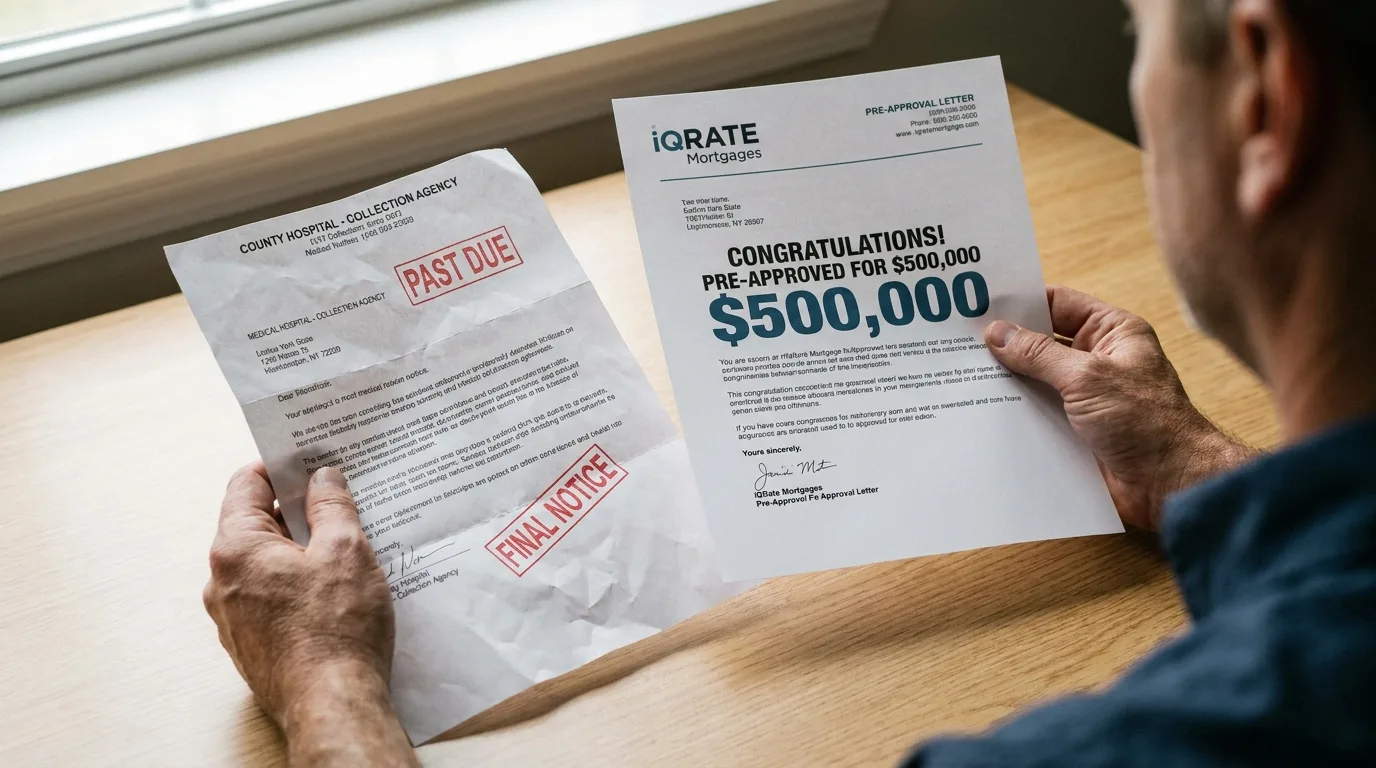
A medical collection is not like a credit card charge-off. Lenders and credit scoring models understand that medical debt is often unintentional, resulting from confusing insurance billing cycles or disputes over coverage. Unlike a decision not to pay a credit card, medical debt doesn't necessarily indicate financial irresponsibility. However, the automated underwriting systems (AUS) that lenders use to pre-approve loans often cannot make this distinction.
To the AUS, a collection is simply a collection. A recent collection, regardless of its source, can cause a significant drop in your credit score. For a homebuyer in Dallas, a score dropping from 625 to 615 can be the difference between qualifying for a conventional loan and being pushed into a more expensive FHA loan. (The data, information, or policy mentioned here may vary over time.) The algorithm sees a new derogatory mark and flags your file as higher risk, even if the collection is for just $150 from a lab you don't recognize.
Do Newer Credit Models Ignore Medical Debt?
Yes, newer scoring models like FICO 9, FICO 10T, and VantageScore 3.0 and 4.0 give less weight to unpaid medical collections. Some even ignore paid medical collections entirely. The problem is that the mortgage industry has been slow to adopt these newer models. The vast majority of lenders still use older FICO models (like FICO 2, 4, and 5) to evaluate mortgage applications. These older, more sensitive models treat a medical collection almost as harshly as any other type of unpaid debt.
So, while your consumer credit score from a free app might look great because it uses a newer model, the score your Houston mortgage lender pulls could be substantially lower due to that one medical collection. This discrepancy is a frequent source of frustration for borrowers who thought their credit was in excellent shape.
Pay vs. Dispute: The Strategic Choice for Your Mortgage
When a medical collection appears, you face a critical decision: pay it off or dispute it. The right choice depends on the collection's validity and your timeline.

When to Pay the Collection
If the debt is legitimate and you need to close on your home quickly, paying it may be the fastest path forward. However, simply paying the collection does not instantly remove it from your credit report or restore your score. The account will be updated to show a zero balance, which may not raise your score enough, or at all, with older FICO models.
Your best strategy is to negotiate a 'pay-for-delete' agreement with the collection agency in writing. This is an agreement where they promise to completely remove the derogatory mark from your credit history in exchange for payment.
When to Dispute the Collection
If you believe the collection is an error, you should absolutely dispute it. This is common with medical billing due to its complexity. You could have been billed incorrectly, an insurer may have failed to pay, or the debt could belong to someone else entirely.
Initiate a formal dispute through the credit bureaus (Equifax, Experian, and TransUnion). Under the Fair Credit Reporting Act (FCRA), they have 30 days to investigate your claim. If the collection agency cannot validate the debt within that period, the bureau must remove it. This is often the most effective solution for permanent score improvement.
Using a Rapid Rescore to Qualify in Dallas
Waiting 30 days for a dispute to resolve isn't an option if you have a purchase contract on a home in Dallas with a looming closing date. This is where a rapid rescore becomes an invaluable tool. A rapid rescore is a process where your mortgage lender submits proof that your credit information has changed directly to the credit bureaus. Instead of waiting for the standard 30 to 45-day reporting cycle, the bureaus can update your file and generate a new credit score in just 3 to 5 business days.
To use a rapid rescore, you must provide clear documentation. This could be a deletion letter from a collection agency (from a 'pay-for-delete') or a letter from the original creditor stating the bill was an error. With this proof, your lender can trigger the rescore, potentially raising your score back above the 620 threshold needed for a conventional loan in time to save your deal. (The data, information, or policy mentioned here may vary over time.)
Essential Documentation for Disputing a Medical Collection
To successfully dispute a collection or use a rapid rescore, you need a solid paper trail. Vague claims are easily dismissed. Arm your lender with undeniable proof.
- For an incorrect bill: Gather any 'Explanation of Benefits' (EOB) from your insurance company showing the service was covered or that your patient responsibility was zero.
- For a paid debt: Provide a canceled check, bank statement, or a dated receipt from the medical provider showing the bill was paid before it went to collections.
- For a 'pay-for-delete': The most critical document is the signed agreement from the collection agency explicitly stating they will delete the account upon receipt of payment.
- For any dispute: Keep copies of all correspondence, including certified mail receipts, when communicating with credit bureaus and collection agencies.
Will a Letter of Explanation Suffice for Underwriting?
A 'Letter of Explanation' (LOX) can be a useful tool, but it is not a magic wand. A LOX is your chance to provide context to the human underwriter reviewing your file. You can explain the circumstances surrounding the medical debt, such as a dispute with an insurance company or an unexpected emergency.
However, a LOX cannot override the minimum credit score requirements set by the automated underwriting system. If the collection has dropped your score below the program's guidelines, an underwriter cannot approve the loan based on your letter alone. The letter is supplemental; it supports the data in your file but doesn't change it. Its primary value is in clarifying a situation for a borderline case that has already passed the initial AUS approval.
FHA vs. Conventional: The Long-Term Cost of a Medical Collection
Being forced from a conventional loan into an FHA loan due to a credit score dip has significant long-term financial consequences. Let’s compare a $425,000 home purchase in Houston.
Conventional Loan Scenario (Score: 620+)
- Down Payment (5%): $21,250
- Private Mortgage Insurance (PMI): Approximately $240/month. Critically, this PMI automatically terminates once your loan-to-value ratio reaches 78%. (The data, information, or policy mentioned here may vary over time.)
- Upfront Costs: No required upfront mortgage insurance premium.
FHA Loan Scenario (Score: 580-619)
- Down Payment (3.5%): $14,875
- Upfront Mortgage Insurance Premium (UFMIP): 1.75% of the loan amount, or $7,177, which is typically added to your total loan balance.
- Annual Mortgage Insurance Premium (MIP): Paid monthly, it lasts for the entire life of the loan if you put down less than 10%. On this loan, it would be around $188/month. (The data, information, or policy mentioned here may vary over time.)
Over the first five years, the FHA borrower in Houston would pay $11,280 in monthly MIP plus the $7,177 in upfront MIP financed into the loan, for a total of $18,457. The conventional borrower would pay around $14,400 in PMI, which then disappears. That's a difference of over $4,000 in just 60 months, all because of one small medical collection.
Protecting Your Houston Mortgage from Future Credit Errors
Once you’ve secured your mortgage, you need to be proactive to prevent future credit issues from disrupting your financial stability. The best defense is a good offense.
- Monitor Your Credit Regularly: Sign up for a credit monitoring service that provides alerts for new accounts or changes to your reports. This allows you to catch errors early.
- Document Everything: After a major medical procedure, keep all bills, insurance EOBs, and receipts in a dedicated file for at least a year. This makes it easy to prove payment if a billing error occurs.
- Communicate in Writing: If you have a dispute with a medical provider or insurance company, communicate via email or certified mail. This creates a paper trail that is invaluable if the debt is later sold to a collection agency.
- Check Reports Before Refinancing: Always pull your own credit reports from all three bureaus several months before you plan to refinance or apply for another major loan. This gives you time to dispute any errors without the pressure of a closing date.
If a medical collection is threatening your home purchase, don't settle for a more expensive loan. A knowledgeable mortgage strategist can help you navigate disputes and rapid rescores to find the best path to approval. Apply for a Mortgage today to take the first step toward a better loan outcome.
Author Bio
David Ghazaryan is the expert mortgage strategist and founder behind iQRATE Mortgages. With a mission to fund home loans that traditional banks won't touch, David specializes in helping clients with unique financial situations, including those recovering from foreclosure or bankruptcy. He expertly crafts smart, strategic, and stress-free mortgages by leveraging a vast network of over 100 lenders to secure competitive rates for investors and homebuyers alike. Praised for exceptional customer service, David has helped hundreds of families with a 97% satisfaction rate, guiding them to the mortgage they deserve.
References
CFPB - How to dispute an error on your credit reports









