


Accepted Foreign Income Documents for Houston Mortgages
When you apply for a mortgage in Houston or Sugar Land with income earned outside the United States, lenders require a meticulous paper trail. Standard W-2s and 1040 tax returns are not applicable, so you must provide equivalent documentation from your country of employment. Lenders need to see consistency, stability, and a high likelihood of continuance for your income, regardless of its origin.
Your documentation package must be comprehensive. Underwriters will not approve a loan with missing or unverified information. Key documents include:
- Tax Returns: Provide the last two years of official, government-filed tax returns from your country. This could be a P60 from the United Kingdom or a T4 from Canada. These documents serve the same purpose as a U.S. 1040, showing your gross income, taxes paid, and net earnings.
- Pay Stubs: You will need your most recent pay stubs covering a 30-day period. These must clearly show your name, the employer's name, pay period, gross earnings, deductions, and net pay in the foreign currency.
- Bank Statements: Lenders typically require the last two to three months of bank statements for all accounts where your income is deposited and where your down payment funds are held. These statements are used to verify direct deposits from your employer and to source your down payment.
- Employment Contract: A copy of your signed employment contract is essential. It should detail your position, salary, start date, and terms of employment. This helps the lender understand the stability of your role.
Professional Translation Requirements for Financial Documents
Submitting documents in a language other than English is a non-starter. All financial and personal documents must be accompanied by a complete, professional translation. A simple translation from a friend or a free online tool will be rejected. Lenders require a certified translation.

What this means is that the translator or translation company must certify in writing that the translation is accurate and complete. The certification should include the translator’s credentials, signature, and contact information. This process adds a layer of authenticity and accountability that underwriters rely on.
Key considerations:
- Find a Reputable Service: Use a well-known, professional translation service that specializes in financial or legal documents.
- Translate Everything: Every single page of every document, including fine print and disclosures, must be translated.
- Budget for Costs: Certified translations are an additional closing cost you must plan for. The price can range from $25 to $75 per page, depending on the complexity and language. (The data, information, or policy mentioned here may vary over time.)
How Lenders Calculate Income with Currency Exchange Rates
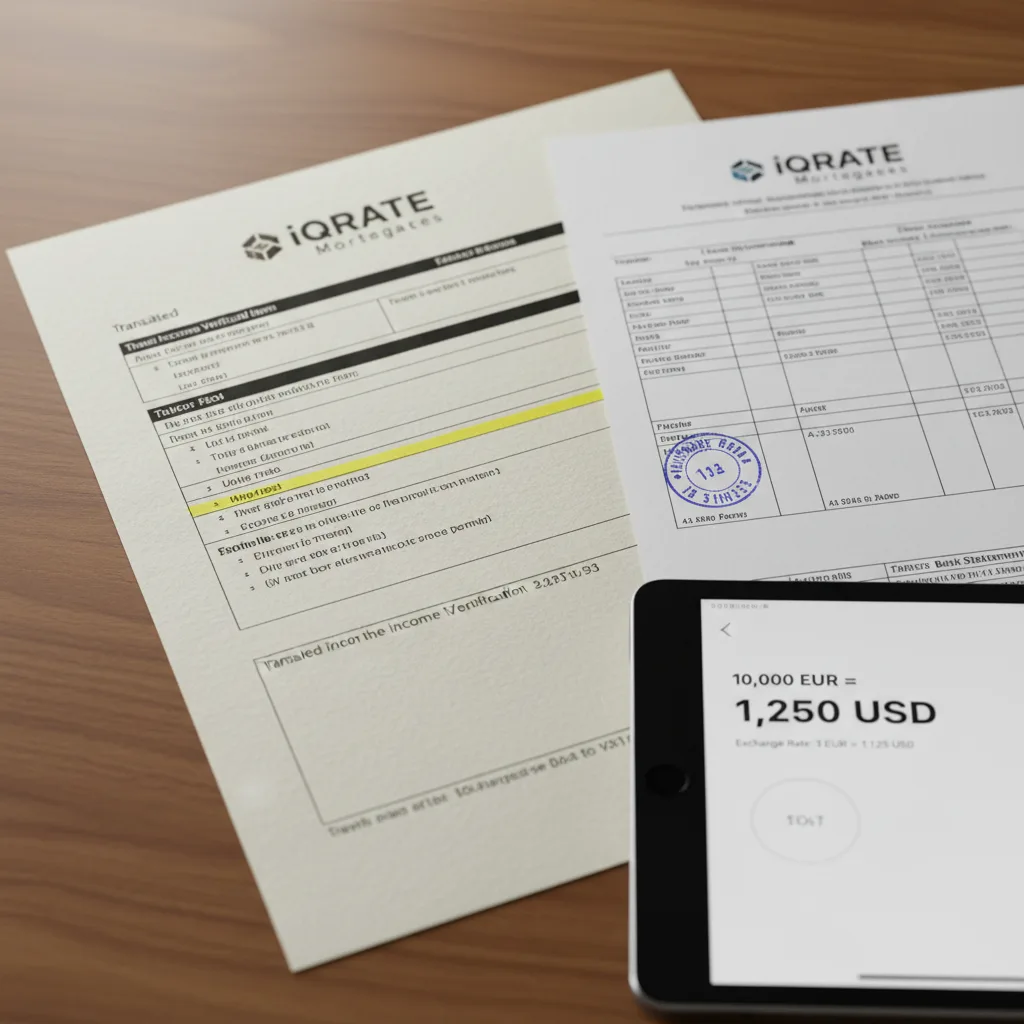
One of the most confusing parts of using foreign income is understanding how it’s converted to U.S. dollars for qualification. Lenders do not use the current day’s fluctuating exchange rate. Doing so would create too much volatility in the approval process. Instead, they use a stable, averaged exchange rate to calculate a conservative and reliable income figure.
Most lenders follow guidelines set by Fannie Mae or Freddie Mac, which require using a recognized financial source to obtain an average exchange rate over a specific period. The lender will then apply this averaged rate to your documented income.
Example: Let's say you earn €80,000 annually while working in Germany and are buying a home in Houston.
- The lender will not use today's exchange rate of, for example, 1.08 USD to 1 EUR.
- Instead, they will pull a historical average, which might be closer to 1.05 USD to 1 EUR.
- Your qualifying income would be calculated as: €80,000 * 1.05 = $84,000 USD.
This method protects both you and the lender from sudden currency devaluations and provides a more predictable income figure for calculating your debt-to-income (DTI) ratio.
Specific Mortgage Programs for Non-United States Buyers in Sugar Land
While conventional loans backed by Fannie Mae and Freddie Mac have strict rules, many non-U.S. buyers or those with foreign income find success with other loan programs. These are particularly common for properties in areas with a large international community, like Sugar Land.
- Non-Qualified Mortgages (Non-QM): These are the most flexible and common option. Non-QM lenders have their own underwriting guidelines, which are often designed for borrowers with unique financial situations. They can use alternative documentation like bank statements or asset-based qualification methods.
- Bank Statement Loans: If you are self-employed abroad or your income fluctuates, a bank statement loan can be an excellent choice. Instead of tax returns, lenders analyze 12 or 24 months of business or personal bank statements to determine your average monthly income.
- Portfolio Loans: Some banks and private lenders keep certain loans on their own books instead of selling them. These 'portfolio loans' allow the lender to set their own rules. If you have a strong financial profile and significant assets, a local or international bank with a presence in Houston may offer a portfolio loan tailored to your needs.
It is important to note that these programs often require a larger down payment (typically 20-30%) and may have slightly higher interest rates than conventional loans to offset the lender's increased risk. (The data, information, or policy mentioned here may vary over time.)
Verifying Employment with a Foreign Company
Proving you work for a legitimate foreign company is a critical underwriting step. The lender must confirm that your job is stable and your income is likely to continue. Beyond your employment contract and pay stubs, they will perform a Verification of Employment (VOE).
This involves:
- A Written VOE Request: Your loan officer will send a form to your employer's Human Resources department. This form asks them to confirm your start date, position, salary, and likelihood of continued employment.
- A Follow-Up Phone Call: An underwriter or processor will call the number listed for the company to verbally confirm the information provided on the written VOE.
This can create delays due to time zone differences and language barriers. You can help streamline the process by providing accurate contact information for an English-speaking HR representative and alerting your employer that a mortgage lender from the U.S. will be contacting them.
Rules for Using Foreign Assets as a Down Payment
Using funds from a foreign bank account for your down payment and closing costs is possible, but it requires careful documentation. The two main principles lenders follow are sourcing and seasoning.
- Seasoning: The funds must have been in your account for a minimum period, typically 60 days. This proves to the lender that the money is yours and not a last-minute, un-documentable loan from someone else.
- Sourcing: You must provide a clear paper trail for where the money came from. If you recently transferred a large sum from a savings or investment account, you will need to provide statements from that account as well.
Before you can use the funds, you must transfer them to a U.S. bank account. You will need to provide:
- A bank statement from the foreign account showing the funds leaving.
- A wire transfer receipt.
- A bank statement from the U.S. account showing the funds arriving.
Lenders will verify the exchange rate used for the transfer. It is best to complete this transfer well in advance of your desired closing date to avoid any last-minute issues.
The Impact of United States Credit History on Your Application
Having an established U.S. credit history with scores from Equifax, Experian, and TransUnion will significantly improve your mortgage options and interest rates. However, many foreign buyers do not have this. While a lack of U.S. credit will make you ineligible for most conventional loans, it is not an automatic denial for all mortgages.
Non-QM lenders are often equipped to handle this scenario. They may:
- Accept an International Credit Report: Some lenders can obtain and analyze credit reports from other countries.
- Build an Alternative Credit Profile: They can verify your payment history on other obligations, such as rent, utility bills, or insurance premiums, to establish your creditworthiness.
Building some U.S. credit is highly recommended. You can start by opening a secured credit card or taking out a small personal loan once you are in the country.
Common Mistakes That Derail Foreign Income Mortgage Applications
Securing a mortgage with foreign income is a detail-oriented process. Simple mistakes can lead to frustrating delays or an outright denial. Here are the most common pitfalls to avoid:
- Submitting Untranslated Documents: Providing documents in their original language is the fastest way to have your application paused. Always get certified translations first.
- Failing to Document Large Deposits: Any large, unusual deposit into your bank accounts within the last 60-90 days must be explained with a paper trail. If you sold a property or received a gift, be prepared to provide the documentation.
- Miscalculating Your Own Income: Do not use the daily exchange rate to estimate your qualifying income. Your lender will use a more conservative, averaged rate, which can result in a lower qualifying amount than you expect.
- Waiting to Transfer Funds: Transferring your down payment from a foreign account to a U.S. account can take several days and may involve compliance checks. Do this as early in the process as possible to ensure the funds are seasoned and ready for closing. Navigating foreign income documentation requires precision and experience. If you are planning to purchase a home in the Houston area, partnering with a mortgage strategist who understands these complex international requirements can prevent costly delays and denials. A specialist can help you prepare your documentation correctly from the start.
Ready to navigate the complexities of a foreign income mortgage in the Houston area? Our team specializes in these unique scenarios and is prepared to guide you through every step. Apply now to begin the conversation and see what you qualify for.
Author Bio
David Ghazaryan is the expert mortgage strategist and founder behind iQRATE Mortgages. With a mission to fund home loans that traditional banks won't touch, David specializes in helping clients with unique financial situations, including those recovering from foreclosure or bankruptcy. He expertly crafts smart, strategic, and stress-free mortgages by leveraging a vast network of over 100 lenders to secure competitive rates for investors and homebuyers alike. Praised for exceptional customer service, David has helped hundreds of families with a 97% satisfaction rate, guiding them to the mortgage they deserve.
References
Fannie Mae: What are the requirements for foreign assets?
Consumer Financial Protection Bureau: Buying a House
U.S. Department of Housing and Urban Development: Homebuying









