


Why Lenders Require a Two-Year History for Your Sacramento 1099 Income
When you work on a W-2, a lender sees a consistent, predictable salary. For a 1099 independent contractor, that consistency isn't as obvious. Your income might be high one month and low the next. Lenders in Sacramento and across California require a two-year history of self-employment to smooth out these peaks and valleys. This isn't an arbitrary rule; it's a standard set by mortgage giants like Fannie Mae and Freddie Mac to assess risk. (The data, information, or policy mentioned here may vary over time.)
The two-year lookback period allows an underwriter to establish a reliable, average income they can count on for repaying the loan. It demonstrates that your business is not a temporary venture but a stable enterprise capable of generating consistent earnings over time. A single great year could be a fluke, but two consecutive years of solid income show a track record of success and financial stability. This history proves that you can manage your business finances and maintain profitability through different economic cycles.
How Is Income Averaged With Multiple Freelance Clients in Roseville?
Lenders calculate your qualifying mortgage income by averaging the net income reported on your federal tax returns, typically over the last 24 months. (The data, information, or policy mentioned here may vary over time.) They look at the net income from Schedule C of your Form 1040, which is your gross income minus your business expenses.
Here’s how the calculation works with a simple example for a Roseville-based marketing consultant:
- Year 1 Net Income: $85,000
- Year 2 Net Income: $95,000
- Add the two years together:
$85,000 + $95,000 = $180,000 - Divide by 24 months:
$180,000 / 24 = $7,500
In this scenario, the lender would use $7,500 as your monthly qualifying income. It doesn't matter if that income came from two clients or twenty; the final net figure is what counts.

Important Note on Declining Income: If your income has decreased, the lender will be more conservative. If Year 1 income was $95,000 and Year 2 was $85,000, they will likely use the lower, more recent income ($85,000 / 12 = $7,083) or ask for a detailed explanation for the decline. A significant drop can be a major red flag.
What Specific Documents Can Strengthen My Application?
While tax returns are the foundation, providing additional documents can paint a clearer and more compelling picture of your financial health. A proactive approach shows the underwriter that you're organized and your business is sound. For gig workers in Folsom or Sacramento, being over-prepared is always better than being under-prepared.
Key Supporting Documents:
- Year-to-Date Profit and Loss (P&L) Statement: This is one of the most powerful tools in your arsenal. It shows your income and expenses from the beginning of the current year up to the most recent month. A professionally prepared P&L demonstrates that your business is still performing well since your last tax filing.
- Business Bank Statements: Provide the most recent 12-24 months of statements from your dedicated business account. (The data, information, or policy mentioned here may vary over time.) This helps verify the income claimed on your P&L and shows consistent cash flow without co-mingling personal funds.
- 1099-NEC or 1099-K Forms: Supplying these forms from your major clients verifies the gross income you reported on your tax returns.
- Letters from Clients: If you have long-term clients, a letter confirming your ongoing professional relationship can add a layer of stability to your application.
- Business License and Registration: Proof that your business is legitimate and in good standing with the state.
Is One High-Income Year Better or Two Steady Years?
Two years of steady income is always better than one exceptionally high-income year followed by a lower one. Lenders prioritize predictability and stability above all else. A sudden spike in income can be seen as a one-time event that may not be repeatable, making it an unreliable basis for a 30-year loan commitment.
Consider two freelancers applying for a mortgage in Roseville:
- Applicant A:
- Year 1 Net Income: $60,000
- Year 2 Net Income: $180,000
- Average Monthly Income: $10,000
- Applicant B:
- Year 1 Net Income: $110,000
- Year 2 Net Income: $115,000
- Average Monthly Income: $9,375
Even though Applicant A has a higher average income, Applicant B is the stronger candidate. Their income is consistent and demonstrates a stable, predictable business model. The underwriter for Applicant A will question the sustainability of that $180,000 year and may be hesitant to approve the loan based on that figure.
How Important Is a Dedicated Business Bank Account?
A dedicated business bank account is critically important for any self-employed borrower. It creates a clear, clean line between your personal and business finances, which is exactly what underwriters need to see. Without it, your income verification process becomes complicated and messy.
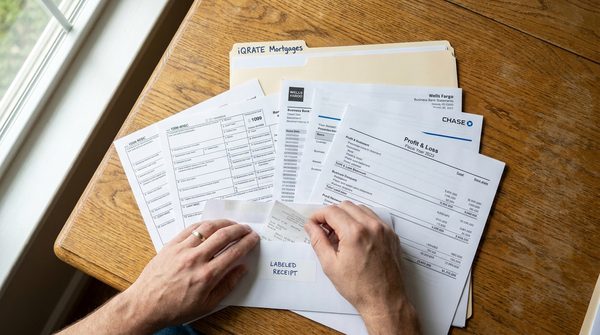
Top 3 Reasons for a Separate Business Account:
- Professionalism and Legitimacy: It shows that you treat your freelance work as a serious business, not a hobby. This simple step adds significant credibility to your application.
- Simplified Income Verification: When an underwriter reviews your bank statements, they can easily see business revenue and expenses without having to sift through personal transactions like grocery bills or movie tickets. This makes their job easier and your file stronger.
- Avoids Red Flags: Co-mingling funds can lead to confusion. Large cash deposits or transfers from family into a personal account might be mistaken for undisclosed loans or gifts, which can derail your mortgage approval. A clean business account prevents these misunderstandings.
Can a Detailed Profit and Loss Statement Help My Chances?
Yes, absolutely. A year-to-date Profit and Loss (P&L) statement, especially one prepared by a CPA or bookkeeper, is a vital document. Your most recent tax return could be almost a year old by the time you apply for a mortgage. The P&L bridges that gap, providing a current snapshot of your business's financial performance.
For example, if you're applying in October 2024, your latest tax return is for 2023. A P&L covering January 1, 2024, to September 30, 2024, proves to the lender that your income is on track to meet or exceed the previous year's performance. It confirms that the income used to qualify you is still being earned. If your P&L shows a strong upward trend, it can help offset any concerns about income fluctuations.
What Are Common Mistakes Gig Workers Make?
Navigating the mortgage process as a 1099 earner is complex, and several common mistakes can jeopardize an application.
- Maximizing Tax Write-Offs Before Applying: While deducting business expenses is smart for tax purposes, it directly reduces your net qualifying income. A web developer in Folsom might write off a new $5,000 computer system, saving on taxes but lowering their mortgage qualification amount. Plan ahead and minimize major deductions in the two years leading up to your home purchase.
- Co-mingling Personal and Business Funds: As discussed, this creates a documentation nightmare for underwriters and raises questions about the source of your funds. Always keep finances separate.
- Inconsistent Income Deposits: Lumpy income is expected, but having no deposits for several months followed by one huge deposit can be a red flag. It's better to show regular, if varied, deposits that align with the revenue reported on your P&L.
- Forgetting About Quarterly Tax Payments: Failing to pay estimated quarterly taxes can result in a large tax liability, which is factored into your debt-to-income ratio. Lenders want to see that you are current on your tax obligations. (The data, information, or policy mentioned here may vary over time.)
How Can I Show a Positive Income Trend With Monthly Fluctuations?
Showing a positive trend is about demonstrating that your annual net income is stable or increasing, even if your monthly revenue is inconsistent. Your P&L statement is the primary tool for this.
Organize your P&L to show quarterly totals in addition to a year-to-date total. This can help illustrate a seasonal pattern that results in a predictable annual outcome. For instance, a Sacramento-based event planner may have very high income in the spring and fall but lower income in the winter. By showing a two-year history of this pattern with overall annual growth, you prove that the fluctuations are part of a normal business cycle.
Additionally, you can reinforce this trend with supporting evidence like signed contracts for future work or renewal agreements with long-term clients. This documentation provides forward-looking assurance to the lender that your income stream is likely to continue, making your application much more compelling. If you're a freelancer or gig worker in California, navigating mortgage qualification doesn't have to be a struggle. A strategic approach to documenting your 1099 income can make all the difference. For a clear assessment of your financial picture, consider consulting with a mortgage professional who specializes in self-employed borrowers.
If you're a self-employed professional in California ready to turn your hard-earned income into a home, we can help demystify the process. Apply now for a personalized assessment and see where you stand.
Author Bio
David Ghazaryan is the expert mortgage strategist and founder behind iQRATE Mortgages. With a mission to fund home loans that traditional banks won't touch, David specializes in helping clients with unique financial situations, including those recovering from foreclosure or bankruptcy. He expertly crafts smart, strategic, and stress-free mortgages by leveraging a vast network of over 100 lenders to secure competitive rates for investors and homebuyers alike. Praised for exceptional customer service, David has helped hundreds of families with a 97% satisfaction rate, guiding them to the mortgage they deserve.









