

How Do Mortgage Lenders View My Public Service Loan Forgiveness Plan?
For Texas public servants working towards loan forgiveness, the Public Service Loan Forgiveness (PSLF) program is a financial lifeline. However, when you apply for a mortgage, lenders view your student loans through a very specific lens: risk assessment. Their primary concern is your ability to repay the new home loan, and your existing student debt is a major part of that equation. They calculate your debt-to-income (DTI) ratio, which compares your total monthly debt payments to your gross monthly income.
A low payment under an Income-Driven Repayment (IDR) plan like SAVE or PAYE is fantastic for your monthly budget, but it can create confusion for mortgage underwriters. They see a large outstanding loan balance—often well over $100,000—paired with a very small, sometimes $0, monthly payment. An inexperienced loan officer might not understand the nuances of PSLF and may default to a more punitive calculation, jeopardizing your application. The key is understanding that lenders don't just look at your payment; they must follow strict guidelines set by agencies like Fannie Mae, Freddie Mac, and the Federal Housing Administration (FHA) to determine which payment amount they are allowed to use in their DTI calculation.
Will Lenders in Dallas Use My Actual Payment or a Higher Amount?
This is the most critical question for a PSLF participant applying for a mortgage in Dallas, Houston, or anywhere in Texas. In the past, mortgage rules were harsh. Lenders were often required to use a hypothetical payment, typically 1% or 0.5% of the total student loan balance, regardless of your actual IDR payment. For a borrower with $150,000 in student loans, that meant using a $1,500 or $750 monthly payment in the DTI calculation, even if their real payment was only $150. This practice disqualified many creditworthy public servants.
Fortunately, the rules have changed significantly for the better. Today, for both conventional and FHA loans, lenders in Dallas are generally required to use the actual documented payment from your IDR plan. This is a game-changer. If your student loan statement clearly shows your monthly payment is $150, that is the figure the lender should use.
However, you must be proactive. You cannot assume the lender will automatically use the correct number. You must provide clear documentation and may even need to educate your loan officer on the current guidelines. If your credit report shows a different payment amount or a $0 payment, it can trigger the need for this specific documentation to override it.
What Documentation Is Needed to Prove My Repayment Terms?
To ensure your lender uses your lower IDR payment, you must provide clear and indisputable proof. Vague or incomplete paperwork will force the underwriter to use the less favorable 0.5% calculation. Your goal is to make it easy for them to approve your loan based on your true financial obligations.
Gather the following documents before you apply:
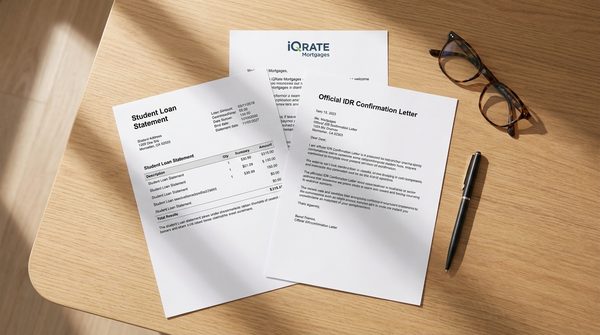
- Your Most Recent Student Loan Statement: This is the most important document. It must be current and clearly state:
- Your name
- The name of your repayment plan (e.g., 'Saving on a Valuable Education (SAVE)')
- The exact monthly payment amount
- The outstanding loan balance
- Proof of Payment: If possible, include evidence that you are making this payment, such as a bank statement showing the auto-debit.
- A Letter from Your Loan Servicer: While not always required, a letter confirming your repayment plan terms can provide additional support, especially if your statement is unclear.
Crucial Note: The statement must show a monthly payment greater than zero for the most straightforward underwriting on a conventional loan. If your documented payment is exactly $0, the rules differ slightly between FHA and conventional loans, which we'll explore below.
Can My Low Student Loan Payment Help Me Qualify for a Larger Home Loan?
Absolutely. Using your actual, lower student loan payment can dramatically increase your purchasing power. Let's look at a realistic example for a homebuyer in Fort Worth.
Scenario:
- Applicant: A teacher in the Fort Worth Independent School District.
- Gross Monthly Income: $6,000
- Other Monthly Debts (Car, Credit Card): $500
- Student Loan Balance: $120,000
- Actual IDR Payment (SAVE Plan): $185 per month
Calculation 1: The Incorrect, Old Method (0.5% of Balance)
- Student Loan Payment Used: $120,000 x 0.5% = $600/month
- Total Monthly Debt: $500 (other) + $600 (student loan) = $1,100
- Assuming a lender's max DTI is 45%, the total allowable debt is $6,000 x 0.45 = $2,700. (The data, information, or policy mentioned here may vary over time.)
- Amount Left for Housing (PITI): $2,700 - $1,100 = $1,600
- This would roughly qualify for a home loan around $240,000, assuming taxes and insurance. (The data, information, or policy mentioned here may vary over time.)
Calculation 2: The Correct, Modern Method (Actual IDR Payment)
- Student Loan Payment Used: $185/month
- Total Monthly Debt: $500 (other) + $185 (student loan) = $685
- Amount Left for Housing (PITI): $2,700 - $685 = $2,015
- This would roughly qualify for a home loan around $310,000. (The data, information, or policy mentioned here may vary over time.)
By ensuring the lender uses the correct $185 payment instead of the punitive $600 calculation, this Fort Worth teacher can qualify for a $70,000 larger mortgage. This is the difference between a small condo and a single-family home in many neighborhoods. It underscores why understanding these rules and providing proper documentation is not just a technicality—it directly impacts your ability to buy the home you want.
Does This Program Work with Federal Housing Administration and Conventional Loans?
Yes, the favorable treatment of IDR payments applies to both major loan types, but with subtle differences, especially concerning $0 payments. Knowing these distinctions can help you and your mortgage advisor choose the best loan product for your situation.

FHA Loan Guidelines for PSLF Borrowers
The Federal Housing Administration (FHA) offers some of the most flexible guidelines for borrowers with student loans. According to the HUD Handbook 4000.1, the lender must use:
- The actual documented monthly payment shown on the credit report or student loan statement.
- This is true even if the payment is $0. If your SAVE plan payment is calculated to be zero, an FHA-approved lender can use $0 in your DTI calculation.
- If for some reason a payment cannot be documented, the lender must revert to using 0.5% of the outstanding loan balance. (The data, information, or policy mentioned here may vary over time.)
This makes FHA loans a powerful option for public servants in the early stages of their careers or those on plans like SAVE that result in a $0 payment.
Conventional Loan Guidelines for PSLF Borrowers
Conventional loans are governed by the rules of Fannie Mae and Freddie Mac. Their guidelines are also very favorable but slightly more conservative regarding zero-dollar payments.
- For payments greater than zero: The lender must use the actual monthly payment documented on the student loan statement.
- For payments of zero: The lender can also use the $0 payment, but they require documentation showing the payment is truly zero under an IDR plan. Forgiveness, deferment, or forbearance for other reasons doesn't count. The loan must be in active repayment status with a calculated $0 payment. (The data, information, or policy mentioned here may vary over time.)
Essentially, both FHA and conventional loans will honor your documented IDR payment. The main difference is the slightly higher documentation burden for a $0 payment on a conventional loan. An experienced loan officer will know exactly how to package your file for either scenario.
What If My Loan Is Denied Because of an Incorrect Student Debt Calculation?
Receiving a denial is disheartening, especially if you know it's based on an error. Do not give up. Take these steps immediately:
- Request a Written Explanation: Ask the lender for the exact reason for the denial, specifically requesting a copy of their DTI worksheet. This will show you precisely which student loan payment figure they used.
- Present Your Documentation: If you see they used 0.5% of the balance, calmly provide them with your official student loan statement showing your actual IDR payment. Reference the specific guideline (Fannie Mae Selling Guide B3-6-05 or HUD Handbook 4000.1).
- Ask for Re-Underwriting: Request that your loan file be re-submitted to underwriting with the correct documentation and payment calculation.
- Escalate if Necessary: If your loan officer seems uninformed or unwilling to help, ask to speak with their manager or directly with the underwriting department. Sometimes the front-line staff is not as well-versed in these specific rules.
- Switch Lenders: If the lender refuses to correct their error, it's time to find a new one. A knowledgeable mortgage broker who works with dozens of lenders is often your best bet, as they are experts at navigating these complex scenarios and can place your loan with a lender who understands the rules.
How Does the SAVE Plan Interact with My Mortgage Application in Houston?
The SAVE (Saving on a Valuable Education) plan is the newest and often most generous IDR plan available. It can result in extremely low—and frequently $0—monthly payments for many public servants. For a borrower in Houston, where home prices require significant purchasing power, the SAVE plan's impact on a mortgage application is profound.
Imagine a social worker in Houston with $90,000 in student debt who qualifies for a $0 monthly payment under the SAVE plan. When they apply for a mortgage:
- With an FHA Loan: The lender will see the official statement showing the $0 payment and use that figure in the DTI calculation. The entire $90,000 debt principal has no negative impact on their DTI ratio, maximizing their borrowing capacity.
- With a Conventional Loan: The lender will also use the $0 payment, provided the documentation is clear that it's an approved SAVE plan payment. The underwriter will verify the loan is in repayment status and not in a general forbearance.
In both cases, the SAVE plan is a massive advantage. It allows Houston-area public servants to have their student loan payment correctly and affordably calculated, freeing up hundreds of dollars in their DTI ratio to be allocated toward a mortgage payment. This makes homeownership in a competitive market like Houston significantly more attainable.
Don't let complex student loan rules stand between you and your new home. Our team specializes in helping public servants like you navigate the mortgage process. Apply now to get a clear, accurate assessment of your home buying power.
Author Bio
David Ghazaryan is the expert mortgage strategist and founder behind iQRATE Mortgages. With a mission to fund home loans that traditional banks won't touch, David specializes in helping clients with unique financial situations, including those recovering from foreclosure or bankruptcy. He expertly crafts smart, strategic, and stress-free mortgages by leveraging a vast network of over 100 lenders to secure competitive rates for investors and homebuyers alike. Praised for exceptional customer service, David has helped hundreds of families with a 97% satisfaction rate, guiding them to the mortgage they deserve.
References
Fannie Mae: Treatment of Student Loans
Federal Student Aid: Public Service Loan Forgiveness (PSLF)
CFPB: How do my student loans affect my ability to get a mortgage loan?