


Meeting VA Occupancy Rules Before Your PCS to San Antonio
One of the biggest concerns for active-duty homebuyers is the Veteran Affairs (VA) occupancy requirement. The rule generally states that a veteran must personally live in the property as their primary residence within a 'reasonable time', which is typically defined as 60 days after the loan closes. (The data, information, or policy mentioned here may vary over time.) This can seem impossible when you have PCS orders and are hundreds or thousands of miles away.
Fortunately, the VA has a specific exception for service members with PCS orders. Your intent to occupy the home after your transfer is sufficient to meet the requirement. You do not need to be physically present in Texas at the time of closing.
How It Works in Practice
To satisfy the occupancy rule remotely, you must provide your lender with a copy of your official PCS orders. These orders serve as legal proof of your impending move and your intent to make the new property your primary residence. The VA understands the logistics of a military move and allows for this flexibility.
Additionally, the occupancy requirement can be met by your spouse. If your spouse and/or dependent children will be moving into the San Antonio home within that 60-day window, even if you are delayed due to training or other duties, the requirement is considered satisfied. This provision provides significant peace of mind for military families managing complex relocation timelines.
Using a Power of Attorney (POA) for a Remote VA Loan Closing
If you cannot be present for the closing appointment, you can designate someone to sign the legal documents on your behalf using a Power of Attorney (POA). For a real estate transaction, you cannot use a generic POA; you need a Specific Power of Attorney (also known as a Limited Power of Attorney).
General POA vs. Specific POA
- General POA: Grants broad powers to your designated 'attorney-in-fact' (the person you appoint) to act on your behalf in various matters. Lenders and title companies rarely accept these for real estate closings due to their broad nature.
- Specific POA: Grants authority for a very specific, defined transaction. In this case, it would explicitly authorize your appointee (usually a spouse) to sign the documents required to purchase a particular property at a specific address.
It is critical to coordinate with your mortgage lender and the title company as soon as you know you'll need a POA. They must approve the exact wording of the document before it is signed and notarized. Many lenders have their own required POA forms. (The data, information, or policy mentioned here may vary over time.) Waiting until the last minute to address the POA is a common mistake that can delay your closing for days or even weeks.
Best Practices for Virtual Home Tours in Killeen
Buying a home sight-unseen is a modern reality, but it requires a thorough and strategic approach. You need a trusted team to be your eyes and ears on the ground in Texas.
Work With a Military-Savvy Real Estate Agent
Partner with a real estate agent who has specific experience working with military families and VA loans, particularly in military-centric cities like Killeen or San Antonio. These agents understand the urgency of a PCS timeline, are experts in conducting detailed virtual tours, and can often recommend other military-friendly professionals, like home inspectors.
Demand High-Quality Live Video Tours
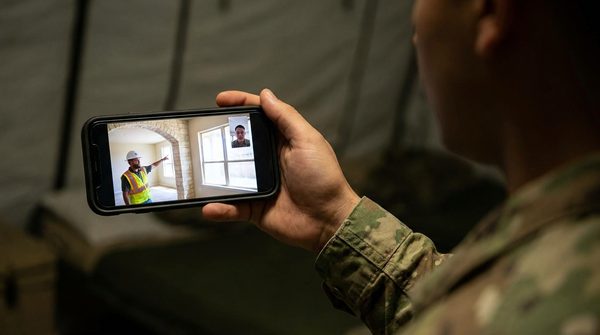
Pre-recorded video tours are useful for an initial look, but they are not sufficient for making a purchase decision. Insist on a live video tour via FaceTime, Zoom, or another platform. During the live tour, direct your agent to:
- Test functionality: Ask them to turn on faucets to check water pressure, flush toilets, open and close all windows and doors, and flip light switches.
- Use their senses: Have them describe any unusual smells, like dampness, mold, or smoke. Ask them to note any strange noises from the HVAC system or appliances.
- Show every detail: Request close-ups of ceilings and baseboards to check for water stains, the condition of flooring under rugs, and the inside of cabinets and closets.

Use Multiple Mapping and Research Tools
Go beyond the listing photos. Use Google Maps Street View to 'walk' the neighborhood. Use satellite imagery to see the condition of neighboring properties and the home's roof. Research school districts, crime rates, and, most importantly, calculate the exact commute time to your new duty station, like Fort Sam Houston or Fort Cavazos, during peak traffic hours.
Managing Remote Home Inspections and Appraisals
Once your offer is accepted, the inspection and appraisal processes begin. These are two separate events with different purposes, and you must manage them carefully from afar.
The Home Inspection
The home inspection is for your benefit. You hire a licensed home inspector to conduct a thorough examination of the property's condition, from the foundation to the roof. Do not rely on an inspector recommended by the seller; hire your own independent professional.
Your agent can attend the inspection on your behalf. Afterward, the inspector will provide a detailed report, complete with photos and descriptions of any issues. The most crucial step is to schedule a follow-up call with the inspector. This call allows you to ask questions and gain context that a written report alone cannot provide. For example, the inspector can clarify if a noted 'issue' is a minor $100 fix or a major $10,000 structural problem.
The VA Appraisal
The VA appraisal is an independent assessment required by the lender. Its purpose is twofold: to determine the home's fair market value and to ensure it meets the VA's Minimum Property Requirements (MPRs) for safety and habitability.
You do not choose the appraiser; one is assigned by the VA. If the appraiser notes any MPR-related issues (e.g., peeling paint in a home built before 1978, a broken window, or a leaky roof), these items must be repaired before the loan can close. Your agent will be your advocate in negotiating with the seller to have these repairs completed. (The data, information, or policy mentioned here may vary over time.)
Essential PCS Documentation for Your VA Lender
To underwrite a VA loan for a service member with PCS orders, your lender will require a few specific documents in addition to the standard financial paperwork.
- Official PCS Orders: This is the most important document. It confirms your relocation and allows the lender to use your future income and satisfy the occupancy requirement.
- Leave and Earnings Statement (LES): Your LES verifies your current pay, allowances, and time in service.
- VA Certificate of Eligibility (COE): This document proves to the lender that you have the required military service to qualify for the VA loan benefit. Your lender can typically pull this for you in minutes.
- Standard Financial Documents: This includes recent bank statements, tax returns for the past two years, and W-2s.
Timing Your Closing to Align With Your Move to Texas
Coordinating your closing date with your PCS timeline is a delicate balance. Your goal should be to close on the home before you or your family arrive, giving you a buffer to handle any last-minute issues.
A good target is to schedule your closing date 15-30 days before your report date. (The data, information, or policy mentioned here may vary over time.) For example, if your report-no-later-than date at your new San Antonio base is August 1st, aiming for a closing in early or mid-July is a smart strategy. This ensures the home is officially yours and allows time to arrange for utilities to be turned on before your moving truck arrives.
Communicate your timeline clearly and frequently with your real estate agent and mortgage lender. They can work backward from your desired move-in date to set realistic deadlines for every step of the mortgage process, from application to final approval.
Using Your New Basic Allowance for Housing (BAH) to Qualify
One of the most powerful advantages of a VA loan during a PCS move is the ability to use your future income to qualify. Lenders can use the Basic Allowance for Housing (BAH) rate for your new duty station, not your current one.
For example, if your current BAH is $1,900 per month but your new BAH for the San Antonio area will be $2,300, your lender can use the higher $2,300 figure in your debt-to-income (DTI) ratio calculation. (The data, information, or policy mentioned here may vary over time.) This $400 monthly increase can significantly boost your purchasing power, potentially allowing you to qualify for a larger loan and a better home for your family. Your PCS orders are the key that unlocks this benefit, as they officially document your new location and corresponding BAH rate.
Common Mistakes to Avoid During a Remote VA Home Purchase
Navigating a remote home purchase is complex. Avoiding these common pitfalls can save you time, money, and stress.
- Not Using a Military-Focused Real Estate Agent: An agent unfamiliar with the PCS process may not understand the urgency or the specific documentation needed, causing unnecessary delays.
- Waiting Too Long to Secure a POA: Getting a Specific POA approved by the lender and title company can take time. Start this process as soon as you know you'll need one.
- Skipping the Inspector Debrief Call: A written report is just data. The conversation with the inspector provides the critical context and expert opinion you need to make an informed decision.
- Ignoring Neighborhood Due Diligence: Don't fall in love with a house without thoroughly researching its surroundings. Check commute times, school ratings, and local amenities to ensure the location fits your family's lifestyle.
- Forgetting About Utility Setup: The last thing you want after a cross-country move is to arrive at a dark house with no running water. Arrange for utility services to be activated in your name effective on your closing date.
Navigating a remote VA loan for your PCS to Texas requires a clear strategy. When you're ready to move forward, take the first step by getting pre-approved. Apply now to see your options and ensure a smooth homebuying journey before you even arrive in the Lone Star State.
Author Bio
David Ghazaryan is the expert mortgage strategist and founder behind iQRATE Mortgages. With a mission to fund home loans that traditional banks won't touch, David specializes in helping clients with unique financial situations, including those recovering from foreclosure or bankruptcy. He expertly crafts smart, strategic, and stress-free mortgages by leveraging a vast network of over 100 lenders to secure competitive rates for investors and homebuyers alike. Praised for exceptional customer service, David has helped hundreds of families with a 97% satisfaction rate, guiding them to the mortgage they deserve.









