
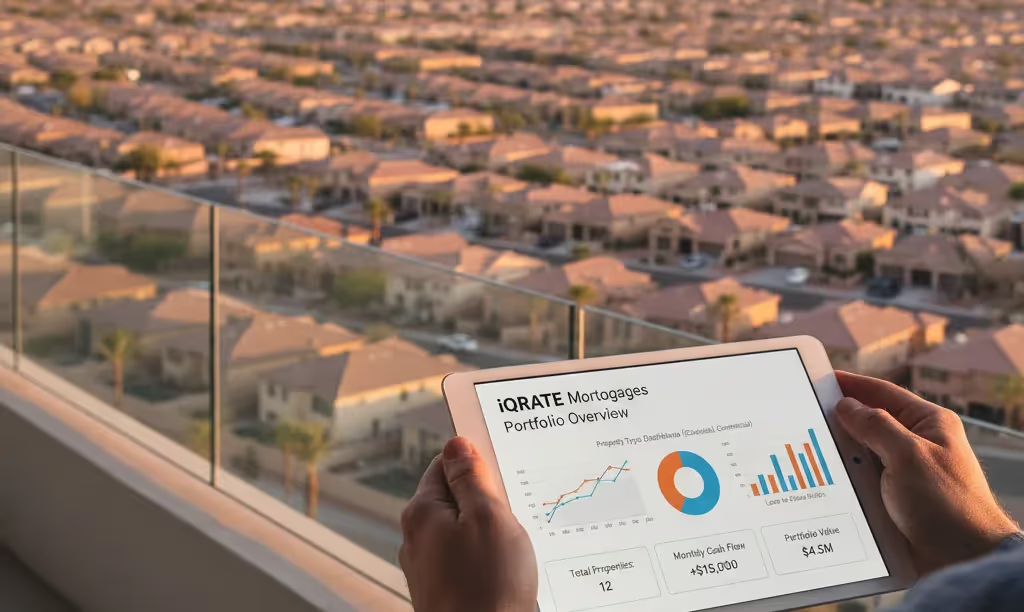

As a real estate investor in Nevada, your goal is to grow your portfolio efficiently. While acquiring properties is exciting, managing a a collection of individual mortgages can quickly become a significant operational headache. Each loan comes with its own payment, escrow account, and paperwork, complicating your finances. More importantly, these individual loans count against your personal credit, potentially capping your ability to expand.
A portfolio loan, also known as a blanket mortgage, offers a strategic solution. It consolidates the debt on multiple properties into a single loan with one monthly payment. This approach is designed for seasoned investors and is underwritten based on the portfolio's performance, not just your personal income, offering a powerful tool to simplify, scale, and succeed. (The data, information, or policy mentioned here may vary over time.)
What are the signs you've outgrown individual rental property loans?
Transitioning from individual mortgages to a portfolio loan is a natural step in an investor's journey. If you're experiencing any of the following, it might be time to consider consolidation:
- You've Hit the Conventional Loan Limit: Fannie Mae and Freddie Mac generally limit investors to financing a maximum of 10 properties. If you've reached this cap, a portfolio loan is one of the only ways to continue acquiring new properties with financing. (The data, information, or policy mentioned here may vary over time.)
- Your Personal DTI is Too High: Each conventional investment property mortgage is tied to your personal debt-to-income (DTI) ratio. As you add properties, your DTI climbs, making it difficult to qualify for new loans, whether for another rental or even a new primary residence.
- Administrative Work is Overwhelming: Juggling four, five, or more separate mortgage payments, insurance bills, and property tax statements is complex and time-consuming. A single payment simplifies your bookkeeping immensely.
- You Want to Tap Equity from Multiple Properties: If you have significant equity spread across several rentals, accessing it requires multiple cash-out refinances. A portfolio loan allows you to perform a single cash-out transaction based on the combined equity of all properties, providing a substantial lump sum for future investments.
How does a portfolio loan simplify your bookkeeping and cash-flow analysis?
The primary administrative benefit of a portfolio loan is simplification. Instead of complexity, you get clarity.
Before a Portfolio Loan
Imagine you own four rental properties in the Las Vegas area. Each month, you're responsible for:
- Four separate mortgage payments to potentially different lenders.
- Four separate escrow accounts for taxes and insurance, each with its own annual analysis.
- Tracking four different loan balances and interest statements.
This fragmented approach makes it difficult to get a quick, accurate snapshot of your portfolio's overall financial health. Calculating your true net operating income (NOI) requires compiling data from multiple sources.

After a Portfolio Loan
By consolidating these four properties under one blanket mortgage, your financial management transforms:
- One Monthly Payment: You make a single payment that covers the principal, interest, taxes, and insurance (PITI) for the entire portfolio.
- One Lender Relationship: All communication, statements, and escrow management are handled through one point of contact.
- Streamlined Analysis: You receive a single monthly statement that details your entire portfolio's debt. This makes it incredibly easy to subtract this single debt payment from your total rental income to analyze your true cash flow and profitability.
Can consolidating my rental loans actually improve my personal DTI score?
Yes, and this is one of the most powerful strategic advantages of a portfolio loan. Conventional mortgages are underwritten based on your personal financial profile. A portfolio loan, however, is a type of commercial financing. Lenders are more concerned with the properties' ability to generate income than your personal salary.
The key metric they use is the Debt Service Coverage Ratio (DSCR). This ratio compares the portfolio's net operating income (gross rents minus expenses like taxes, insurance, and maintenance) to the total loan payment. A lender typically wants to see a DSCR of 1.20 or higher, meaning the properties generate 20% more net income than is needed to cover the debt service. (The data, information, or policy mentioned here may vary over time.) Because the loan is secured by the assets and their cash flow, it often does not appear on your personal credit report. (The data, information, or policy mentioned here may vary over time.)
Example: An investor has four rental properties with mortgages totaling $4,000 per month. These payments contribute significantly to their personal DTI, which sits at 48%, preventing them from qualifying for more loans.
They secure a portfolio loan to consolidate the four properties. The new single payment is now a business expense tied to the portfolio's performance. The $4,000 in monthly payments are removed from their personal credit obligations. Their personal DTI drops dramatically, freeing up their borrowing capacity to purchase another investment property or a vacation home using conventional financing.
How is the LTV and cash-out amount calculated on an entire portfolio?
Calculating the loan-to-value (LTV) and potential cash-out on a portfolio is a multi-step process that aggregates the value of all your properties.
- Individual Appraisals: The lender will order an appraisal for each property you want to include in the portfolio.
- Aggregate Portfolio Value: The appraised values are added together to determine the total value of the portfolio.
- Apply LTV: The lender applies its LTV limit to the total value. For portfolio loans, LTVs typically range from 65% to 75%. (The data, information, or policy mentioned here may vary over time.)
Example Calculation: An investor in Henderson, Nevada, wants to consolidate three properties and pull cash out.
Property 1 Appraised Value: $400,000
Property 2 Appraised Value: $375,000
Property 3 Appraised Value: $450,000
Total Portfolio Value: $400,000 + $375,000 + $450,000 = $1,225,000
Now, let's assume the lender offers a 75% LTV.
- Maximum Loan Amount: $1,225,000 x 0.75 = $918,750
To determine the cash-out amount, you subtract the existing mortgage balances.
Existing Mortgages on Properties 1, 2, & 3: $250,000 + $200,000 + $275,000 = $725,000
Available Cash-Out: $918,750 (Max Loan) - $725,000 (Existing Debt) = $193,750
This substantial amount of cash can be used for down payments on new properties, renovations, or other investment opportunities.

What are the typical interest rates and terms for a Nevada blanket loan?
Because portfolio loans are commercial financial products, their rates and terms differ from standard owner-occupied mortgages. You should expect:
- Higher Interest Rates: Rates are typically 1% to 3% higher than a conventional 30-year fixed mortgage. This premium accounts for the lender's increased risk in financing multiple investment properties under one loan. (The data, information, or policy mentioned here may vary over time.)
- Adjustable Rates or Shorter Fixed Periods: While a 30-year amortization schedule is common (to keep payments low), the fixed-rate period is often shorter. Common structures include a 5/1 ARM, 7/1 ARM, or a 10-year fixed period, after which the rate adjusts or a balloon payment is due. (The data, information, or policy mentioned here may vary over time.)
- Prepayment Penalties: Unlike conventional loans, many portfolio loans include a prepayment penalty. This clause requires the borrower to pay a fee if they pay off the loan within a specified period, typically the first 3 to 5 years. (The data, information, or policy mentioned here may vary over time.)
Do all my properties need to be in Nevada to be included in the loan?
This depends entirely on the lender. Some smaller, local Nevada banks or credit unions may only lend on a portfolio of properties located within the state. (The data, information, or policy mentioned here may vary over time.)
However, many national portfolio lenders who operate in Nevada have a much broader footprint. These lenders can and often will finance a portfolio that includes properties in multiple states. For example, you could include your rentals in Reno and Las Vegas alongside properties you own in Arizona or California in the same blanket loan. This is a significant advantage for investors who have diversified their holdings geographically.
What are 'release clauses' and why are they critical for my portfolio?
A release clause is arguably the most important feature to look for in a portfolio loan agreement. This provision gives you the flexibility to sell an individual property from the portfolio without having to pay off and refinance the entire loan.
Without a release clause, selling a single property would trigger a 'due-on-sale' clause for the whole portfolio, forcing a costly and inconvenient refinance of all the remaining properties.
How a Release Clause Works
A properly structured release clause will outline a specific process for selling a property. Typically, you must use a portion of the sale proceeds to pay down the principal balance of the portfolio loan. The lender will require a payment greater than the original loan amount attributed to that one property, often around 120% of its pro-rata debt. (The data, information, or policy mentioned here may vary over time.) This 'paydown premium' reduces the lender's risk by improving the LTV on the remaining properties.
Example: Your portfolio loan balance is $800,000 across four properties, with one property in Summerlin being responsible for $200,000 of that debt. You sell the Summerlin property for $400,000. The release clause may require you to pay down the portfolio loan by $240,000 (120% of $200,000). The property is then released from the blanket mortgage lien, and you continue making payments on the new, lower loan balance of $560,000. If you're managing multiple rental properties in Nevada, a portfolio loan could be the strategic move that simplifies your finances and fuels your growth. To explore your specific options and see how a tailored blanket loan can work for your portfolio, it's best to consult with a mortgage expert who specializes in investor financing.
If you're ready to trade complexity for clarity and unlock the full potential of your real estate investments, it's time to explore a portfolio loan. Apply now to see how our investor-focused financing can help you scale your Nevada portfolio.
Author Bio
David Ghazaryan is the expert mortgage strategist and founder behind iQRATE Mortgages. With a mission to fund home loans that traditional banks won't touch, David specializes in helping clients with unique financial situations, including those recovering from foreclosure or bankruptcy. He expertly crafts smart, strategic, and stress-free mortgages by leveraging a vast network of over 100 lenders to secure competitive rates for investors and homebuyers alike. Praised for exceptional customer service, David has helped hundreds of families with a 97% satisfaction rate, guiding them to the mortgage they deserve.
References









