

What is a Piggyback or 80-10-10 Loan in Reno?
A piggyback loan, commonly known as an '80-10-10' loan, is a home financing strategy that uses two separate mortgages to purchase a single property. It's an effective tool for homebuyers in markets like Reno and Carson City where property values often exceed the conforming loan limits set by federal regulators. Instead of taking out one large loan, you split the financing into three parts:
- 80% First Mortgage: This is the primary loan, covering 80% of the home's purchase price. Because it's at an 80% loan-to-value (LTV) ratio, it does not require private mortgage insurance (PMI).
- 10% Second Mortgage: This is a smaller, 'piggyback' loan that sits on top of the first one. It can be structured as a home equity line of credit (HELOC) with a variable rate or a fixed-rate home equity loan.
- 10% Down Payment: This is the cash contribution you make from your own funds.
For example, let's say you want to buy a $900,000 home in Reno. With an 80-10-10 structure, your financing would look like this:
- Down Payment: $90,000 (10%)
- First Mortgage: $720,000 (80%)
- Second Mortgage: $90,000 (10%)
This approach allows you to secure financing with a manageable down payment without incurring the extra monthly cost of PMI, making it a powerful alternative to a traditional jumbo loan that might demand a 20% down payment.
How a Piggyback Loan Helps You Avoid Private Mortgage Insurance
Private Mortgage Insurance, or PMI, is a type of insurance required by conventional lenders when a homebuyer makes a down payment of less than 20%. It protects the lender—not you—in case you default on your loan. PMI payments are added to your monthly mortgage bill and can cost anywhere from 0.5% to 2% of your loan amount annually, representing a significant added expense. (The data, information, or policy mentioned here may vary over time.)
The primary strategic advantage of a piggyback loan is its ability to sidestep this requirement entirely. The 80-10-10 structure is designed specifically to keep the first, primary mortgage at an 80% loan-to-value (LTV) ratio. Since the 80% LTV threshold is the exact point where PMI is no longer required, the lender for your main mortgage doesn't mandate it.
By using the second mortgage to cover the 10% gap that would have otherwise triggered PMI, you are essentially replacing a PMI payment with a second loan payment. While the second loan comes with its own interest costs, these costs are often less than PMI payments and the interest paid is sometimes tax-deductible (consult a tax advisor). This makes the 80-10-10 loan a calculated financial move to reduce your total monthly housing expense.
Is a Jumbo Loan or a Piggyback Loan Cheaper in Incline Village?
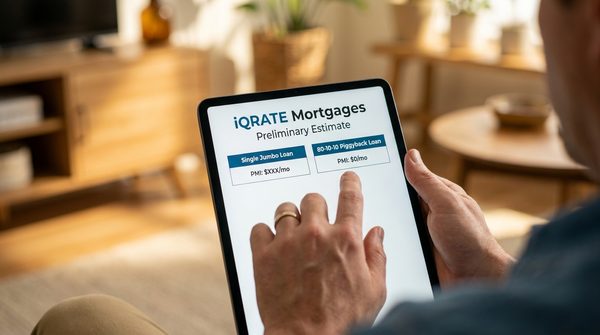
Deciding between a single jumbo loan and a piggyback loan depends entirely on the numbers—interest rates, PMI costs, and your financial profile. Let's run a detailed cost comparison for a hypothetical $1,300,000 home purchase in Incline Village, Nevada.

Scenario: $1,300,000 Purchase Price with a 10% Down Payment ($130,000)
Option 1: Single Jumbo Loan
A jumbo loan is a mortgage that exceeds the conforming loan limits set by the Federal Housing Finance Agency (FHFA). Lenders often require higher credit scores and larger down payments for these loans.
- Purchase Price: $1,300,000
- Down Payment (10%): $130,000
- Total Loan Amount: $1,170,000
- Interest Rate (example): 7.00% (Jumbo rates can be competitive but vary)
- PMI Cost (example): 0.75% annually, or $731/month ($1,170,000 * 0.0075 / 12)
Monthly Payment Breakdown (Principal & Interest + PMI):
- Principal & Interest: $7,784
- PMI: $731
- Total Monthly P&I + PMI: $8,515
Option 2: Piggyback (80-10-10) Loan
This option splits the financing into two loans to avoid PMI.
- Purchase Price: $1,300,000
- Down Payment (10%): $130,000
- First Mortgage (80%): $1,040,000 at 6.875% (example conforming/jumbo rate)
- Second Mortgage (10%): $130,000 at 9.50% (second liens have higher rates)
Monthly Payment Breakdown (Loan 1 + Loan 2):
- First Mortgage (P&I): $6,839
- Second Mortgage (P&I, assuming a 30-year term for comparison): $1,093
- Total Monthly P&I: $7,932
Comparing the Financial Outcome
In this Incline Village scenario, the results are clear. The single jumbo loan would result in a total monthly payment of $8,515 (including principal, interest, and PMI). The piggyback loan structure, with its two separate payments, would have a combined total monthly payment of $7,932.
By choosing the 80-10-10 loan, the borrower saves $583 per month. The higher interest rate on the smaller second mortgage is more than offset by the complete elimination of the costly PMI premium. This demonstrates why it's critical to compare actual loan estimates before making a decision.
What are the Qualification Requirements for a Second Mortgage?
Qualifying for a piggyback loan means you are essentially applying for and must be approved for two loans from potentially two different lenders simultaneously. The underwriting standards are rigorous because the lender of the second mortgage takes on more risk.
Key requirements typically include:
- Credit Score: While you might secure a first mortgage with a score in the high 600s, lenders for second mortgages often look for higher scores, typically 700 or above. (The data, information, or policy mentioned here may vary over time.) A strong credit history demonstrates reliability.
- Debt-to-Income (DTI) Ratio: Underwriters will calculate your DTI using the combined monthly payments of both new mortgages, plus any other existing debts (car loans, credit cards). Lenders generally prefer a DTI ratio of 43% or lower for this loan structure. (The data, information, or policy mentioned here may vary over time.)
- Cash Reserves: You will need to show you have sufficient funds to cover the down payment, all closing costs, and several months' worth of payments for both loans. This is often referred to as post-closing liquidity.
- Stable and Documented Income: Just like any mortgage, you must provide proof of consistent employment and documented income through tax returns, W-2s, and pay stubs.
How to Calculate Your Combined Loan-to-Value (CLTV)
When you have more than one loan on a property, lenders use a metric called Combined Loan-to-Value (CLTV) to assess their total risk exposure. It represents the total amount of liens on your property relative to its appraised value. The formula is straightforward:
CLTV = (First Mortgage Balance + Second Mortgage Balance) / Home's Appraised Value
Using our previous Incline Village example:
- First Mortgage: $1,040,000
- Second Mortgage: $130,000
- Appraised Value: $1,300,000
CLTV = ($1,040,000 + $130,000) / $1,300,000
CLTV = $1,170,000 / $1,300,000
CLTV = 0.90 or 90%
Lenders use this 90% CLTV figure to determine eligibility and pricing for your loans. A higher CLTV indicates higher risk, which is why the interest rate on the second mortgage is always higher.
Pros and Cons of Two Separate Mortgage Payments
Managing two mortgages has distinct advantages and disadvantages. It's crucial to weigh them before committing to this strategy.
Advantages of a Piggyback Structure
- Avoids PMI: This is the single biggest benefit, potentially saving you thousands of dollars per year.
- Smaller Down Payment: Enables you to buy a higher-priced home in places like Carson City without needing to save a full 20% down payment.
- Flexibility to Pay Off Second Loan: You can aggressively pay down the smaller, higher-rate second mortgage to eliminate that payment and reduce your total interest costs faster, without affecting your low-rate primary loan.
- Potentially Lower Blended Rate: In some interest rate environments, the combined 'blended' rate of the two loans can be lower than the rate on a single jumbo loan that requires PMI.
Disadvantages of a Piggyback Structure
- Two Sets of Closing Costs: You may have to pay origination and underwriting fees for both loans, which can slightly increase your upfront costs. (The data, information, or policy mentioned here may vary over time.)
- Higher Interest on Second Loan: The interest rate on the second mortgage will be significantly higher than the rate on your primary loan.
- Complexity: Managing two separate loan payments to two different servicers requires more organization.
- Variable Rate Risk: If your second loan is a HELOC, its interest rate is variable and can rise over time, increasing your monthly payment.
Can I Pay Off the Smaller Second Mortgage Early?
Yes, absolutely. In fact, this is one of the key strategies for maximizing the value of an 80-10-10 loan. Most second mortgages, whether they are fixed-rate loans or HELOCs, do not have prepayment penalties. (The data, information, or policy mentioned here may vary over time.) This allows you to make extra payments toward the principal balance whenever you can.
By paying off the higher-interest second mortgage early—perhaps with a bonus, raise, or other financial windfall—you can:
- Eliminate one of your monthly payments.
- Significantly reduce the total amount of interest you pay over the life of the loans.
- Build equity in your home much faster.
Before signing, always confirm the terms and ask your lender directly: 'Does this loan have a prepayment penalty?' This ensures you have the flexibility you need for this strategy to work.
Are Interest Rates on a Second Mortgage Higher?
Yes, the interest rate on a second mortgage is consistently higher than the rate on a first mortgage, often by 2% to 4% or more. The reason comes down to risk.
The first mortgage is in the 'first lien position'. This means if you default on your loans and the home is sold through foreclosure, the lender of the first mortgage gets paid back first from the proceeds. The second mortgage lender is in the 'second lien position' and only gets paid if there is money left over after the first lender has been fully repaid.
Because of this subordinate position, the second mortgage is a riskier investment for the lender. To compensate for that increased risk, they charge a higher interest rate. This is a fundamental principle of mortgage lending and a key factor to include in your cost calculations when comparing a piggyback loan to a single jumbo loan. Deciding between a jumbo and a piggyback loan requires a detailed cost analysis based on current interest rates and your financial profile. To understand the exact numbers for your situation in Reno, Carson City, or anywhere in Nevada, it’s best to compare personalized loan estimates.
Ready to determine if a piggyback loan is your cheapest path to homeownership in Nevada? Apply now to get a personalized loan estimate and see your exact numbers to make a confident decision.
Author Bio
David Ghazaryan is the expert mortgage strategist and founder behind iQRATE Mortgages. With a mission to fund home loans that traditional banks won't touch, David specializes in helping clients with unique financial situations, including those recovering from foreclosure or bankruptcy. He expertly crafts smart, strategic, and stress-free mortgages by leveraging a vast network of over 100 lenders to secure competitive rates for investors and homebuyers alike. Praised for exceptional customer service, David has helped hundreds of families with a 97% satisfaction rate, guiding them to the mortgage they deserve.
References
CFPB - What is private mortgage insurance?