


What Is the Core Difference Between a P&L and a Bank Statement Loan?
For the self-employed entrepreneur in Florida, traditional mortgage qualification using tax returns can be a significant roadblock. Tax returns are designed to minimize tax liability, not maximize qualifying income. This is where alternative documentation or 'non-QM' loans become essential tools. The two most powerful options are the Profit & Loss (P&L) statement loan and the bank statement loan.
While both serve the same ultimate purpose—getting you approved for a home loan—they analyze your business's financial health from two distinct angles.
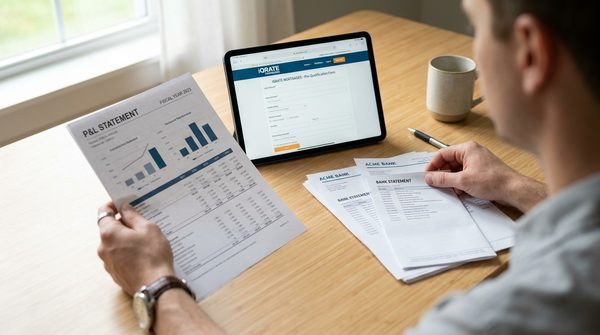
P&L Statement Loan: This loan type uses a P&L statement, typically prepared by a Certified Public Accountant (CPA), to determine your qualifying income. The P&L is a snapshot of your business's revenues and expenses over a specific period (e.g., the last 12 months or year-to-date). It's a forward-looking tool that can capture recent, explosive growth that hasn't yet been reflected on a filed tax return.
Bank Statement Loan: This loan uses your business bank statements, usually from the most recent 12 or 24 months, to verify income. Lenders analyze the deposits to establish a consistent monthly revenue average. This method is backward-looking, focusing on historical cash flow and stability rather than a profitability summary. It proves what you actually deposited, providing a concrete measure of your business's revenue stream.
Choosing the right one depends entirely on the story your business's financials tell.
Who Is the Ideal Candidate for a Profit and Loss Statement Loan in Miami?
A P&L loan is the perfect solution for a business owner whose recent success outpaces their last tax filing. This is common in a dynamic market like Miami, where businesses can scale rapidly.
The ideal candidate for a P&L loan often fits one of these profiles:
- The Rapid Growth Business: Your company's revenue has significantly increased in the last 6 to 12 months. Your 2023 tax return might show an income of $80,000, but your P&L for the last 12 months shows a net profit of $200,000. The P&L loan allows you to qualify based on that higher, more current figure.
- The New Business Owner: You have been self-employed for at least 12 months but less than two years and don't have the two-year tax return history required by conventional lenders.
- The Business with High Write-Offs but Strong Profitability: Your business might have significant but legitimate expenses that a simple bank statement analysis can't properly account for. A CPA-prepared P&L can accurately present your true net profit after all costs are considered.
Example Scenario in Miami
Consider a marketing consultant in Miami who landed two major contracts mid-way through last year. Her business bank statements show deposits jumping from an average of $15,000 per month to $40,000 per month. Her last tax return reflects the lower income period. By providing a P&L prepared by her CPA covering the most recent 12 months, she can demonstrate a net income that accurately reflects her current success, allowing her to qualify for a much larger mortgage.

When Are Twelve-Month Bank Statements a Better Option in Fort Myers?
A bank statement loan is the go-to choice for established business owners with consistent and predictable revenue. It’s a powerful tool for professionals in stable industries, a common scenario for business owners in communities like Fort Myers.
This loan is best suited for:
- The Steady Earner: Your business deposits are reliable and don't have wild monthly fluctuations. A service provider like a therapist, an insurance agent, or a fishing charter captain in Fort Myers with consistent year-round bookings is a perfect example.
- The Business with Low Overhead: If your business has minimal expenses, a bank statement loan is often simpler. Lenders apply a standard 'expense factor' to your total deposits to calculate qualifying income. For a business with few costs, this method can be highly favorable.
- The Owner Who Prefers Simplicity: Gathering 12 or 24 months of bank statements is often less complex than engaging a CPA to prepare and attest to a formal P&L statement.
Example Scenario in Fort Myers
An established general contractor in Fort Myers wants to buy a new home. Over the past 24 months, his business bank account shows consistent deposits averaging $50,000 per month. His expenses are predictable. A lender can take his total deposits over 24 months ($1,200,000), apply a standard 50% expense factor, and arrive at a qualifying annual income of $600,000 (or $50,000 per month). This process is straightforward and based on documented cash flow.
Does a P&L-Only Loan Require a Letter from a Certified Public Accountant?
Yes, almost universally. A self-prepared P&L holds very little weight with lenders. To be considered a valid document for mortgage qualification, the P&L statement must be prepared and signed by a licensed third-party, such as a Certified Public Accountant (CPA), Enrolled Agent (EA), or licensed tax preparer.
Furthermore, lenders will require a formal letter from the CPA attesting to the accuracy of the P&L. This letter serves as a crucial piece of validation. It confirms that the professional has reviewed your business's books and that the P&L is a fair and accurate representation of its financial performance. This third-party verification gives the lender the confidence needed to approve a loan based on a document other than a federal tax return.
How Do Lenders Calculate Income from Business Bank Statement Deposits?
The calculation for bank statement loans is a methodical process designed to create a conservative and reliable picture of your income.
- Gather Statements: You will provide 12 or 24 full, consecutive months of business bank statements. All pages are required.
- Add Up Deposits: The lender totals all business-related deposits over the chosen period. Transfers from personal accounts or other non-revenue deposits are excluded.
- Apply an Expense Factor: This is the most critical step. The lender subtracts a predetermined percentage from the total deposits to account for business expenses. This is called the 'expense factor' or 'expense ratio'.
- A standard expense factor is often 50%. This is a default assumption for many businesses. (The data, information, or policy mentioned here may vary over time.)
- For certain low-overhead professions (e.g., consultants, freelance writers), a lender might use a lower expense factor (e.g., 30%) with a letter from a CPA or other documentation justifying the lower overhead. (The data, information, or policy mentioned here may vary over time.)
- Calculate Monthly Income: The resulting net figure is divided by the number of months (12 or 24) to determine the final qualifying monthly income.
Example Calculation:
- Total deposits over 12 months: $300,000
- Standard 50% expense factor applied: $300,000 x 0.50 = $150,000 in expenses
- Net qualifying income: $300,000 - $150,000 = $150,000
- Qualifying monthly income: $150,000 / 12 = $12,500
Are Down Payments or Interest Rates Different for These Two Loan Types?
Yes, the terms can differ slightly, but both fall under the non-QM loan umbrella. This means you should generally expect terms that are different from a conventional Fannie Mae or Freddie Mac loan.
Interest Rates: Rates for both P&L and bank statement loans are typically 0.5% to 2% higher than conventional rates. This premium accounts for the lender's increased risk in using alternative documentation. The final rate depends heavily on your credit score, the loan-to-value (LTV) ratio, and the overall strength of your financial profile. (The data, information, or policy mentioned here may vary over time.)
Down Payments: The minimum down payment for both loan types usually starts at 10%, but 20% is more common to secure the best terms. A larger down payment reduces the lender's risk and can result in a lower interest rate. A file perceived as riskier, such as one using a 12-month P&L instead of 24 months of bank statements, might require a larger down payment. (The data, information, or policy mentioned here may vary over time.)
Can I Get One of These Loans If My Business Is Less Than Two Years Old?
This is a common question, and the answer is a qualified 'yes'. While most lenders strongly prefer a two-year history of self-employment to demonstrate stability, some have programs for newer businesses. (The data, information, or policy mentioned here may vary over time.)
- 12-23 Months Self-Employed: It is possible to secure a P&L or bank statement loan with less than two years in business. To do so, you will need strong compensating factors. These include:
- A very high credit score (e.g., 720+)
- A significant down payment (25% or more)
- Substantial cash reserves (e.g., 12 months of mortgage payments saved)
- Prior experience in the same industry before becoming self-employed.
Lenders need to be convinced that your new business is viable and stable. The more strength you can show in other areas of your financial profile, the more likely you are to gain an exception to the two-year rule.
What Documentation Should I Prepare for Each Application?
Being prepared with the correct documentation is key to a smooth and fast closing process. Here is a checklist for each loan type.
For a P&L Statement Loan Application:
- CPA-Prepared P&L Statement: Typically for the most recent 12-month period and/or year-to-date.
- CPA Letter: A signed letter from your CPA attesting to the P&L's accuracy.
- Business Bank Statements: Usually 2-3 of the most recent months to show current cash flow.
- Proof of Business Existence: Business license, articles of incorporation, or other state registration.
- Personal Financial Documents: Personal bank statements, photo ID, and authorization for a credit report.
For a Bank Statement Loan Application:
- Consecutive Bank Statements: 12 or 24 full months of business bank statements (all pages, no gaps).
- Proof of Business Existence: Same as above (business license, etc.).
- Personal Financial Documents: Same as above.
- Letter of Explanation (If needed): A brief letter explaining any unusually large, non-recurring deposits to differentiate them from regular business revenue. The choice between a P&L and bank statement loan isn't always clear, and the right decision can significantly impact your purchasing power. If you're a self-employed professional in Florida, understanding these nuances is the first step toward securing the best financing. To discuss your specific business scenario and find a tailored mortgage solution, connect with an expert who specializes in non-QM lending.
If you're ready to explore how a P&L or bank statement loan can unlock your homeownership goals, take the next step. Apply now to get a personalized assessment of your unique financial situation.
Author Bio
David Ghazaryan is the expert mortgage strategist and founder behind iQRATE Mortgages. With a mission to fund home loans that traditional banks won't touch, David specializes in helping clients with unique financial situations, including those recovering from foreclosure or bankruptcy. He expertly crafts smart, strategic, and stress-free mortgages by leveraging a vast network of over 100 lenders to secure competitive rates for investors and homebuyers alike. Praised for exceptional customer service, David has helped hundreds of families with a 97% satisfaction rate, guiding them to the mortgage they deserve.
References
Consumer Financial Protection Bureau - What is a qualified mortgage?
U.S. Small Business Administration - How to Prepare a Profit and Loss Statement









