


Why Your Low S-Corp Salary Obstructs Your Los Angeles Mortgage Application
As an S-Corporation owner, you're likely paying yourself a 'reasonable' salary via a W-2. This is a common and effective tax strategy. It minimizes self-employment taxes, allowing you to take additional profits as distributions. While this is smart for your business finances, it creates a significant hurdle for mortgage lenders. When you apply for a home loan in Los Angeles, the underwriter’s initial calculation is almost always based on the income shown on your W-2.
If your W-2 salary is $60,000 per year, but your S-Corp actually generated a net profit of $250,000, a lender’s standard automated system sees only the $60,000. This lower figure can lead to an immediate denial or an approval for a much smaller loan than you can comfortably afford, putting that dream home in Irvine out of reach. The core issue is that lenders prioritize stable, predictable income. A W-2 salary is the simplest form of this. The responsibility falls on you and your mortgage advisor to comprehensively document and prove that the S-Corp's profits provide a consistent, reliable income stream that should be included in your qualification.
The Underwriter's Perspective
A mortgage underwriter's job is to assess risk. They need to be confident that you can repay the loan for its entire term. From their viewpoint:
- W-2 Income is Stable: It is a fixed, documented, and predictable amount.
- Distributions Are Variable: Profits can fluctuate year to year. A distribution is not a guaranteed salary.
- Business Health is Key: They need to ensure that using business profits for your personal mortgage won't jeopardize the company's financial stability.
To overcome this, you must present a complete financial picture that goes far beyond your personal W-2.
Documents That Prove Your Business Profitability Beyond a W-2
To move past the W-2 salary, you must provide a detailed file that showcases the true financial health and earning power of your S-Corporation. Lenders require specific documents to analyze your business income thoroughly. Generic or incomplete paperwork will only cause delays. Be prepared to provide the following:
- Personal Federal Tax Returns (IRS Form 1040): A complete two-year history is the standard requirement. This includes all schedules, especially Schedule E, which reports income or loss from rental real estate, royalties, partnerships, S corporations, estates, and trusts.
- S-Corporation Federal Tax Returns (IRS Form 1120-S): Lenders need the full business returns for the most recent two years. This is the primary document they use to analyze your company's revenue, expenses, and profitability.
- Schedule K-1 (Form 1120-S): This form is part of the 1120-S and reports each shareholder's share of the S-Corp's income, deductions, credits, etc. Your K-1 shows your percentage of ownership and the pass-through income allocated to you.
- Year-to-Date (YTD) Profit and Loss (P&L) Statement: This shows your business's current performance. If you're applying mid-year, the lender needs to see that your income is stable or increasing compared to previous years.
- Business Balance Sheet: This document provides a snapshot of your company's assets, liabilities, and shareholder equity. It helps the lender assess the overall financial stability of your business.

Having these documents organized and ready before you apply will dramatically streamline the underwriting process for your Los Angeles mortgage.
Using Retained Earnings to Qualify for an Irvine Mortgage
Yes, lenders can absolutely use your S-Corp's retained earnings to help you qualify, but it comes with strict conditions. Retained earnings are the cumulative profits the company has kept rather than distributing to shareholders. Lenders view this as a potential source of income or assets, but they must verify that accessing these funds won't harm the business.
An underwriter will analyze your business balance sheets and cash flow statements for the past two years. They are looking for two key things:
- A History of Distributions: Have you historically taken distributions from the company without negatively impacting its operations? If you have a pattern of taking $100,000 in distributions each year, the lender is more likely to count that as part of your qualifying income.
- Sufficient Business Liquidity: The lender will perform a stress test. They need to be certain that your withdrawal of funds for the mortgage (down payment, closing costs, and reserves) will not leave the business unable to cover its operating expenses, payroll, and debt service. (The data, information, or policy mentioned here may vary over time.) If your S-Corp has $500,000 in retained earnings but only $50,000 in its business checking account, you cannot use the full $500,000.
For a high-value market like Irvine, using retained earnings can be the key to qualifying for a larger loan. You must demonstrate that the business is healthy enough to support both itself and your personal mortgage obligations.
How Business Debts Are Factored into Your Personal Home Loan
Lenders will scrutinize your S-Corporation's debts to determine if they should be counted against your personal debt-to-income (DTI) ratio. The general rule is straightforward: if a business debt is paid by the business, it does not count against you personally. (The data, information, or policy mentioned here may vary over time.)
To prove this, the lender will require:
- Evidence of Payment: You must provide at least 12 months of canceled business checks or bank statements showing the debt payments were made directly from the business account.
- No Impact on Your Personal Credit: The debt must not be negatively impacting your personal credit report.
For example, imagine your S-Corp has a $2,000 monthly payment for an equipment loan. If you can provide a year's worth of business bank statements showing that $2,000 payment leaving the business account each month, the underwriter will not include it in your personal DTI calculation. However, if you've been paying that loan from your personal checking account, the lender will treat it as a personal liability, which could significantly reduce your borrowing power.
Understanding Add-Backs to Increase Your Qualifying Income
Add-backs are one of the most powerful tools for a self-employed borrower. These are non-cash expenses that your business writes off on its tax returns to reduce its taxable income. Because no actual money leaves the company for these expenses, mortgage lenders can 'add them back' to your net profit to get a more accurate picture of your cash flow. This directly increases your qualifying income.
Common S-Corp Add-Backs
- Depreciation: This is a deduction for the wear and tear on business assets like vehicles, equipment, and property. It's a paper expense, not a cash outlay.
- Amortization: Similar to depreciation, this is the deduction for the cost of intangible assets (like patents or trademarks) over time.
- Depletion: Used for businesses that extract natural resources (oil, gas, minerals), it accounts for the reduction of reserves.
- One-Time Major Expenses: If your business had a significant, non-recurring expense (e.g., a major equipment purchase or a lawsuit settlement), you may be able to add this back with proper documentation proving it was a one-off event.
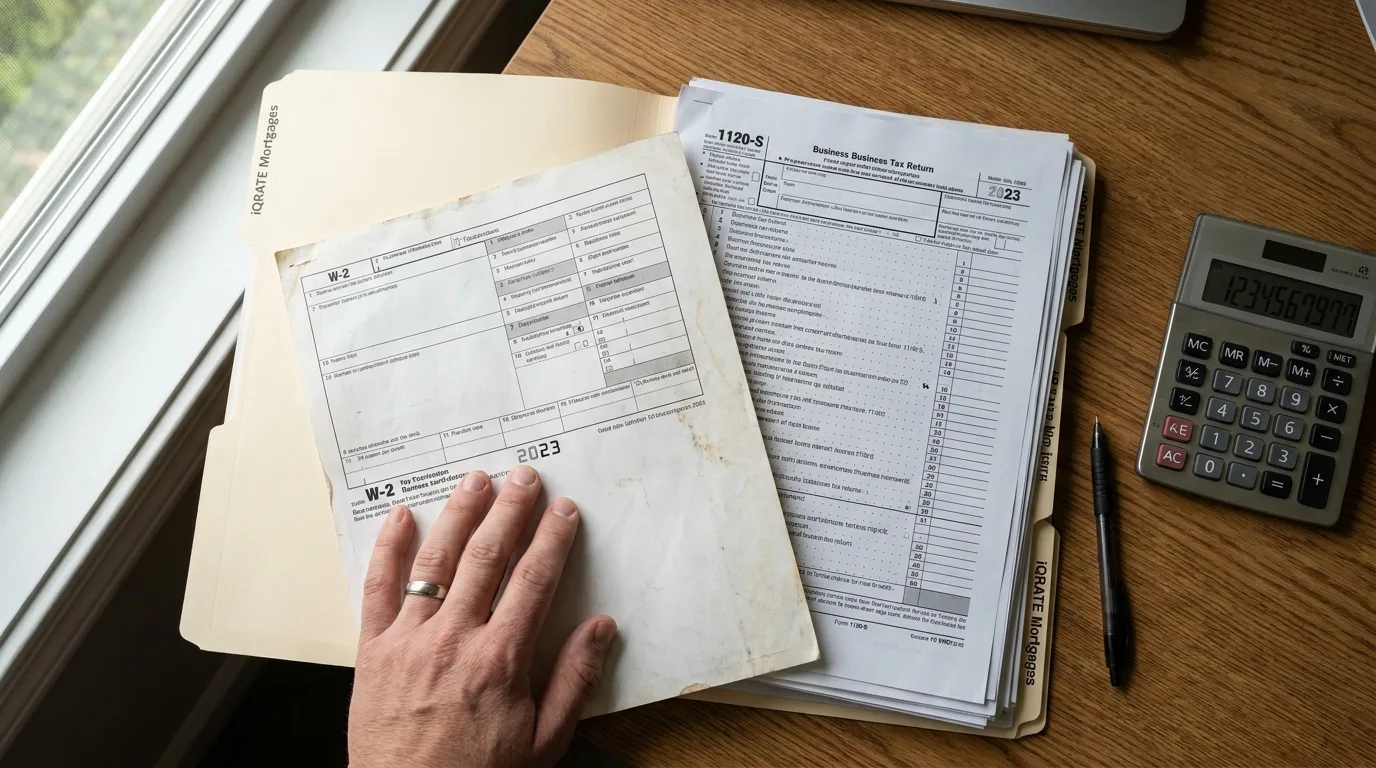
Example: Let's say your S-Corp's 1120-S shows a net profit of $90,000. Your accountant also claimed $40,000 in depreciation for company vehicles and equipment.
- Taxable Profit: $90,000
- Depreciation Add-Back: +$40,000
- Mortgage Qualifying Income: $130,000
By correctly identifying and documenting add-backs, you can substantially boost the income used to qualify for your Los Angeles home loan.
Should You Change Your Compensation Before Applying for a Mortgage?
Making sudden, drastic changes to your compensation structure right before applying for a mortgage is a major red flag for lenders. Underwriters rely on a two-year history to establish a stable and predictable income pattern. If you suddenly double your W-2 salary three months before applying for a home loan in Irvine, it looks like you are artificially inflating your income solely to qualify for the mortgage.
This can be perceived as loan fraud and will likely lead to a denial. The best approach is strategic, long-term planning. If you know you want to buy a home in the next two to three years, consult with both your CPA and a mortgage advisor who specializes in self-employed borrowers. You can work together to gradually adjust your W-2 salary and distribution strategy in a way that is both tax-efficient and positions you favorably for a future mortgage application. Consistency is far more valuable to an underwriter than a last-minute income spike.
How to Prepare S-Corporation Tax Returns for a Los Angeles Lender
Your tax returns are the cornerstone of your mortgage application. Lenders in competitive markets like Los Angeles will not accept drafts, unsigned copies, or documents that haven't been officially filed with the IRS. To ensure a smooth process, follow these guidelines:
- Use a Professional: Have your business and personal tax returns prepared by a qualified CPA or tax professional. This minimizes errors and ensures all forms and schedules are completed correctly.
- File on Time: File your returns well before any tax deadlines. If you file an extension, lenders will require a copy of the filed extension and will not be able to finalize your loan until the returns are actually filed.
- Ensure Consistency: The information on your business returns (1120-S), K-1s, and personal returns (1040) must align perfectly. Discrepancies will cause significant delays as the underwriter works to reconcile the numbers.
- Be Ready for Verification: Lenders will use IRS Form 4506-C to request a transcript of your tax returns directly from the IRS. This is a non-negotiable step to verify that the documents you provided are the same ones the IRS has on file.
Can You Use a Profit and Loss Statement Instead of Tax Returns?
No, a Profit and Loss (P&L) statement cannot replace your tax returns for mortgage qualification. Tax returns are federally filed documents that have been officially recorded, making them the ultimate source of truth for an underwriter. A P&L, while valuable, is an internal document that is not verified by a government agency.
However, the P&L plays a critical supporting role. Lenders require a YTD P&L to ensure that your business's current income is consistent with or better than the income reported on your last two years of tax returns. For example, if you apply in July 2024, the lender will use your 2022 and 2023 tax returns as the primary basis for income calculation. They will then use your YTD P&L (January 1 to June 30, 2024) to confirm that the business is still performing well in the current year. A strong P&L can support your application, but a weak one showing a decline in revenue or profit could jeopardize your approval. Navigating an S-Corp mortgage requires careful planning and expert guidance. If you're a business owner in California, understanding how to present your full financial picture is the first step. Partnering with a mortgage professional who specializes in self-employed borrowers can make the difference in securing the financing for your next home.
As an S-Corp owner, you know your business's true worth. Let us help you prove it. If you're ready to translate your business success into homeownership, take the first step with a team that understands complex income structures. Apply now for a mortgage assessment that sees beyond the W-2.
Author Bio
David Ghazaryan is the expert mortgage strategist and founder behind iQRATE Mortgages. With a mission to fund home loans that traditional banks won't touch, David specializes in helping clients with unique financial situations, including those recovering from foreclosure or bankruptcy. He expertly crafts smart, strategic, and stress-free mortgages by leveraging a vast network of over 100 lenders to secure competitive rates for investors and homebuyers alike. Praised for exceptional customer service, David has helped hundreds of families with a 97% satisfaction rate, guiding them to the mortgage they deserve.
References
Fannie Mae: Self-Employment Income Guidelines









