


Why Lenders See a New S-Corporation as High-Risk
You made a savvy business decision by converting your sole proprietorship to an S-Corporation, likely for significant tax advantages. You’re the same owner, doing the same work, for the same customers. Yet, when you apply for a mortgage, the lender’s underwriting system flags your business as brand new. This happens because the S-Corporation has a new Employer Identification Number (EIN) and a different legal structure.
From an underwriter's perspective, a business with no history is an unknown risk. They cannot immediately see the years of stable income you generated as a sole proprietor. Their primary job is to verify stable, ongoing income, and a business entity that's only a few months old appears, on paper, to be the opposite of that. They need a clear, documented bridge connecting your past success to your present operations.
How to Prove Income Stability After Changing Business Types in Reno
Proving stability is about creating a seamless narrative for the underwriter. You must demonstrate that the change from a sole proprietorship to an S-Corp was purely structural and did not disrupt your actual business operations or cash flow. For a competitive market like Reno, having this documentation prepared upfront is critical.
Here’s how to build your case:
- Maintain Operational Consistency: Show that your business name (if using a DBA), address, services, products, and client base have not changed.
- Provide Clean Financial Records: Supply bank statements for the last 12-24 months, showing consistent revenue deposits transitioning from your old business account to your new S-Corp account.
- Write a Letter of Explanation (LOE): Clearly and concisely explain why and when you changed your business structure. State that the ownership, management, and core business functions remain 100% the same.
- Engage Your CPA: A letter from your Certified Public Accountant is one of the most powerful tools you have. This professional third-party verification adds immense credibility to your file.
Documents to Connect Your Sole Proprietorship to Your New Las Vegas S-Corp
To get approved for a mortgage in Las Vegas, you must provide a specific set of documents that bridges the gap between your old and new business structures. Simply telling the underwriter 'it's the same business' is not enough. You need to provide the paper trail. (The data, information, or policy mentioned here may vary over time.)

Essential Documentation Checklist:
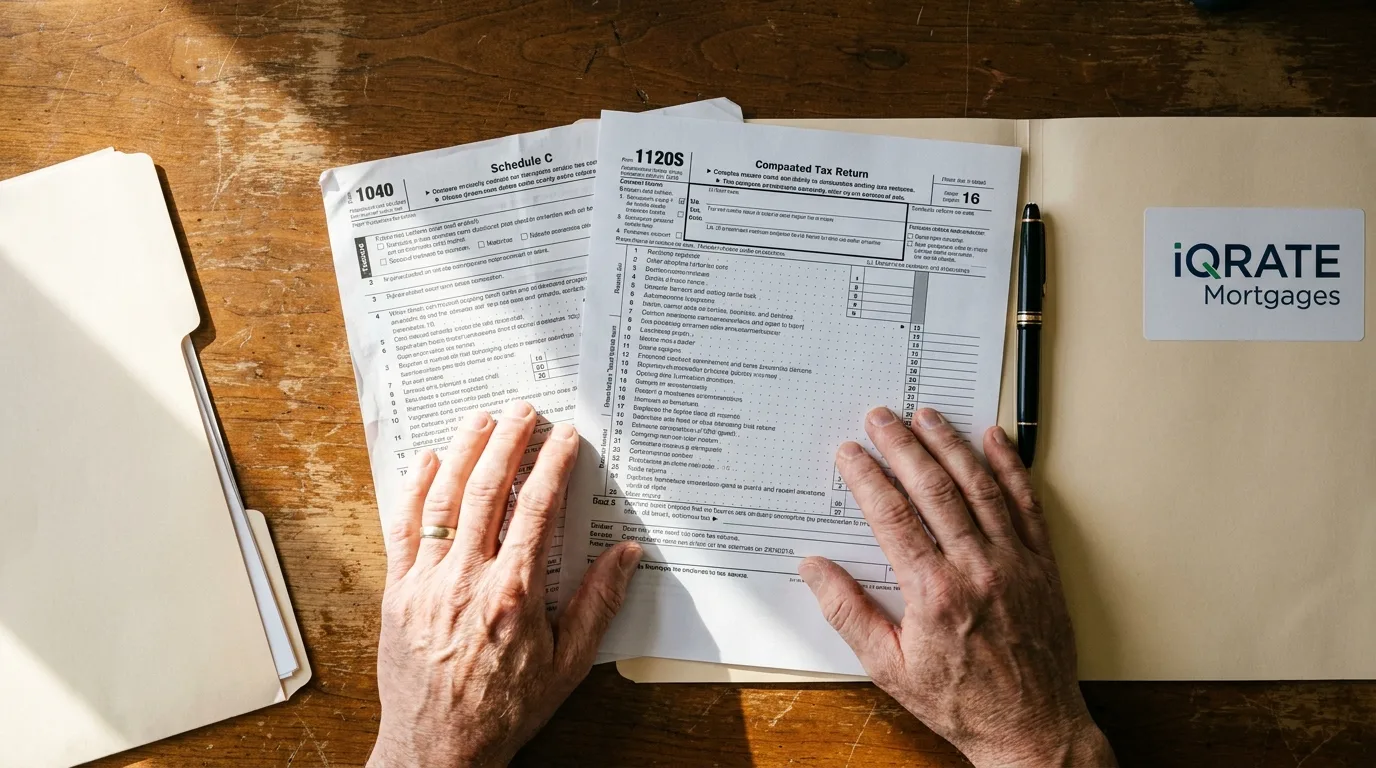
- Last Two Years of Personal Tax Returns (Form 1040): This must include your Schedule C, which shows the profit or loss from your business when it was a sole proprietorship.
- S-Corporation Formation Documents: Include the Articles of Incorporation filed with the Nevada Secretary of State.
- Most Recent Business Tax Return (Form 1120S): Even if you have only operated as an S-Corp for part of a year, you must provide the first filed return. If you haven't filed one yet, a year-to-date Profit and Loss (P&L) statement and balance sheet prepared by a CPA is required.
- Schedule K-1: This document accompanies the 1120S and shows your individual share of the corporation's income, deductions, and credits.
- Letter from a Certified Public Accountant: This letter should explicitly state that the S-Corp is a direct continuation of the prior sole proprietorship, with no change in business operations.
How Long Must I Be an S-Corporation Before Applying?
There isn't a universal timeline set in stone, as the answer depends on the quality of your documentation. The focus is on the history of the business activity, not the legal entity. If you can clearly prove continuity, most lenders will consider your entire 24-month income history, regardless of the change. (The data, information, or policy mentioned here may vary over time.)
However, a best practice is to have operated as an S-Corp long enough to have filed at least one business tax return (Form 1120S). Having this tax filing makes the income calculation cleaner and more definitive for the underwriter. If a home purchase in Reno or Las Vegas is on your immediate horizon, it's wise to speak with a mortgage advisor before making the structural change.
Will Lenders Average My Old and New Business Income?
Yes, and this is the goal. When you successfully document the business continuity, lenders will use a standard 24-month average to calculate your qualifying income. They will combine the net income from your old Schedule C with the earnings shown on your new K-1 and W-2 (if you pay yourself a salary). (The data, information, or policy mentioned here may vary over time.)
Example:
- Year 1 (Sole Proprietorship): Your Schedule C showed a net profit of $120,000.
- Year 2 (S-Corporation): Your W-2 salary was $70,000 and your K-1 ordinary income was $60,000, for a total of $130,000.
An underwriter would typically add these together ($120,000 + $130,000 = $250,000) and divide by 24 months.
$250,000 / 24 = $10,416 per month in qualifying income.
Important Note: If your income shows a decline from Year 1 to Year 2, the underwriter will likely use the lower, more recent income figure to be conservative.
Should I Have Waited to Change My Business Structure?
In hindsight, if your primary goal in the next 12 months is to secure a mortgage, waiting to change your business structure is often the path of least resistance. A consistent history as a sole proprietorship for two full years is the simplest scenario for an underwriter to analyze.
Changing your business entity introduces new layers of required documentation and potential underwriting questions. While it's entirely possible to get approved, it complicates the process. If you haven't made the change yet and plan to buy a home in Las Vegas soon, consider holding off until after you've closed on your new home. This removes any ambiguity and streamlines your mortgage approval.
How My New K-1 Income Gets Calculated for a Home Loan in Reno
Underwriters analyze more than just the final number on your K-1. They look at the full business tax return (1120S) to understand the S-Corporation's true cash flow. Your qualifying income is not just your salary plus distributions.
Here is a simplified breakdown of how they analyze your S-Corp income:
- Start with Your Salary: They begin with the W-2 wages the S-Corp paid you.
- Add K-1 Income: They add the ordinary business income shown in Box 1 of your Schedule K-1.
- Analyze the Business Return (1120S): They may add back certain non-cash expenses to your income, such as business depreciation. This can increase your qualifying income.
- Verify Business Stability: They review the company's balance sheet to ensure it's financially sound. They check to see if your distributions are sustainable and not draining the company of its cash reserves.
This comprehensive analysis ensures the income used for qualification is stable and likely to continue.
Can a Letter From My Certified Public Accountant Help?
Yes, a CPA letter is not just helpful; it is often the key that unlocks the entire approval. It serves as an authoritative, third-party validation of the narrative you are presenting to the lender. A well-written letter can resolve an underwriter's primary concerns before they even become official questions.
What the CPA Letter Must Include:
- A clear statement that you have been a client for a specified number of years.
- Confirmation of the exact date the business structure changed from a sole proprietorship to an S-Corporation.
- A declaration that you remain the 100% owner of the business.
- An assertion that the fundamental nature of the business, its operations, and its services have not changed.
- The CPA’s professional opinion that the business is financially stable and profitable.
This letter provides the underwriter with the confidence they need to 'connect the dots' between your past and present income streams. Navigating a mortgage after a business structure change requires precision. If you're a self-employed professional in Reno or Las Vegas, partnering with a specialist who understands complex income analysis can make the difference between denial and approval.
If you've navigated the change to an S-Corporation and are ready to take the next step toward homeownership, our team specializes in complex income scenarios. Get the clarity you need by starting your application with us today. Apply Now.
Author Bio
David Ghazaryan is the expert mortgage strategist and founder behind iQRATE Mortgages. With a mission to fund home loans that traditional banks won't touch, David specializes in helping clients with unique financial situations, including those recovering from foreclosure or bankruptcy. He expertly crafts smart, strategic, and stress-free mortgages by leveraging a vast network of over 100 lenders to secure competitive rates for investors and homebuyers alike. Praised for exceptional customer service, David has helped hundreds of families with a 97% satisfaction rate, guiding them to the mortgage they deserve.
References
Fannie Mae: B3-3.2-01, Self-Employment Income
Consumer Financial Protection Bureau: What documents will I need to apply for a mortgage?









