


Sourcing Your Down Payment for a Jumbo Loan in Miami
When you apply for any mortgage in the United States, lenders are legally required to verify the source of the funds you're using for the down payment and closing costs. This process is rooted in federal regulations like the Bank Secrecy Act (BSA), which aims to prevent money laundering and other financial crimes. For a jumbo loan, which exceeds the conforming loan limits set by the Federal Housing Finance Agency (FHFA), this scrutiny intensifies significantly.
In high-value markets like Miami, lenders are especially diligent. The 'source of funds' requirement means you must provide a clear, documented history of where your money came from. It’s not enough to show a large balance in your U.S. bank account; you must prove how it got there. Lenders will look for a logical paper trail showing the funds have been in your possession for a period, a process known as 'seasoning'.

For example, if you're buying a $2.5 million condominium in Miami Beach and plan to put down 20% ($500,000), the lender will want to see the account history where that money accumulated. A sudden, large deposit without a clear explanation, like the sale of a documented asset, is a major red flag. They need to see that the funds are legitimately yours and not from an unverified or illicit source.
Bank Statement Requirements for Foreign Funds
Typically, for a standard mortgage, lenders require two to three months of bank statements. However, when sourcing funds from a foreign country for a jumbo loan, expect this requirement to be much more extensive. Most lenders will ask for a minimum of 60 to 90 days, but it is common for underwriters to request six months or even a full year of statements from your foreign bank accounts. (The data, information, or policy mentioned here may vary over time.)
The extended timeframe allows the lender to establish a credible history of the funds. They are looking for a consistent pattern of income, savings, and financial behavior, not a sudden influx of cash just before the property purchase. This helps them confirm the funds are seasoned and genuinely belong to you.
Critical Documentation Standards
All foreign documents must be accompanied by a certified translation into English. The translation must be performed by a disinterested, professional third party. You cannot translate the documents yourself.
Each statement must clearly show:
- Your full name as the account holder
- The bank’s official name and logo
- The complete account number
- A detailed transaction history for the entire period
- The currency of the account
The Best Way to Transfer Funds to a United States Bank Account
The cleanest and most universally accepted method for transferring your down payment from a foreign country is a direct bank-to-bank wire transfer. This creates a simple, transparent, and easily verifiable paper trail that underwriters prefer.
Avoid the temptation to use alternative methods, as they can complicate or even jeopardize your loan approval. Methods to avoid include:
- Third-party money transfer services: While convenient, these often lack the detailed documentation lenders require.
- Multiple small transfers: Sending money in smaller increments to stay under reporting thresholds can be misinterpreted as an attempt to hide the source of funds, a practice known as 'structuring'.
- Carrying physical cash: Transporting large sums of cash is not only risky but also creates a documentation nightmare, as its origin is nearly impossible to verify for mortgage purposes.
Steps for a Clean Fund Transfer
- Open a U.S. Bank Account: Establish an account with a reputable U.S. financial institution well in advance of your planned purchase.
- Notify Both Banks: Inform both your foreign and U.S. banks about the upcoming large international wire transfer to ensure a smooth transaction.
- Execute a Single Wire: Transfer the entire amount needed for your down payment, closing costs, and required reserves in one single transaction.
- Keep All Records: Obtain and save the wire transfer receipt from the sending bank and the confirmation of receipt from the U.S. bank. These documents are non-negotiable proof for your lender.
Using Proceeds from a Foreign Property or Business Sale
Yes, you can absolutely use proceeds from selling a significant asset like a foreign property or business for your down payment. However, this path requires meticulous documentation to create a clear bridge from the asset sale to your U.S. bank account.
For the sale of a home in another country to purchase a new one in Palm Beach, for instance, you will need to provide a complete file that proves the legitimacy of the transaction. This includes:
- A fully executed and translated copy of the final sales contract for the foreign property.
- A document equivalent to a U.S. closing statement or settlement statement, showing the final sale price and the net proceeds distributed to you.
- A copy of your foreign bank statement showing the exact proceeds from the sale being deposited into your account.
- The wire transfer receipt showing those same funds moving from your foreign account to your U.S. account.
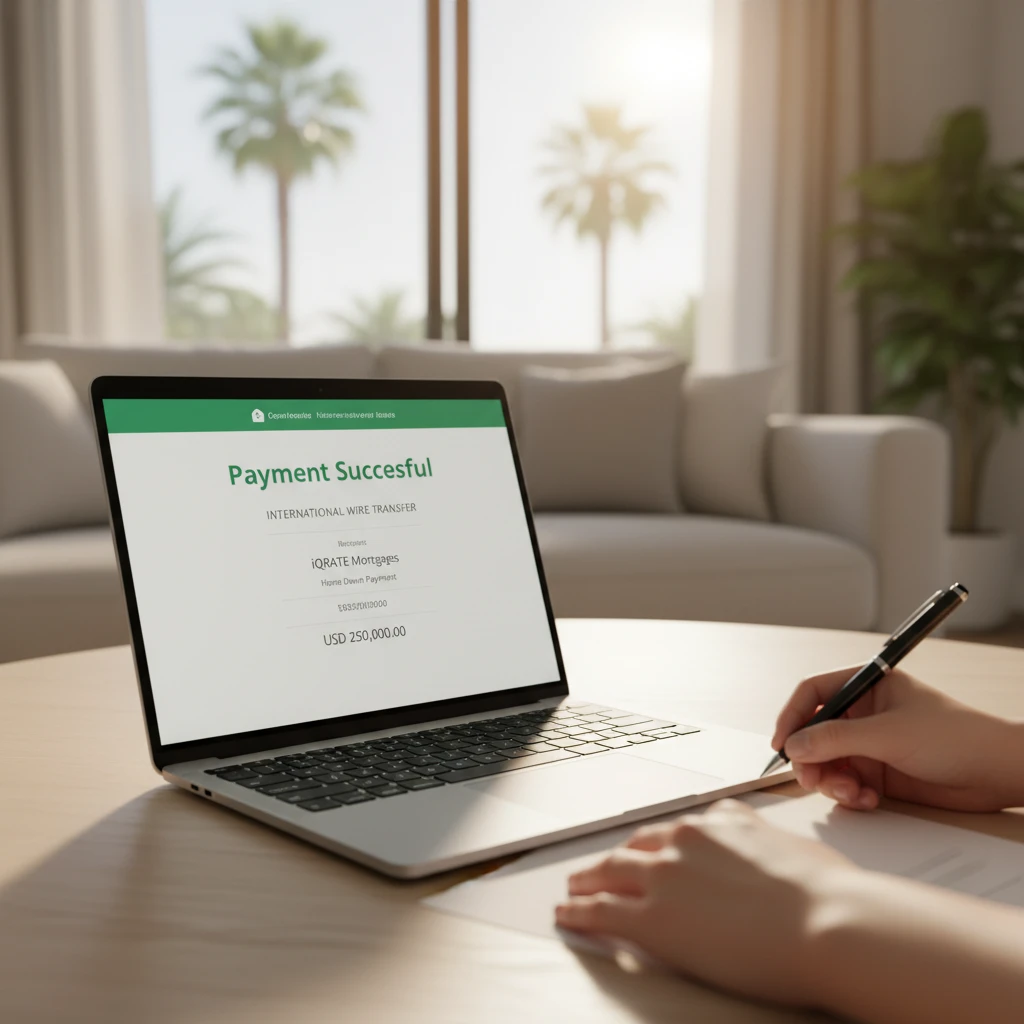
Similarly, if you sold a business, you would need to provide the notarized bill of sale, business asset statements, and corresponding bank records showing the deposit and subsequent transfer.
Documenting a Down Payment Gift from a Foreign Relative
Using a gift from a family member for a portion or all of your down payment is permissible, but it is subject to strict documentation rules, especially when the gift originates from a foreign source. The lender's primary goal is to confirm that the money is a true gift and not a disguised loan that would affect your debt-to-income ratio.
The Gift Fund Checklist
To ensure acceptance, you must provide the following:
- A Signed Gift Letter: This is a formal letter from the donor that must include their name, address, and relationship to you; the exact dollar amount of the gift; and a clear, unequivocal statement that the funds are a gift with no expectation of repayment.
- Proof of the Donor's Ability to Give: The donor must provide their own bank statements showing they had the funds available to give. This proves the money is theirs and is also properly sourced.
- A Clear Paper Trail: You must document the transfer of funds. The ideal method is a direct wire transfer from the donor's foreign account to your U.S. account. You will need to provide receipts for this transaction.
The donor's funds must meet the same sourcing and seasoning requirements as your own. Lenders will scrutinize the donor's account history to ensure the gift money didn't suddenly appear from an unknown source.
How Lenders Verify Foreign Asset Statements
Lenders have established protocols to verify the authenticity of foreign financial documents. They do not simply take them at face value, particularly in the luxury market of Palm Beach where jumbo loans are common.
Verification methods include:
- Third-Party Verification Services: Many lenders use specialized international services that can verify the existence and standing of foreign banks and authenticate the documents provided.
- Public Records and Bank Directories: Underwriters will check if the foreign financial institution is a legitimate, recognized entity. Statements from small or obscure banks may trigger additional requests for information.
- Consistency Checks: They cross-reference all the documents you provide. The names, addresses, and account numbers must be perfectly consistent across bank statements, wire transfers, and gift letters. Any discrepancy can cause a delay.
- Apostille or Embassy Certification: In some cases, a lender may require that key documents, like a proof of asset ownership, be certified by a government entity in the home country through an apostille or verified at a U.S. embassy.
Can Cryptocurrency Be Used for a Down Payment?
Directly using cryptocurrency like Bitcoin or Ethereum for a down payment is not currently accepted by virtually any U.S. mortgage lender. The primary issues are its price volatility and the difficulty in tracing its origin, which conflicts directly with the anti-money-laundering regulations lenders must follow.
However, you can use the proceeds from the sale of cryptocurrency if you follow a strict conversion and seasoning process. To do so, you must:
- Liquidate the Assets: Sell your cryptocurrency on a reputable exchange for a fiat currency, such as U.S. dollars.
- Document the Sale: Keep detailed records of the transaction, showing the amount of crypto sold, the exchange rate, and the total cash proceeds.
- Deposit into a Bank Account: Transfer the full cash amount into a traditional, verifiable bank account in your name.
- Season the Funds: Leave the money in that account for at least 60-90 days, and likely longer for a jumbo loan. You must provide the lender with a full paper trail, from the crypto exchange to the bank account, and the subsequent bank statements showing the funds remaining untouched.
Even with this process, some conservative lenders may still be hesitant. Full transparency is your best strategy.
Common Red Flags That Delay Foreign Fund Verification
Navigating the verification process for foreign funds can be smooth if you know what to avoid. Here are the most common red flags that cause underwriters to pause an application and request more information, leading to frustrating and costly delays:
- Large, Unseasoned Deposits: A significant sum of money appearing in your account within the last 60-90 days without a clear source (e.g., payroll, asset sale) is the biggest red flag.
- Funds Moved Through Multiple Accounts: Transferring money between several different accounts or countries before it lands in your U.S. account can look like 'layering', a technique used to obscure the original source of funds.
- Inconsistent Naming Conventions: Minor variations in how your name is spelled or listed across different documents can create doubt and require additional letters of explanation.
- Untranslated or Uncertified Documents: Submitting documents in a foreign language without a certified English translation is an automatic rejection.
- Use of Third-Party Payment Systems: Using services that are not traditional banks makes the paper trail much harder to follow.
- Funds from OFAC-Restricted Countries: Attempting to source funds from a country on the U.S. Office of Foreign Assets Control (OFAC) sanctions list will result in an immediate denial.
- Cash Deposits: Any deposit noted as 'cash' on your bank statements will be heavily scrutinized and may need to be excluded from the funds you can use for closing. Navigating the complexities of foreign funds for a jumbo loan requires expert guidance. If you're planning to buy in Miami or Palm Beach, partnering with a mortgage strategist who understands international finance can ensure a smooth process. A specialist can help you prepare your documentation correctly from the start, preventing last-minute surprises.
Ready to navigate the complexities of securing a jumbo loan with foreign funds? Our experienced team can guide you through every step of the documentation process. Apply now to begin your journey toward homeownership in Miami or Palm Beach.
Author Bio
David Ghazaryan is the expert mortgage strategist and founder behind iQRATE Mortgages. With a mission to fund home loans that traditional banks won't touch, David specializes in helping clients with unique financial situations, including those recovering from foreclosure or bankruptcy. He expertly crafts smart, strategic, and stress-free mortgages by leveraging a vast network of over 100 lenders to secure competitive rates for investors and homebuyers alike. Praised for exceptional customer service, David has helped hundreds of families with a 97% satisfaction rate, guiding them to the mortgage they deserve.
References









