


What is the True Minimum Down Payment for a Conventional Home Loan?
The longstanding advice to save 20% for a down payment is one of the biggest obstacles preventing hardworking people from becoming homeowners. While a 20% down payment helps you avoid Private Mortgage Insurance (PMI), it is not a requirement to secure a conventional mortgage. For decades, government-sponsored enterprises like Fannie Mae and Freddie Mac have created programs to make homeownership more accessible.
Today, most creditworthy borrowers can qualify for a conventional loan with as little as 3% to 5% down. These are not subprime or risky loans; they are standard, high-quality mortgage products designed for the modern homebuyer.
Here are the most common low down payment conventional loan options:
- Conventional 97 Loan: This Fannie Mae program allows a 3% down payment. While some 3% down programs are designed for first-time homebuyers, Fannie Mae's standard 3% down option is available to all qualifying homebuyers purchasing a primary residence.
- Freddie Mac Home Possible®: This program requires only a 3% down payment and is geared toward low- to moderate-income borrowers. It offers flexible credit terms and reduced mortgage insurance coverage levels.
- Fannie Mae HomeReady®: Similar to Home Possible, HomeReady is another 3% down payment option designed for creditworthy, low- to moderate-income buyers. It also allows for more flexibility with co-borrowers who do not live in the home, like a parent.
- Standard 5% Down Conventional Loan: If you do not qualify for the 3% down programs, the standard minimum for a conventional loan is just 5% down. This is available to all borrowers, including repeat buyers, and doesn't have the income limitations of the HomeReady and Home Possible programs.
These programs make it possible to enter the competitive real estate markets of Austin and Dallas years sooner than you might think.
How Much Does Private Mortgage Insurance Actually Cost in Austin?
Private Mortgage Insurance (PMI) is the tool that makes low down payment loans possible for lenders. It is an insurance policy that protects the lender, not you, in case you default on the loan. It is required on conventional loans when you put down less than 20%. (The data, information, or policy mentioned here may vary over time.)
Many potential buyers overestimate the cost of PMI. The actual monthly premium is based on three primary factors:
- Your Credit Score: A higher credit score results in a lower PMI rate.
- Your Down Payment Percentage: A 10% down payment will have cheaper PMI than a 3% down payment.
- Your Loan Amount: The premium is a percentage of the total loan.

PMI is not a permanent cost. It automatically terminates once your loan balance drops to 78% of the original home value. You can also request to have it removed once you reach 20% equity through a combination of your mortgage payments and home appreciation.
Example: Calculating PMI in Austin
Let's imagine you are buying a home in a competitive Austin neighborhood for $450,000.
- Down Payment (5%): $22,500
- Loan Amount: $427,500
- Credit Score: 740 (Very Good)
With these figures, your monthly PMI premium would likely be between $180 and $250 per month. While this is an added expense, compare it to the cost of waiting. If that same $450,000 home appreciates by 5% in one year, its value will increase by $22,500. By buying now, you have captured that equity, which far outweighs the annual cost of your PMI.
What Are the Credit Score Requirements for a Low Down Payment Mortgage?
To qualify for a conventional loan with a low down payment, lenders generally look for a minimum credit score of 620. However, this is the floor, not the target. A higher credit score will unlock significant savings. (The data, information, or policy mentioned here may vary over time.)
A score above 720-740 is considered excellent and will give you access to the best possible interest rates and the lowest PMI premiums. If your score is in the 620-680 range, you can still qualify, but you should expect to pay a slightly higher interest rate and a more expensive PMI premium. This is because lenders use a risk-based pricing model, where a lower score indicates a higher risk of default.
Before applying for a mortgage, it is wise to check your credit report for errors, pay down high-balance credit cards, and avoid opening any new lines of credit. Even a 20-point increase in your score can translate into thousands of dollars saved over the life of your loan.
How Does a Smaller Down Payment Affect My Mortgage Interest Rate?
Your down payment percentage is one of several factors that influence your final mortgage interest rate. Lenders use a system called Loan-Level Price Adjustments (LLPAs), which are set by Fannie Mae and Freddie Mac. LLPAs are essentially fees that adjust your rate based on risk factors, including your down payment and credit score.
A loan with a 5% down payment is considered slightly riskier than a loan with a 25% down payment. As a result, the LLPA will be higher, which may translate to an interest rate that is 0.125% to 0.375% higher. While this seems significant, the real-world impact on your monthly payment is often manageable. (The data, information, or policy mentioned here may vary over time.)
For example, on a $400,000 loan, a 0.25% rate increase amounts to roughly $60 per month. For many buyers, paying an extra $60 per month is a small price to pay to get into a home and start building equity immediately, rather than waiting years to save more money while home prices continue to climb.
Can I Compete with Offers in Dallas if I Don't Put 20% Down?
In a hot market like Dallas, buyers worry that a low down payment offer will be seen as weak. This is another persistent myth. To a seller, the down payment amount is largely irrelevant. The seller receives the full purchase price at closing, regardless of whether your down payment was 3% or 30%.
What sellers really care about is the certainty that the deal will close. A strong offer is defined by:
- A Solid Pre-Approval Letter: A pre-approval from a reputable lender shows the seller you are a serious, qualified buyer whose financing is secure.
- A Clean Offer: Minimizing contingencies (like demanding the seller make minor repairs) makes your offer more attractive.
- A Responsive Team: Working with an experienced real estate agent and lender who can communicate effectively and close on time is critical.
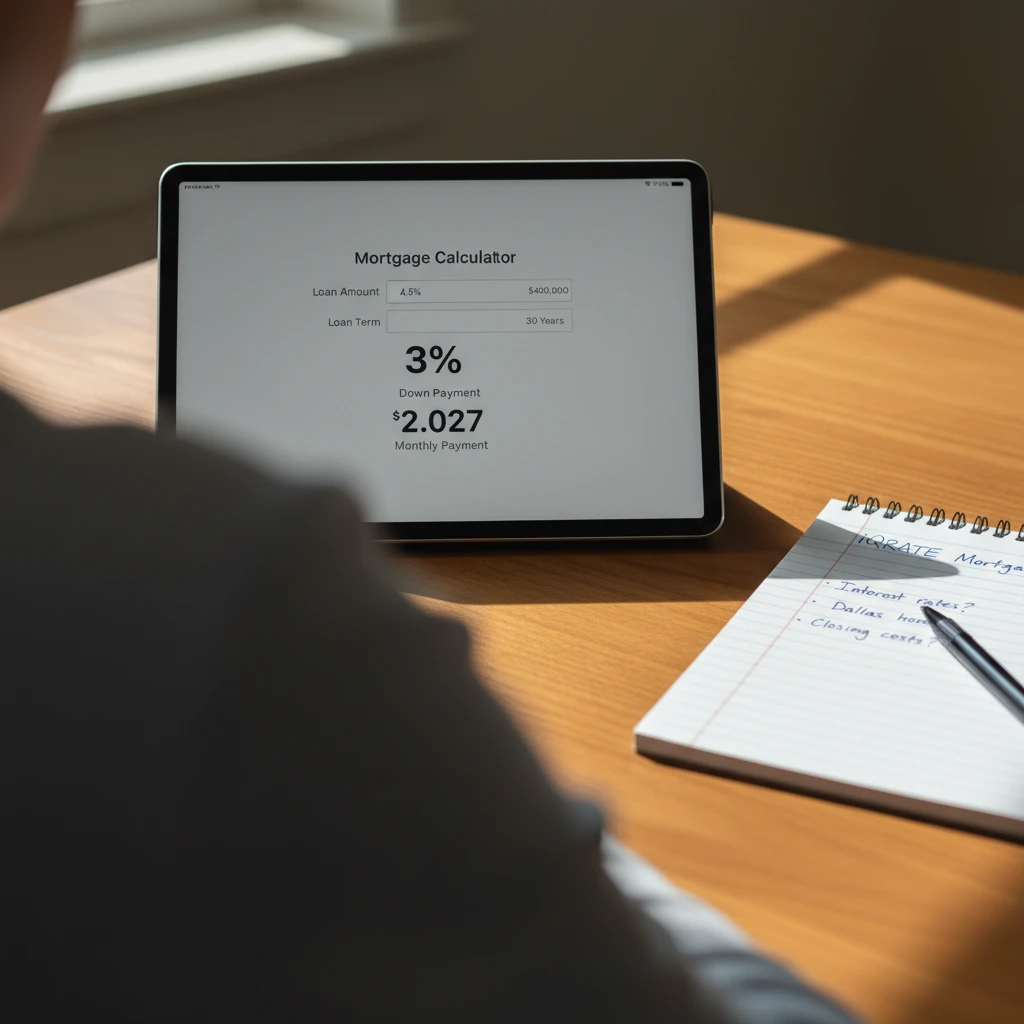
An offer with 5% down from a buyer with a rock-solid pre-approval is often stronger than an offer with 20% down from a buyer whose financing seems uncertain. Do not let your down payment size discourage you from making a competitive offer on your dream home in Dallas.
How Do I Calculate the Cost of Waiting to Save Versus Buying Now?
Waiting to save a 20% down payment can be a costly financial mistake due to two main factors: home price appreciation and rent payments.
Let's run a scenario for a potential homebuyer in Dallas:
- Target Home Price Today: $400,000
- Current Rent: $2,200 per month
- Savings Rate: $1,500 per month
- Annual Home Price Appreciation (Conservative Estimate): 4%
Option 1: Buy Now with 5% Down
- Down Payment: $20,000
- Loan Amount: $380,000
- You stop paying rent and start building equity immediately.
- After one year, your home is worth $416,000. You have gained $16,000 in appreciation, plus the principal you've paid down.
Option 2: Wait 4 Years to Save 20%
- Target 20% Down Payment: To buy that $400,000 home, you need $80,000. It would take you over four years to save this amount.
- Rent Paid Over 4 Years: $2,200 x 48 months = $105,600 (This money is gone forever).
- Future Home Price: In four years, that $400,000 home, appreciating at 4% annually, will now cost approximately $468,000.
- New 20% Down Payment Target: You now need $93,600 for a 20% down payment, so you have to save even longer.
In this scenario, waiting cost you over $100,000 in rent and forced you to chase a moving target as home prices increased. The cost of PMI in the first scenario pales in comparison to the financial loss incurred by waiting.
Are There Programs to Help with My Down Payment and Closing Costs?
Yes. Many state and local agencies offer Down Payment Assistance (DPA) programs to help homebuyers overcome the initial cash hurdle. In Texas, the Texas Department of Housing and Community Affairs (TDHCA) offers several programs, such as 'My First Texas Home' and 'My Choice Texas Home'.
These programs typically provide a grant or a silent second mortgage to cover your down payment and/or closing costs. While some have income and purchase price limits, they are a fantastic resource for first-time buyers. A knowledgeable mortgage advisor can help you determine if you qualify and which program best fits your financial situation. (The data, information, or policy mentioned here may vary over time.)
When Is It Financially Better to Make a Larger Down Payment?
Despite the benefits of buying with a low down payment, there are situations where putting down 20% or more is the smarter move.
- You Have Ample Savings: If you can comfortably make a 20% down payment while still retaining a healthy emergency fund (3-6 months of living expenses) and funds for closing costs and moving, then it is a great option.
- You Want the Lowest Possible Payment: A larger down payment reduces your loan amount and eliminates PMI, resulting in the lowest possible monthly mortgage payment.
- You Are Buying a High-Priced Home: On a jumbo loan (a loan that exceeds conventional loan limits), lenders often require a larger down payment of 10-20% or more. (The data, information, or policy mentioned here may vary over time.)
- You Want to Lower Your Debt-to-Income Ratio: If you are trying to qualify for a larger home, a bigger down payment reduces the loan size and can help your debt-to-income ratio fall within qualifying guidelines.
The decision ultimately comes down to a personal financial analysis. It is not just about avoiding PMI; it is about deploying your capital in the most effective way to achieve your long-term goals. The 20% down payment myth shouldn't hold you back from homeownership in Texas. To understand your specific options and see how little you might need to buy a home in Austin or Dallas, consult with a mortgage expert who can analyze your full financial picture.
Ready to explore your homeownership options in Texas without the 20% down payment myth holding you back? Find out how much you can afford and what programs you qualify for. Apply now to get a clear picture of your financial power.
Author Bio
David Ghazaryan is the expert mortgage strategist and founder behind iQRATE Mortgages. With a mission to fund home loans that traditional banks won't touch, David specializes in helping clients with unique financial situations, including those recovering from foreclosure or bankruptcy. He expertly crafts smart, strategic, and stress-free mortgages by leveraging a vast network of over 100 lenders to secure competitive rates for investors and homebuyers alike. Praised for exceptional customer service, David has helped hundreds of families with a 97% satisfaction rate, guiding them to the mortgage they deserve.
References
CFPB - What is private mortgage insurance (PMI)?









