


What are the standard income history rules for a Veteran Affairs loan in Reno?
For most mortgage types, including VA loans, lenders look for a stable and predictable income stream. The standard guideline for self-employed individuals is a minimum of two years of business history. Lenders typically verify this by reviewing your last two years of federal income tax returns. This two-year lookback period allows them to calculate an average monthly income and confirm that the business is not just a temporary venture but a sustainable enterprise.
For a veteran entrepreneur looking to buy a home in Reno, this 'rule' can feel like a major roadblock. If you launched your business 18 months ago, an automated underwriting system at a large bank will likely reject your application outright. However, it's critical to understand that this is a guideline, not a law. The Department of Veterans Affairs allows for exceptions, especially when a strong case can be made for the business's future success and the borrower's expertise in their field. The key is finding a lender willing to perform a manual underwrite and assess your entire financial profile, not just the age of your business.
How can my prior military experience substitute for a longer work history?
This is where your service record becomes a powerful asset in your mortgage application. The VA understands that skills acquired in the military are highly transferable to the civilian workforce. If your new business operates in a field directly related to your Military Occupational Specialty (MOS), a lender can consider your time in service as relevant work experience.
This creates a narrative of continuous employment and expertise in your chosen field. For example:
- IT Specialist: A veteran who spent six years in the Army Signal Corps managing network infrastructure and now runs a successful IT consulting firm in Sparks. The lender can view this as a continuation of their career, not a brand-new endeavor.
- Logistics Manager: A Navy veteran who managed supply chain logistics for their unit and now owns a trucking and logistics company. Their military background directly proves their capability to run the business successfully.
- Mechanic: An Air Force veteran who serviced aircraft and now owns an auto repair shop in Reno. Their hands-on experience is a direct substitute for a two-year business history.
To make this case effectively, you'll need to provide your DD Form 214 and a letter of explanation detailing how your military duties provided the foundational experience for your current business. This helps the underwriter connect the dots and justify approving the loan despite the business being less than two years old.
What documents are needed to prove my new business is stable and profitable?
When you have less than two years of tax returns, the burden of proof shifts to showing current and projected stability. You must paint a clear picture of a healthy, growing business. Lenders in Reno and Sparks will require a comprehensive set of documents to manually underwrite your file. Vague or incomplete paperwork will lead to a denial.

Business Formation and Licensing
You must provide documents proving your business is legitimate and compliant with state and local regulations. This includes:
- Articles of Organization/Incorporation: Shows the legal structure of your business (LLC, S-Corp, etc.).
- Business Licenses: Any city, county, or state licenses required to operate in Nevada.
- Fictitious Business Name Statement: If you operate under a DBA ('doing business as').
Financial Documentation
This is the most critical part of your application. Since you don't have a two-year history, your current financials must be impeccable.
- Most Recent Federal Tax Return: Even if you only have one year filed as a self-employed individual, it's required. The lender will analyze your Schedule C (for sole proprietors) or business return (1120-S for S-Corps, 1065 for partnerships).
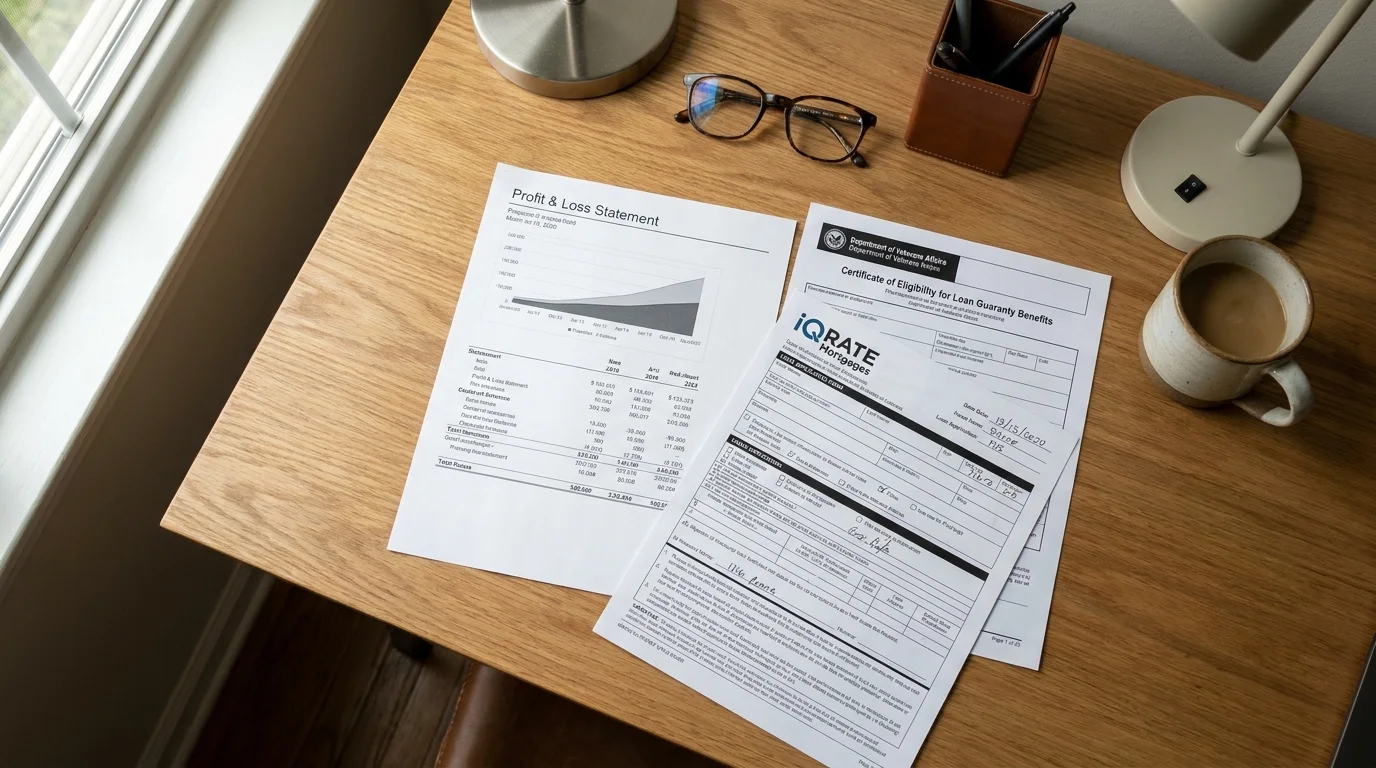
- Year-to-Date Profit and Loss (P&L) Statement: This document shows your company's revenues and expenses over a specific period, such as from January 1st to the current date. It must be detailed and accurate.
- Current Balance Sheet: This provides a snapshot of your company's financial health, listing its assets, liabilities, and owner's equity.
- Business Bank Statements: At least 12 months of statements may be requested to show consistent cash flow and verify the income reported on your P&L. (The data, information, or policy mentioned here may vary over time.)
Will a Sparks lender require a Profit and Loss Statement and Balance Sheet?
Yes, absolutely. For a self-employed borrower with less than two years of business history, the P&L and balance sheet are non-negotiable requirements for any lender in Sparks, Reno, or anywhere else in the country. The two-year tax return rule exists to give underwriters a simple way to average your income. Without that two-year history, the P&L and balance sheet are the only tools they have to evaluate your business's current performance and viability.
A lender will scrutinize your year-to-date P&L to see if your income is consistent or increasing. They want to ensure the business is not failing and that the income you claim can be sustained. For example, if your single filed tax return showed an average of $8,000 per month in net income, your P&L for the current year should support a similar or higher figure. If it shows income has dropped to $4,000 per month, your application will likely be denied.
Does a larger down payment help offset the risk of a short business history?
While the hallmark of the VA loan is the option for 100% financing (zero down payment), making a voluntary down payment can significantly strengthen your application. For a lender, a newer business represents a higher risk. A down payment helps mitigate that risk in several ways:
- Reduces the Loan-to-Value (LTV) Ratio: A lower LTV is always less risky for the lender. If you were to default, they would have a better chance of recouping their investment.
- Demonstrates Financial Discipline: It shows you have 'skin in the game' and are a responsible saver, which reflects positively on your overall financial profile.
- Shows Cash Reserves: Having enough capital for a down payment implies you also have reserves to handle business downturns without immediately jeopardizing your ability to pay the mortgage.
Consider a home purchase in Reno for $550,000. A 5% down payment ($27,500) might be the deciding factor that gives an underwriter the confidence to approve your loan, even with only 16 months of business history.
Are there lenders who specialize in VA loans for entrepreneurs?
Yes, but they are not always the big-name national banks. Many large institutions rely heavily on automated underwriting systems (AUS) that automatically flag applications that don't meet the standard two-year guideline. These systems are designed for efficiency, not for nuance.
The best lenders for veteran entrepreneurs are often those that embrace manual underwriting. This is a hands-on process where a human underwriter reviews every document and considers the complete story behind your application. Mortgage brokers are particularly valuable here, as they work with a wide network of wholesale lenders, including those who are more flexible and experienced with complex income situations like yours. They know which lenders have a proven track record of approving VA loans for self-employed veterans with shorter business histories.
Can I use a business bank statement loan instead of a traditional VA loan?
A business bank statement loan is a viable alternative, but it should be considered a secondary option if you can qualify for a VA loan. These are non-qualified mortgage (Non-QM) products designed for self-employed borrowers who cannot document their income through tax returns.
How Bank Statement Loans Work
Instead of tax returns, lenders use 12 or 24 months of your business bank statements to determine your income. They will add up all the deposits and then apply an 'expense factor' (typically around 50%, depending on the industry) to calculate a qualifying monthly income. (The data, information, or policy mentioned here may vary over time.) This is a powerful tool if you have high revenue but also high tax-deductible expenses that reduce your net income on paper.
VA Loan vs. Bank Statement Loan: Key Differences
Here is a simple comparison for a home purchase in Sparks:
- Down Payment:
- VA Loan: 0% typically required.
- Bank Statement Loan: 10% - 20% is standard. (The data, information, or policy mentioned here may vary over time.)
- Interest Rates:
- VA Loan: Among the most competitive rates available.
- Bank Statement Loan: Rates are higher to compensate for the increased risk.
- Funding Fee:
- VA Loan: A one-time VA Funding Fee is required (can be financed), but veterans with a service-connected disability are exempt.
- Bank Statement Loan: No funding fee, but the higher interest rate persists for the life of the loan.
- Credit Score:
- VA Loan: Generally more lenient credit requirements. (The data, information, or policy mentioned here may vary over time.)
- Bank Statement Loan: Stricter credit score minimums often apply. (The data, information, or policy mentioned here may vary over time.)
Ultimately, the VA loan offers superior financial benefits. It's almost always worth the effort to gather the necessary P&L, balance sheets, and other documentation to qualify for your VA home loan benefit before resorting to a bank statement program. If you're a veteran entrepreneur in Nevada navigating the VA loan process with a new business, understanding your options is the first step. A mortgage strategist can review your unique financial picture and connect you with lenders who see your potential, not just your timeline.
Your journey as a veteran entrepreneur is unique, and your mortgage application should reflect that. Connect with a strategist who understands how to leverage your military background and new business for a VA loan. Ready to see where you stand? Apply now to get a personalized assessment.
Author Bio
David Ghazaryan is the expert mortgage strategist and founder behind iQRATE Mortgages. With a mission to fund home loans that traditional banks won't touch, David specializes in helping clients with unique financial situations, including those recovering from foreclosure or bankruptcy. He expertly crafts smart, strategic, and stress-free mortgages by leveraging a vast network of over 100 lenders to secure competitive rates for investors and homebuyers alike. Praised for exceptional customer service, David has helped hundreds of families with a 97% satisfaction rate, guiding them to the mortgage they deserve.
References
U.S. Department of Veterans Affairs - VA Lender's Handbook Chapter 4









