


Does Creating an S-Corporation Restart My Two-Year History?

This is the single biggest fear for self-employed borrowers in California, and the answer is a relieving 'no', provided you handle the transition correctly. Mortgage lenders are required to verify a minimum of two years of stable, predictable income. When you switch from a sole proprietorship to an S-Corporation, they don't see you as starting a brand-new venture. Instead, they view it as a change in the legal structure of an existing, ongoing business.

The key concept for underwriters is continuity. As long as you can prove that the S-Corporation is a direct continuation of the sole proprietorship, your history remains intact. The burden of proof is on you, the borrower, to connect the dots for the lender with clear and concise documentation.

What Lenders Consider Continuity

To satisfy an underwriter, the business must demonstrate consistency across three core areas:

  • Ownership: You must have been the 100% owner of the sole proprietorship and maintain majority ownership (typically 51% or more) of the new S-Corporation. (The data, information, or policy mentioned here may vary over time.)
  • Industry and Services: The nature of the business cannot fundamentally change. If you were a freelance marketing consultant in Los Angeles operating as a sole proprietor and then formed an S-Corp to continue that same work, you have continuity. If you closed your marketing business and opened a bakery in Long Beach, that is a new business, and the two-year clock would restart.
  • Operations: The business should continue serving the same or a similar client base with the same products or services. A name change is acceptable, but a complete pivot in your business model is not.

How to Document Your Income During the Transition

Flawless documentation is non-negotiable. Your goal is to present a paper trail so clear that the underwriter can easily follow your income from the old entity to the new one. Haphazard records can lead to delays or even denial. You will need to provide more paperwork than a standard W-2 employee.

Self-employed professional organizing financial documents for a mortgage application.

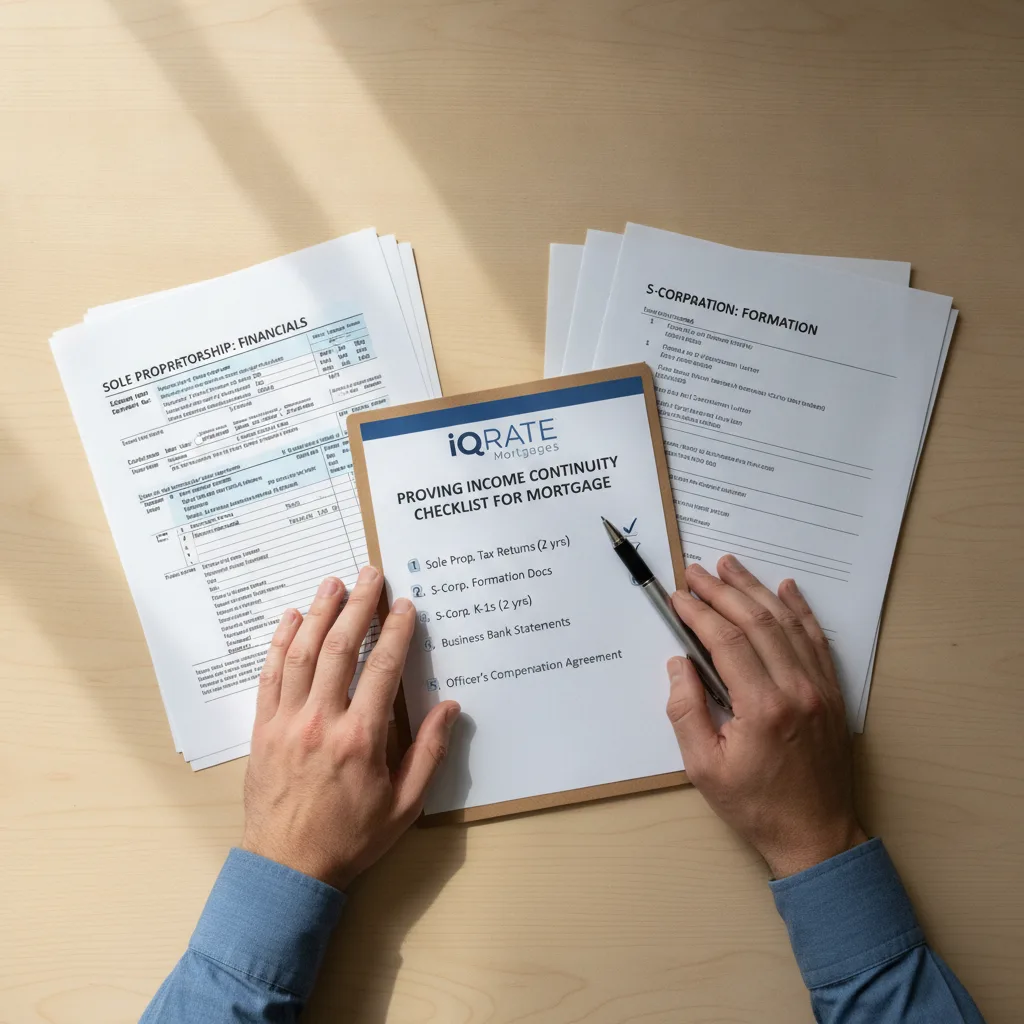
Here is a checklist of the essential documents you'll need to gather:

  • Tax Returns (Two Most Recent Years): This includes your full personal tax returns (Form 1040) and all associated schedules. This will show your final Schedule C from the sole proprietorship and the new income from the S-Corp.
  • Business Tax Returns: You will need the most recent S-Corporation tax return (Form 1120-S) and its corresponding Schedule K-1, which details your share of the company's profits or losses.
  • Proof of S-Corp Income: Provide your most recent pay stubs from the S-Corp and your W-2 for the previous year if applicable.
  • Year-to-Date Profit & Loss (P&L) Statement: The lender will require a current P&L, typically for the most recent quarter. It should be prepared by a third-party accountant, as self-prepared statements carry less weight. (The data, information, or policy mentioned here may vary over time.)
  • Business Bank Statements: Provide statements for the last 6-12 months for both the old sole proprietorship account and the new S-Corporation account to show consistent cash flow. (The data, information, or policy mentioned here may vary over time.)
  • Corporate Documents: Include a copy of your Articles of Incorporation and a letter from your CPA or a personal letter of explanation detailing the date and reason for the business structure change.

What Underwriters Look For to See Income Continuity

Underwriters are trained to identify risk. When they see a change in business structure, their primary objective is to confirm that the income is just as stable as it was before. They are looking for a seamless financial story.
Mortgage underwriter reviewing a loan application for income continuity.

Key Green Flags for Underwriters:

  • Consistent Revenue: The combined income from the sole proprietorship in one year and the S-Corp in the next should be stable or, ideally, increasing. A significant, unexplained drop in revenue during the transition is a major red flag.
  • Clean Separation of Funds: They will scrutinize bank statements to ensure you are not co-mingling personal and business funds. The S-Corp structure requires this separation, and adhering to it demonstrates financial discipline.
  • Identical Ownership: The name on the Schedule C must match the majority shareholder on the K-1. Any changes in ownership structure need to be explained and documented.
  • Logical Timing: The end date of the sole proprietorship's operations should align perfectly with the start date of the S-Corporation. Overlapping dates or significant gaps can create confusion and require detailed explanations.

Should I Wait to Apply for a Mortgage After Changing Entities?

There is no universal rule, but strategy is key. Applying immediately after forming an S-Corp is possible if your documentation is impeccable and your income is strong. However, waiting can sometimes make the process smoother.

  • Applying Soon After Transition: This is feasible if you have a strong history and can provide a detailed letter of explanation and a robust, accountant-prepared P&L. This might be necessary in a competitive housing market like Los Angeles, where waiting could mean missing out on a property.
  • Waiting for the Next Tax Filing: The simplest path is often to wait until you have filed at least one full-year tax return (Form 1120-S) for the S-Corporation. This provides the underwriter with the cleanest possible picture of the company's annual performance and your corresponding income, leaving little room for interpretation.

Ultimately, the decision depends on your financial stability, the quality of your records, and your urgency. Consulting with a mortgage advisor who specializes in self-employed borrowers can help you time your application perfectly.

How Lenders Calculate Your New Salary and Distributions

Lenders will use a combination of your W-2 salary and the net distributable income from the S-Corporation to determine your qualifying income. They will average this income over a 24-month period, looking at both the old and new business structures.

Here’s a simplified example:

  • Year 1 (as a Sole Proprietor): Your Schedule C shows a net profit of $180,000.
  • Year 2 (as an S-Corporation): You paid yourself a W-2 salary of $80,000. The S-Corp's net income on the 1120-S was $110,000, which flows to you via the K-1. Your total income for Year 2 is $80,000 + $110,000 = $190,000.

The Lender's Calculation:

  1. Total 24-Month Income: $180,000 (Year 1) + $190,000 (Year 2) = $370,000
  2. Average Monthly Income: $370,000 / 24 months = $15,416

This is your qualifying monthly income for the mortgage. Important note: If your income declined from Year 1 to Year 2, the lender would likely use the lower, more recent income as the basis for their calculation to be conservative.

Providing Tax Returns for Both Old and New Businesses

Yes, this is mandatory. You cannot simply provide your new S-Corp returns and expect approval. The lender must analyze a full 24-month period to meet federal lending guidelines. The final Schedule C from your sole proprietorship establishes the income baseline, and the new 1120-S and K-1 demonstrate that the income continued after the legal change. Think of it as two halves of one continuous story. Omitting one half leaves the underwriter with an incomplete picture and no choice but to deny the loan.

Is a Bank Statement Loan a Better Option in This Scenario?

A bank statement loan can be an excellent alternative for some self-employed borrowers. Instead of analyzing tax returns, these non-QM (Non-Qualified Mortgage) loans use 12 or 24 months of business bank statements to verify income. They calculate your qualifying income based on the average monthly deposits.

When a Bank Statement Loan Makes Sense:

  • High Write-Offs: If your tax returns show low net income due to aggressive but legal business deductions, a bank statement loan can reflect your true cash flow more accurately.
  • Recent Transition: If you just switched to an S-Corp and don't have the tax documents ready, but your business bank account shows strong, consistent deposits, this could be your path to homeownership.
  • Complex Income: If your income structure is unusually complex, a bank statement program can be more forgiving.

The Trade-Offs: Bank statement loans typically require a larger down payment (often 20% or more) and come with higher interest rates compared to conventional loans. (The data, information, or policy mentioned here may vary over time.) However, for a business owner in Long Beach looking to buy now, they offer a viable and powerful financing solution.

Partnering with Your Accountant for a Smoother Application

Your accountant is a key player on your home-buying team. Proactive communication with them is crucial. Before you apply for a mortgage, sit down with your CPA and discuss these points:

  • 'Set a Reasonable Salary': Instruct them to help you establish a W-2 salary from your S-Corp that is reasonable for your industry and position. A salary that is too low can be a red flag, even if K-1 distributions are high.
  • 'Maintain Consistent Payroll': Run payroll consistently (e.g., bi-weekly or monthly). This demonstrates stability to lenders, who prefer predictable income patterns.
  • 'Prepare a Letter of Explanation': Ask them to draft a brief letter on company letterhead confirming the date of the business structure change and stating that the business's nature and ownership remain the same.
  • 'Generate a Clean P&L': Ensure they can prepare a clean, detailed, and accurate year-to-date P&L statement and balance sheet on short notice, as lenders will almost always request this just before closing. Changing your business structure shouldn't put your homeownership goals on hold. If you're a self-employed professional in California who has recently formed an S-Corporation, it's wise to partner with a mortgage expert who understands the nuances of underwriting your income. A specialist can help you prepare your documentation correctly and present your financial situation in the best possible light.

When you're ready to put this knowledge into practice, the next step is getting a clear view of your options. A carefully prepared application makes all the difference for self-employed professionals. Apply now to begin the pre-approval process with confidence.

Author Bio

David Ghazaryan is the expert mortgage strategist and founder behind iQRATE Mortgages. With a mission to fund home loans that traditional banks won't touch, David specializes in helping clients with unique financial situations, including those recovering from foreclosure or bankruptcy. He expertly crafts smart, strategic, and stress-free mortgages by leveraging a vast network of over 100 lenders to secure competitive rates for investors and homebuyers alike. Praised for exceptional customer service, David has helped hundreds of families with a 97% satisfaction rate, guiding them to the mortgage they deserve.

References

Fannie Mae Selling Guide: B3-3.2-01, Underwriting Factors and Documentation for a Self-Employed Borrower

Consumer Financial Protection Bureau (CFPB): Explore the mortgage process

Get Your Questions Answered With No Obligation Today!

Thank you! Your submission has been received. We will be in touch asap!
Oops! Something went wrong while submitting the form.

FAQ

Will forming an S-Corporation make me restart my two-year work history for a mortgage?
How do lenders define and verify business continuity during this transition?
What documents are required to prove my income after switching to an S-Corp?
How is qualifying income calculated when transitioning from a sole proprietorship to an S-Corp?
What positive signs do underwriters look for in an application after this business change?
Should I apply for a mortgage immediately after forming an S-Corp or wait?
When might a bank statement loan be a good alternative in this scenario?
David Ghazaryan
David Ghazaryan

Smart, Strategic, and Stress-Free Mortgages
- Expertly Crafted by David Ghazaryan

Learn More




