


Short-Term vs. Long-Term Rentals: DSCR Impact in Las Vegas
Choosing between a short-term rental (STR) and a long-term rental (LTR) in a market like Las Vegas significantly influences your Debt Service Coverage Ratio (DSCR) loan eligibility. Lenders analyze these strategies differently.
Long-Term Rentals (LTR): For an LTR, lenders typically use the gross monthly rent from an executed lease agreement. If the property is vacant, they will use a market rent analysis from the appraisal report. This provides a stable, predictable income figure for the DSCR calculation. The formula is straightforward: Gross Annual Rent / Annual PITI (Principal, Interest, Taxes, Insurance) = DSCR. Most lenders look for a ratio of 1.25 or higher. (The data, information, or policy mentioned here may vary over time.)
Short-Term Rentals (STR): For an STR, such as an Airbnb in a tourist-heavy area of Las Vegas, the income is variable. Lenders cannot use your projected income. Instead, they rely on historical data for the specific property or data from third-party sources like AirDNA for comparable properties in the area. They often apply a 'haircut' to the gross income, meaning they might only consider 75-90% of the historical revenue to account for vacancies and operational costs. While an STR can generate higher gross income, the lender's conservative calculation might result in a lower qualifying income than you expect.
An STR in Las Vegas might show a potential gross income of $5,000 per month, while an LTR lease is for $3,000. However, the lender might only qualify the STR based on $3,750 ($5,000 x 75%), making the LTR a more straightforward path to meeting the DSCR requirement.
Are Condominiums a Risk for DSCR Loans?
Condominiums, especially in high-amenity buildings in Las Vegas or Reno, can seem like great hands-off investments. However, they introduce a significant factor that can jeopardize a DSCR loan: high homeowners association (HOA) fees.

When calculating your property's expenses, lenders include the HOA fee alongside taxes and insurance. This is part of the 'I' in your PITI calculation, effectively becoming PITIA (Principal, Interest, Taxes, Insurance, and Association fees). A high monthly HOA fee can inflate your total housing expense and crush your DSCR.
Example:
- Property: A condo in Henderson.
- Gross Monthly Rent: $2,200
- Principal & Interest: $1,800
- Monthly Taxes: $200
- Monthly Insurance: $100
- Monthly HOA Fee: $400
Calculation:
- Total Monthly PITIA: $1,800 + $200 + $100 + $400 = $2,500
- DSCR: $2,200 / $2,500 = 0.88
This DSCR of 0.88 is well below the typical minimum, meaning the loan would be denied. Without the HOA fee, the DSCR would have been $2,200 / $2,100 = 1.05, which is still too low. The HOA fee makes a difficult situation impossible. Investors must carefully vet condos and ensure the rent can comfortably cover all expenses, including steep association dues.
Why a Duplex Might Be the Ideal DSCR Property in Reno
A duplex or other small multi-family property (2-4 units) often represents the sweet spot for DSCR loan investors, particularly in markets like Reno where rental demand is strong.
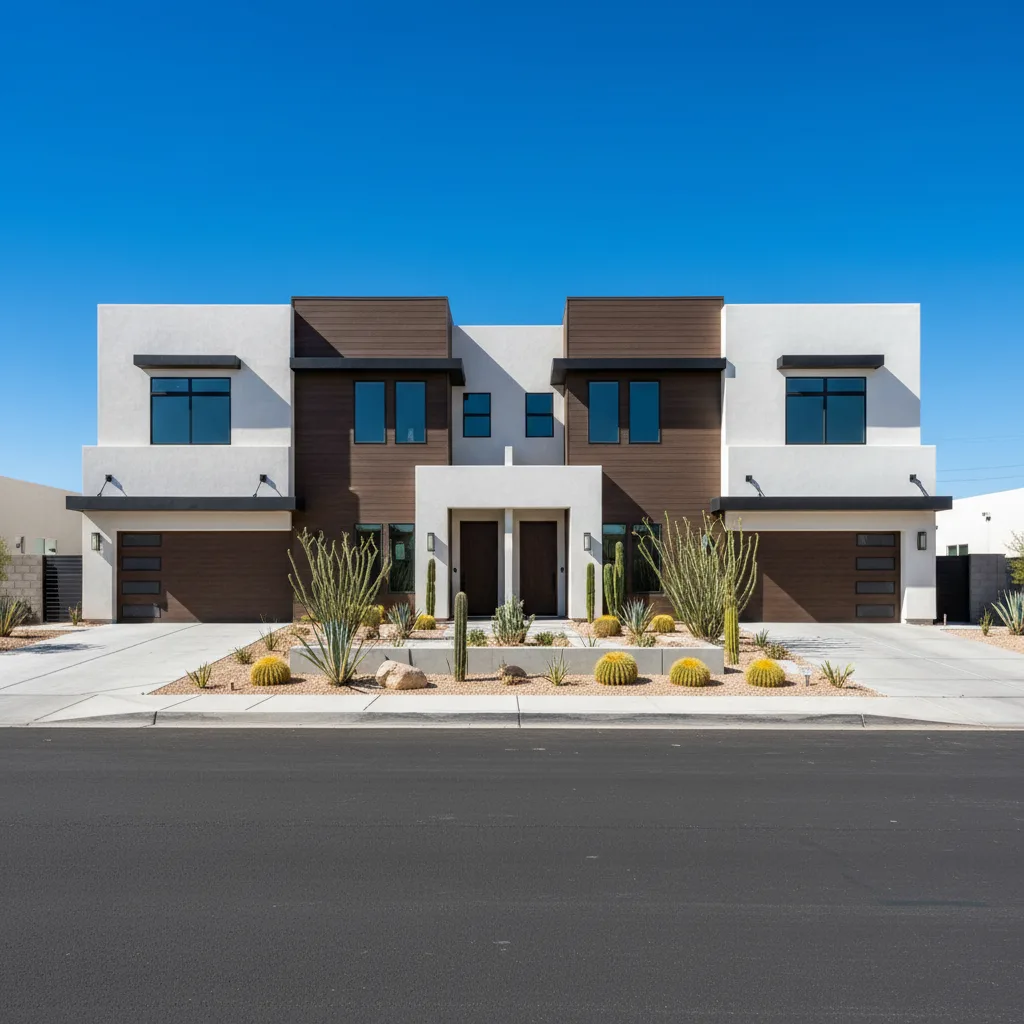
Here’s why a duplex excels:
- Two Income Streams: The most obvious benefit is having two separate rental incomes. This diversifies your risk. If one unit is vacant, you still have 50% of your gross potential rent coming in, which can often be enough to cover the mortgage payment.
- Stronger DSCR: The combined rent from two units typically creates a much healthier DSCR compared to a single-family home with a similar purchase price. The income-to-debt ratio is simply more robust.
- Economies of Scale: You have one roof, one foundation, and one property tax bill for two rental units. While maintenance costs are higher than for a single-family home, they are generally lower than for two separate properties.
For an investor in Reno, purchasing a duplex allows them to achieve a high DSCR, mitigate vacancy risk, and efficiently manage their investment.
How Property Taxes and Insurance Vary and Impact the Ratio
Property taxes and homeowner's insurance are critical components of the DSCR calculation, and they can vary significantly by property type and location.
- Property Taxes: In Nevada, property taxes are based on the assessed value. A new luxury condo in Las Vegas will have a much higher tax bill than an older duplex in Reno, even if their market values are similar. This higher tax burden directly increases your monthly PITI, requiring more rental income to achieve the target DSCR.
- Insurance: Insurance costs also differ. A single-family home may have a standard policy. A condo's policy (an HO-6) is typically cheaper because it only covers the interior, but this is offset by the master policy paid for through HOA fees. A duplex or multi-family property will require a commercial or landlord policy, which can be more expensive and may have different liability coverage requirements. These costs must be accurately quoted and included in your DSCR calculation.
Can I Use a DSCR Loan for a Condo-Hotel Unit?
Generally, the answer is no. Condo-hotels, which are prevalent in Las Vegas, are considered high-risk properties by most lenders, including those offering DSCR loans. These properties operate more like a hotel, with a front desk, rental pool agreements, and restrictions on owner usage. They do not fit the standard residential or multi-family investment property profile that DSCR loan programs are designed for. The income structure is complex, and the property's value is tied to the hotel's operational success, making it an unacceptable risk for most mortgage lenders.
DSCR Loan Requirements for a Small Multi-Family Building
Qualifying for a DSCR loan on a small multi-family building (2-4 units) is very similar to a single-family investment, but with a few key distinctions.
- Higher DSCR Minimum: While some lenders allow a DSCR as low as 1.0 for single-family homes, they may require a higher ratio, such as 1.25 or 1.35, for multi-family properties. (The data, information, or policy mentioned here may vary over time.) This provides an extra cushion against the financial impact of a vacancy.
- Appraisal Schedules: The appraisal will be more detailed. It will include a Comparable Rent Schedule (Form 1007) for each unit to establish market rents, providing a comprehensive view of the property's income potential.
- Experience and Reserves: Some lenders may prefer to see that you have prior landlord experience, although this is not always a firm requirement. They will also verify you have sufficient cash reserves, often requiring 6-12 months of PITI payments in the bank after closing. (The data, information, or policy mentioned here may vary over time.)
Using a DSCR Loan Calculator for Henderson Properties
Before making an offer, you should use a DSCR calculator to model different scenarios. Let’s compare a single-family home and a duplex in Henderson.
Scenario 1: Single-Family Home
- Purchase Price: $450,000
- Down Payment (25%): $112,500
- Loan Amount: $337,500
- Interest Rate: 8.0%
- Monthly P&I: $2,476
- Monthly Taxes: $300
- Monthly Insurance: $120
- Total Monthly PITI: $2,896
- Market Rent: $2,900
- DSCR Calculation: $2,900 / $2,896 = 1.00
This property breaks even and might not qualify with many lenders.
Scenario 2: Duplex
- Purchase Price: $600,000
- Down Payment (25%): $150,000
- Loan Amount: $450,000
- Interest Rate: 8.25%
- Monthly P&I: $3,383
- Monthly Taxes: $400
- Monthly Insurance: $200
- Total Monthly PITI: $3,983
- Market Rent (Unit A + Unit B): $2,500 + $2,500 = $5,000
- DSCR Calculation: $5,000 / $3,983 = 1.26
In this example, the duplex easily meets the 1.25 DSCR threshold, making it a much stronger candidate for a DSCR loan.
Which Property Type Appreciates Fastest While Cash Flowing?
Historically, single-family homes in desirable residential neighborhoods tend to appreciate the fastest. Their value is driven by homeowner demand, school districts, and community amenities. A well-located single-family home in a Henderson suburb, for example, is likely to see stronger percentage-based appreciation than a duplex in an area with a higher concentration of renters.
However, multi-family properties like duplexes are valued based on their income potential (cash flow). While their appreciation might be slower, they often provide superior and more consistent cash flow from day one.
The ideal choice depends on your investment strategy:
- For appreciation: A single-family home in a high-demand area.
- For cash flow: A duplex or small multi-family property.
Ultimately, a successful DSCR investment requires finding a property where the numbers work. Analyzing each property type through the lens of the DSCR formula is the best way to secure financing and build a profitable real estate portfolio.
Ready to see how these strategies apply to your next investment? If you have a property in mind, you can Apply now to get a personalized DSCR analysis and see what's possible.
Author Bio
David Ghazaryan is the expert mortgage strategist and founder behind iQRATE Mortgages. With a mission to fund home loans that traditional banks won't touch, David specializes in helping clients with unique financial situations, including those recovering from foreclosure or bankruptcy. He expertly crafts smart, strategic, and stress-free mortgages by leveraging a vast network of over 100 lenders to secure competitive rates for investors and homebuyers alike. Praised for exceptional customer service, David has helped hundreds of families with a 97% satisfaction rate, guiding them to the mortgage they deserve.
References









