


What Is a Blanket Loan for Multiple Investment Properties in Miami?
A blanket loan, also known as a portfolio mortgage, is a single loan that finances two or more properties simultaneously. Instead of juggling multiple mortgages with different terms and payment dates, an investor can consolidate them into one streamlined financial instrument. This is particularly useful for seasoned investors looking to simplify their operations or unlock equity from their entire portfolio at once.
Imagine an investor owns three cash-flowing condos in Miami's bustling Brickell neighborhood. Each property has a separate mortgage.
- Property 1: $300,000 remaining balance
- Property 2: $250,000 remaining balance
- Property 3: $275,000 remaining balance
Managing three separate payments, escrow accounts, and insurance policies is administratively burdensome. To scale up and purchase a fourth property, the investor could apply for a blanket loan. A lender would appraise all three properties, and if their combined value is, say, $1.5 million, the lender might offer a single loan for $825,000 (the total debt) or a cash-out refinance for up to 75% of the portfolio's value, providing capital for expansion while simplifying the debt structure into one monthly payment. (The data, information, or policy mentioned here may vary over time.)
How Does a Blanket Loan Differ From Multiple DSCR Loans?
While both are tools for real estate investors, their structure, qualification, and strategic uses are fundamentally different. A Debt Service Coverage Ratio (DSCR) loan is an individual mortgage where underwriting focuses on the property's ability to generate enough income to cover its debt obligations, not the borrower's personal income.
Here’s a direct comparison:

Blanket Loan
- Structure: One loan, one monthly payment, one lender for a portfolio of properties.
- Collateral: All properties in the portfolio are cross-collateralized, meaning each property serves as collateral for the entire loan.
- Qualification: Based on the entire portfolio's performance (combined DSCR and LTV), plus the investor's experience and credit.
- Use Case: Best for simplifying management of a stable, mature portfolio or for large-scale equity extraction.
Multiple DSCR Loans
- Structure: Individual loans for each property, resulting in multiple payments and lender relationships.
- Collateral: Each property secures only its own loan. A default on one loan does not automatically trigger a default on the others.
- Qualification: Based on each individual property's DSCR. As long as the rent covers the mortgage payment (typically by a ratio of 1.0 to 1.25 or more), the loan can be approved. (The data, information, or policy mentioned here may vary over time.)
- Use Case: Ideal for acquiring properties one at a time and maintaining the flexibility to sell individual assets without disturbing the financing on others.
Are Interest Rates Typically Higher for Blanket Mortgages in Orlando?
Yes, interest rates for blanket mortgages can be slightly higher than for a conventional investment property loan or even a standalone DSCR loan. Lenders view a blanket loan as a more complex and concentrated risk. If an economic downturn impacts the rental market in Orlando, it could affect the performance of all properties in the portfolio, jeopardizing a single, large loan.
Lenders price for this consolidated risk. However, the rate isn't always higher than all other options. Consider an investor with a mixed portfolio:
- Two high-performing properties in a desirable Orlando suburb.
- One property that is older and has a tighter cash-flow margin.
Financed with individual DSCR loans, the two strong properties might get excellent rates, while the third gets a noticeably higher rate due to its weaker performance. A blanket loan would average this risk out, potentially resulting in a single rate that is higher than the best DSCR loan's rate but lower than the worst one. The final rate depends heavily on the portfolio's aggregate strength, the overall LTV, and the investor's track record.
What Are the Pros and Cons of a Single Portfolio Loan?
Opting for a blanket mortgage is a significant strategic decision with clear advantages and disadvantages that every investor must weigh.
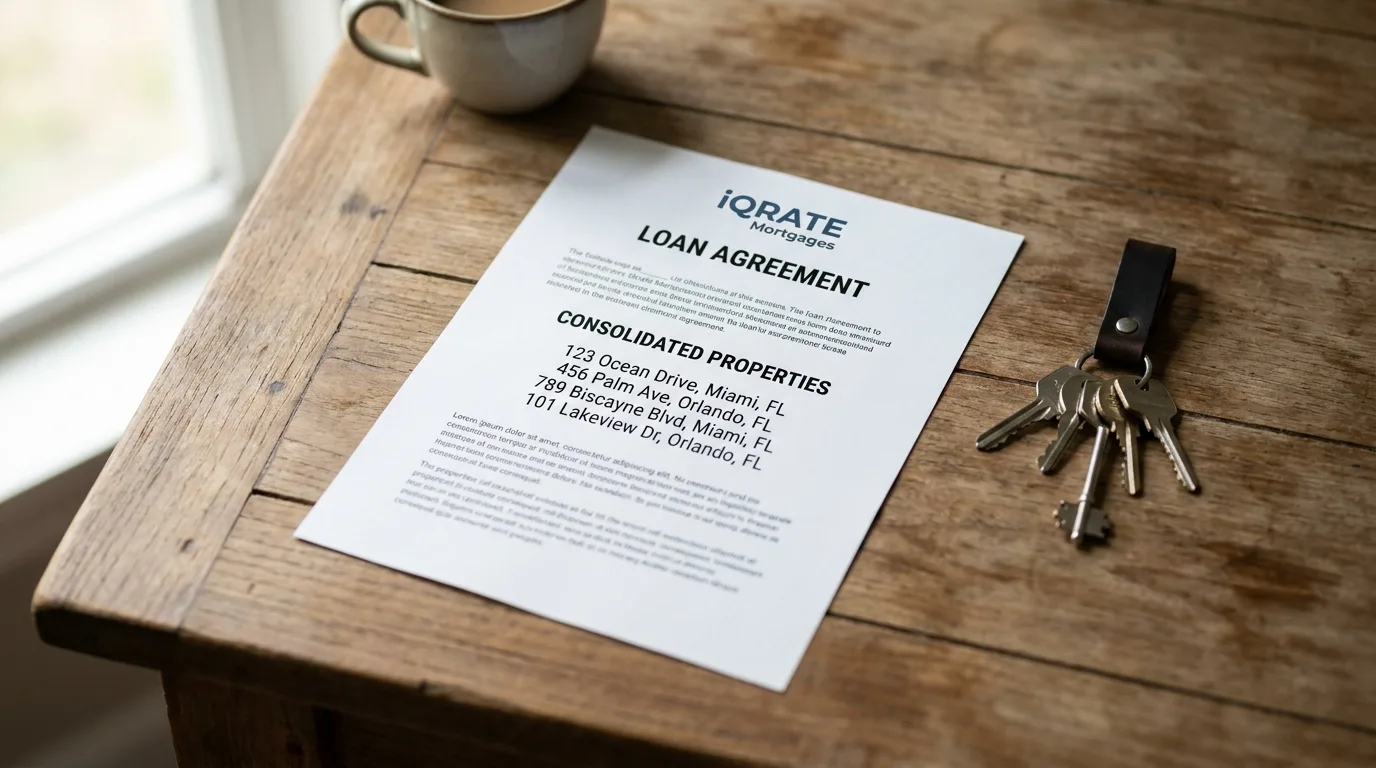
Pros of a Blanket Loan
- Simplified Management: The most significant benefit is convenience. One payment, one statement, and one point of contact for your entire portfolio saves time and reduces administrative headaches.
- Potential for Better Terms: When consolidating, you may be able to secure a better overall deal than you had with multiple smaller, older loans, especially if property values have increased significantly.
- Streamlined Equity Access: A cash-out refinance on a blanket loan allows you to tap into the combined equity of all your properties in a single transaction, providing substantial capital for new investments.
Cons of a Blanket Loan
- Cross-Collateralization Risk: This is the biggest drawback. Because all properties secure the loan, a default caused by one underperforming property (e.g., a long-term vacancy in a Miami Beach condo) puts your entire portfolio at risk of foreclosure.
- Reduced Flexibility: Selling one property is more complicated than with individual loans. It requires lender approval and adherence to a 'partial release clause', which can be restrictive.
- Higher Prepayment Penalties: These loans often come with more substantial prepayment penalties, making it costly to refinance or sell the entire portfolio before the term is up.
Can I Sell One Property From a Blanket Loan Without Refinancing?
Yes, it is possible, but only if your loan agreement includes a partial release clause. This is a critical provision that must be negotiated upfront before you sign the loan documents. Without it, your only option to sell a single property is to pay off the entire blanket loan, which often triggers prepayment penalties and requires refinancing the remaining properties.
A partial release clause outlines the specific terms for selling an individual asset. For instance, an investor in Orlando with five properties under a blanket loan decides to sell one. The clause might stipulate that to release the property's title, the investor must pay down the loan principal by an amount greater than the sold property's allocated debt—for example, 120% of its portion of the loan. Lenders do this to ensure their overall loan-to-value ratio doesn't become riskier after the best-performing assets are sold off.
Always review the partial release clause carefully with a legal or mortgage professional before committing to a blanket loan.
Which Option Offers Lower Overall Closing Costs for an Investor?
The answer depends on the timing and scale of your transactions.
For an investor looking to consolidate an existing portfolio of, say, five properties in Florida, a blanket loan will almost always have lower total closing costs. You are paying for one set of origination fees, one appraisal management fee (though each property is still appraised), and one set of title and legal fees. Closing five separate DSCR refinances at the same time would mean multiplying those costs by five, making it significantly more expensive upfront.
However, for an investor building a portfolio over time, DSCR loans are more cost-effective. You pay closing costs for one property at a time as you acquire it. There is no large, single outlay of cash. The costs are spread out, mirroring the growth of your portfolio. Therefore, for an acquisition strategy, multiple DSCR loans are the standard, whereas for a refinancing and consolidation strategy, a blanket loan presents a cost advantage.
How Do Lenders Qualify a Portfolio of Properties in Florida?
Lenders take a holistic, data-driven approach when underwriting a blanket loan for a portfolio in competitive markets like Miami and Orlando. They are not just looking at one property; they are assessing the health and risk profile of your entire real estate enterprise. Key qualification metrics include:
- Portfolio-Wide DSCR: The lender will calculate a global DSCR by taking the total monthly rental income from all properties and dividing it by the total monthly debt service (principal, interest, taxes, and insurance) for all properties. Most lenders require a portfolio DSCR of at least 1.20x to 1.25x. (The data, information, or policy mentioned here may vary over time.)
- Aggregate Loan-to-Value (LTV): This is the total loan amount requested divided by the total appraised value of all properties in the portfolio. Lenders typically cap the LTV at 70-75% for blanket loans. (The data, information, or policy mentioned here may vary over time.)
- Investor Experience: Lenders want to see a proven track record. They will ask how many years you have been a landlord and how many rental units you currently own and manage.
- Property Condition and Location: The quality, condition, and marketability of each property are scrutinized. A diverse portfolio with properties in strong rental submarkets is viewed more favorably than one concentrated in a single, high-risk area.
- Personal Credit and Liquidity: While the focus is on the properties, the borrower's credit score (typically 680+) and post-closing liquidity (cash reserves) are still important factors in demonstrating financial stability. (The data, information, or policy mentioned here may vary over time.)
Which Financing Strategy Is Better for Long-Term Growth?
Choosing the right strategy depends entirely on your investment goals: agility and scaling versus stability and simplification.
Multiple DSCR loans are generally better for an aggressive growth and acquisition strategy. This approach offers maximum flexibility. You can buy a new property in Miami without affecting your existing loans on properties in Orlando. You can sell an underperforming asset to free up capital with no strings attached to your other properties. This 'a la carte' financing method allows an investor to be nimble, reacting quickly to market opportunities and optimizing the portfolio one asset at a time. It is the preferred path for investors focused on actively trading properties and scaling their door count.
A blanket loan is better for a consolidation and optimization strategy, often used by mature investors. Once a portfolio reaches a certain size and stability, the primary goal may shift from rapid acquisition to efficient management and wealth preservation. A blanket loan simplifies operations and can be a powerful tool for unlocking a large amount of equity for a significant new venture, like purchasing a small apartment building or diversifying into a different asset class. It suits the investor who has built their portfolio and now wants to stabilize it for long-term, passive cash flow. Understanding the nuances between a blanket loan and multiple DSCR loans is key to scaling your Florida real estate portfolio. To analyze your specific properties and long-term goals, discussing your strategy with a mortgage expert can provide clarity on costs and benefits.
Deciding between a blanket loan and multiple DSCR loans is a critical step in scaling your investments. Our team specializes in structuring the right financing for your unique portfolio and goals. Apply now to get a clear, expert-led strategy for your next move.
Author Bio
David Ghazaryan is the expert mortgage strategist and founder behind iQRATE Mortgages. With a mission to fund home loans that traditional banks won't touch, David specializes in helping clients with unique financial situations, including those recovering from foreclosure or bankruptcy. He expertly crafts smart, strategic, and stress-free mortgages by leveraging a vast network of over 100 lenders to secure competitive rates for investors and homebuyers alike. Praised for exceptional customer service, David has helped hundreds of families with a 97% satisfaction rate, guiding them to the mortgage they deserve.
References
CFPB - How does my rental income count toward my ability to repay my mortgage?
Fannie Mae Selling Guide - B3-3.1-08, Rental Income
Freddie Mac Seller/Servicer Guide - Section 5304.1: Rental income









