

S-Corp vs. LLC Income: An Underwriter's Perspective
When you're applying for a jumbo loan for a property in Beverly Hills or Newport Beach, underwriters don't view all business income equally. The structure of your business—whether it's an S-Corporation (S-Corp) or a Limited Liability Company (LLC)—directly impacts how they calculate your qualifying income. Understanding this distinction is the first step to a successful application.
An S-Corp often pays its owner-employee a formal W-2 salary. This is straightforward for lenders; it's predictable, regular income. In addition to this salary, you receive distributions from the company's profits, which are reported on a Schedule K-1. Underwriters see the W-2 salary as stable and reliable. They view K-1 distributions with more caution, as they can fluctuate with the business's performance. They will analyze the company’s overall profitability to ensure these distributions are sustainable and not just a one-time pull of cash that depletes the business.
LLC income, on the other hand, is typically treated as 'pass-through' income. All net profits from the business pass directly to you, the owner, and are reported on your personal tax return (often via a K-1 if it's a multi-member LLC). There's no separate W-2 salary from the LLC itself. Here, underwriters focus intensely on the business's net income after expenses. They are looking for a consistent history of profitability. They will scrutinize the business's cash flow to confirm that the income you claim is actually available to you for personal use without jeopardizing the company's operations.
For a borrower with an S-Corp and two LLCs, an underwriter will segregate and analyze each income stream. They will use your W-2 salary from the S-Corp as a baseline and then carefully add a portion of the K-1 income from all three entities, but only after confirming each business is financially sound.
Key Differences for Jumbo Loan Qualification
- Stability Perception: W-2 income from an S-Corp is perceived as more stable than LLC pass-through profits.
- Cash Flow Analysis: For LLCs, the focus is on net income and ensuring that drawing that income doesn't harm the business. For S-Corps, they verify the company can sustain both the salary and the distributions.
- Documentation: While both require tax returns, S-Corps have the added layer of payroll records (W-2s), which can simplify a part of the income verification process.
Documenting Income from Multiple K-1s
Presenting income from multiple businesses requires meticulous documentation. Lenders need a complete and transparent financial picture to get comfortable with the risk associated with a large jumbo loan. A disorganized or incomplete file is one of the fastest ways to receive a denial, especially in high-value markets like La Jolla. You must provide a clear narrative that shows consistent, stable, and accessible income.
Here is the essential documentation checklist for a borrower with multiple K-1s:
- Personal Tax Returns: Complete federal returns for the most recent two years, including all schedules. This is the foundational document that ties all your income sources together.
- Business Tax Returns: Complete returns for the most recent two years for each business entity (your S-Corp and all LLCs). For an S-Corp, this would be Form 1120-S. For an LLC, it's typically Form 1065 (for partnerships) or Schedule C (for single-member LLCs).
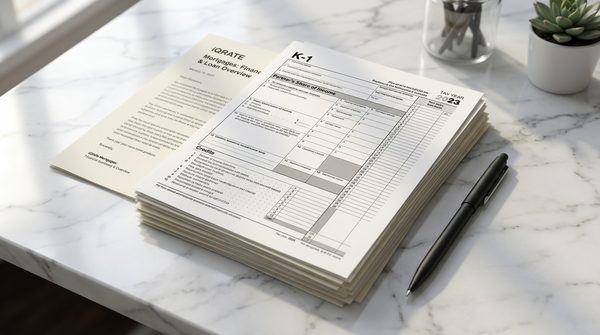
- Schedule K-1s: Provide the K-1 forms from each entity for the past two years. The underwriter will match these K-1s to the income reported on your personal tax returns (Schedule E).
- Year-to-Date Profit and Loss (P&L) Statement: For each business, you need a current P&L statement, typically dated within 60 days of the loan application. It must be signed and dated by you or your CPA.
- Balance Sheet: A current balance sheet for each business is also required. This shows the company's assets, liabilities, and equity, giving the underwriter a snapshot of its overall financial health.

Consistency is critical. The numbers on your P&L statements must logically align with the revenue and profit trends shown in your last two years of tax returns. If your 2023 tax return showed an average monthly profit of $50,000, but your current P&L shows a profit of only $15,000, you will face questions. Be prepared to explain any significant variances.
The Strategic Role of a CPA Letter
A standard income verification letter from your Certified Public Accountant (CPA) is not enough for a complex jumbo loan application. You need a detailed, strategic 'Letter of Explanation' (LOE) from your CPA that goes beyond the numbers and tells the story of your financial success. This letter can be the deciding factor for an underwriter on the fence.
A powerful CPA letter should:
- Confirm Business Structure and History: Clearly state the name of each business, its legal structure (S-Corp, LLC), your percentage of ownership, and the date the business was established. This provides immediate context.
- Explain Income Trends: The letter should address the income trajectory for each business. If profits increased, the CPA can attribute it to specific factors like market expansion or a new product line. If there was a dip, the CPA can explain the reason, such as a one-time capital equipment purchase that reduced net income but strengthened the company for the future.
- Justify Cash Flow and Distributions: The CPA should explicitly state that the income you are using to qualify has been consistently drawn from the businesses without negatively impacting their operations. This addresses the underwriter's primary concern about business stability.
- Address Retained Earnings: If the businesses have significant retained earnings, the CPA can clarify that these funds are not required for day-to-day operations and are accessible to you if needed. This is crucial for using retained earnings to qualify, as discussed below.
For a home purchase in Beverly Hills, where the loan amounts are substantial, a well-crafted letter from a reputable CPA adds an immense layer of credibility to your application.
Qualifying with Retained Earnings: The Rules
Retained earnings—the accumulated profits held within your business—can be a powerful tool for qualifying for a jumbo loan, but lenders have strict rules. They need to be certain that these funds are truly surplus and not essential for the company's survival. Simply having a large amount of cash in a business account is not enough.
To use retained earnings, you must typically meet these conditions:
- Prove Business Liquidity: You must demonstrate that even after withdrawing the funds, the business will maintain sufficient working capital and liquidity to operate smoothly. Lenders often use a business's current ratio (current assets divided by current liabilities) to assess this. A ratio of 2:1 or better is often preferred. (The data, information, or policy mentioned here may vary over time.)
- CPA Attestation: Your CPA must provide a letter stating that the withdrawal of these specific funds will not have an adverse effect on the business. This professional opinion carries significant weight with underwriters.
- History of Distributions: It is much easier to make a case for using retained earnings if you have a history of taking distributions of a similar size. This shows that the business is accustomed to operating after such withdrawals.
Example: Imagine you want to buy a $4 million home in La Jolla. Your regular income qualifies you for a $2.5 million loan, but you need a $3 million loan. Your S-Corp has $750,000 in retained earnings. Your CPA provides a letter explaining that the business maintains a 3:1 current ratio and that a one-time $200,000 distribution to help with the down payment and closing costs will not impact operations. This, combined with strong business bank statements, could allow the lender to consider that additional liquidity, helping you secure the larger loan.
Averaging Income from Businesses with Varying Histories
Lenders prioritize stability and predictability. When you have multiple businesses with different start dates, they will not simply add up the current year's profits. Instead, they average the income, typically over a 24-month period, to create a more conservative and reliable qualifying figure.
The history of each business is critical:
- Businesses Over Two Years Old: For any S-Corp or LLC that has been in operation for at least two years, the lender will generally take the income from the last two tax returns, add them together, and divide by 24 to get a monthly average. If the most recent year's income is lower, they will likely use the lower figure.
- Businesses Under Two Years Old: Income from a business that is less than two years old is considered less stable. Most lenders will heavily discount or entirely disregard this income. Even if a new LLC is highly profitable, you may not be able to use its income for qualification until you have a two-year history established through tax returns.
For example, consider a borrower buying in Newport Beach with two businesses:
- S-Corp (5 years old): 2022 income was $400,000. 2023 income was $450,000. The lender would average this to $425,000 annually, or $35,416 per month.
- LLC (18 months old): 2023 income was $150,000. Because it lacks a two-year history, the lender will likely exclude this $150,000 from the calculation entirely, even though it's substantial.
This is why it's crucial to understand how a lender will view your specific income blend before you start shopping for homes.
Securing a Jumbo Loan Despite a Business Loss
A business loss on a tax return can seem like a deal-breaker, but it doesn't have to be. Underwriters are trained to look at the big picture. If you have multiple streams of income, a loss from one business can be offset by strong profits from others. The key is to proactively explain the context behind the loss.
Here’s how to approach it:
- Analyze the 'Why': Was the loss due to a one-time event, like a major investment in equipment or a build-out of a new office? This is far more acceptable than a loss caused by declining sales or market share. A capital expenditure can be framed as an investment in future growth.
- Show Overall Positive Trend: Even with one business showing a loss, your overall combined net income from all entities must be stable or increasing. If your profitable S-Corp's income grew by $200,000 while your new LLC had a paper loss of $50,000 due to startup costs, your net position is still strong.
- Provide an Explanation: Do not wait for the underwriter to ask. Include a letter of explanation, supported by your CPA, that details the reason for the loss, provides documentation (like receipts for a large purchase), and demonstrates how the business is now on a profitable track.
If you're seeking a jumbo loan for a Beverly Hills estate, your financial portfolio must be resilient. Demonstrating that you can absorb a loss in one venture while maintaining significant overall profitability shows the kind of financial strength underwriters want to see.
Preparing Business Bank Statements for Underwriting
Your business bank statements are a direct reflection of your company's health. They must be clean, complete, and consistent with the information in your tax returns and P&L statements. Underwriters will scrutinize them for red flags.
Follow these best practices when preparing your statements:
- Provide All Pages: Submit every single page of your bank statements for the requested period (usually 2-3 months), even if a page is blank. Missing pages will cause delays.
- Source Large Deposits: Any large, non-typical deposit will be questioned. If you transferred $100,000 from a savings account or received a large payment from a client that is outside your normal revenue pattern, be prepared to provide a paper trail showing where the funds came from.
- Avoid Overdrafts and NSFs: Non-sufficient funds (NSF) fees or overdrafts are a major red flag. They suggest poor cash management and financial instability, which is the opposite of what you want to project when applying for a jumbo loan.
- Ensure Consistency: The revenue flowing into your bank accounts should align with the revenue reported on your P&L statement. If your P&L shows $100,000 in monthly revenue, but your bank deposits only total $40,000, you need a clear explanation for the discrepancy (e.g., credit card processing holds).
By presenting a well-documented and professionally packaged application, you transform your complex income from a liability into a clear demonstration of financial strength, paving the way for a successful jumbo loan approval.
If your income structure is complex, navigating the jumbo loan process requires an expert eye. A mortgage strategist can help you package your finances effectively to meet underwriter requirements and secure your luxury home. Apply now to begin your personalized application journey.
Author Bio
David Ghazaryan is the expert mortgage strategist and founder behind iQRATE Mortgages. With a mission to fund home loans that traditional banks won't touch, David specializes in helping clients with unique financial situations, including those recovering from foreclosure or bankruptcy. He expertly crafts smart, strategic, and stress-free mortgages by leveraging a vast network of over 100 lenders to secure competitive rates for investors and homebuyers alike. Praised for exceptional customer service, David has helped hundreds of families with a 97% satisfaction rate, guiding them to the mortgage they deserve.
References
Fannie Mae Selling Guide: B3-3.2-01, Underwriting Factors for a Self-Employed Borrower
Consumer Financial Protection Bureau (CFPB): What documents will I need to apply for a mortgage?