


Understanding 'Add-Backs' for a Self-Employed Mortgage
For a self-employed business owner, tax season is a strategic effort to minimize taxable income by maximizing business deductions. While this is great for reducing your tax liability, it can create a significant hurdle when applying for a mortgage. The low net income reported on your tax returns might make it seem like you can't afford the home you want. This is where 'add-backs' become a critical tool.
An add-back is a non-cash expense or a non-recurring business loss that a mortgage lender can add back to your net income to determine your true qualifying income. Lenders understand that your tax return is a reflection of tax strategy, not necessarily a complete picture of your business's cash flow. They use add-backs to get a more accurate assessment of your ability to repay a loan.
The fundamental principle is to distinguish between paper expenses and actual cash leaving your business account. For example, depreciation is a significant tax deduction, but you aren't writing a check for it each year. By adding it back, the lender acknowledges that this 'expense' is still available as income to support a mortgage payment.

Common Business Expenses That Qualify as Add-Backs
Mortgage underwriters follow specific guidelines from agencies like Fannie Mae and Freddie Mac to determine which expenses are eligible to be added back. These are expenses that reduce your taxable profit but don't impact your day-to-day cash flow. Here are the most common add-backs lenders will consider:
- Depreciation: This is the most frequent and significant add-back. It’s an accounting method used to allocate the cost of a tangible asset over its useful life. Whether it’s for a vehicle, machinery, or office equipment, the depreciation amount shown on your tax forms can be added directly back to your net income.
- Amortization: Similar to depreciation, amortization is the practice of spreading an intangible asset's cost over its useful life. This can include costs like patents, trademarks, or business startup costs. Lenders can add this paper expense back to your income.
- Depletion: This is common in businesses related to natural resources like oil, gas, or timber. It is an accounting method for allocating the cost of extracting these resources. Since it’s a non-cash expense, it can be added back.
- One-Time Major Expenses or Capital Expenditures: If your business had a significant, non-recurring expense, it can often be excluded from the income calculation. For instance, if you paid for a complete office renovation or bought a major piece of equipment that you won’t purchase again for years, a lender may add this cost back with proper documentation. (The data, information, or policy mentioned here may vary over time.)
- Business Use of Home: The deduction for business use of your home is a non-cash expense that can typically be added back to your qualifying income.
It's important to note that expenses like regular salaries, rent, utilities, and marketing are considered normal costs of doing business and cannot be added back. The focus is strictly on expenses that don't represent an ongoing cash outlay.
How to Document Depreciation for Your Mortgage Lender
Proper documentation is non-negotiable. An underwriter cannot simply take your word for it; the add-backs must be clearly identified on your official business tax returns. When you apply for a mortgage as a self-employed individual, your lender will require at least two years of business and personal tax returns.
Here’s where to find and document depreciation:
- Locate the Correct Form: The primary document for tracking depreciation is IRS Form 4562, 'Depreciation and Amortization'. This form details all the assets your business is depreciating.
- Identify the Depreciation Amount: Your lender will look for the total depreciation amount listed on this form. This figure is then transferred to your business's primary tax schedule.
- Trace it to Your Business Schedule:
- For a Sole Proprietorship, the depreciation amount from Form 4562 will be listed as an expense on your Schedule C (Form 1040).
- For a Partnership, it will be on Form 1065.
- For an S-Corporation, it will be found on Form 1120-S.
- For rental property income, it appears on Schedule E (Form 1040).
The underwriter will verify the figure on Form 4562 and add it back to the net income reported on the corresponding schedule. Having your tax documents well-organized and ready for submission will significantly speed up the underwriting process.
Will Lenders Exclude One-Time Business Expenses?
Yes, lenders can often exclude significant one-time expenses, but it requires clear evidence that the expense is truly non-recurring. This helps present a more stable and representative picture of your business's ongoing profitability. (The data, information, or policy mentioned here may vary over time.)
For example, imagine your consulting firm spent $30,000 on a one-time software development project in the previous tax year. This expense drastically reduced your net income. To have this excluded, you would need to provide:
- A detailed letter of explanation describing the nature of the expense.
- Invoices or receipts proving the cost and that it was paid.
- A revised Profit and Loss (P&L) statement that shows your income with and without this one-time expense.
The lender’s goal is to determine a stable, predictable income stream. If they are confident that this $30,000 expense will not repeat, they can add it back to your net profit for qualification purposes, potentially increasing your monthly qualifying income by $2,500 ($30,000 / 12 months).
The Role of Your Accountant in the Mortgage Process
Your accountant or CPA is a valuable partner in the mortgage process, but it's crucial to understand their role and its limits. An accountant can be instrumental in preparing the necessary financial documents, such as a clear and accurate P&L statement, balance sheet, and ensuring your tax returns are filed correctly.
When applying for a loan, your accountant can write a letter to the lender explaining certain financial nuances, like the purpose of a one-time expense or the reason for an income fluctuation. This adds a layer of professional validation to your file.
However, the final decision rests solely with the mortgage underwriter. The underwriter is bound by lender and agency guidelines (Fannie Mae, Freddie Mac, FHA) and cannot deviate from them, regardless of what an accountant's letter says. The accountant provides clarity and documentation; the underwriter makes the official income calculation based on established rules. Involving your accountant early can ensure your financial story is presented as clearly and favorably as possible within those rules.
Do Bank Statement Loans Care About Tax Return Write-Offs?
For many self-employed borrowers, even with add-backs, the income on their tax returns is too low to qualify for a traditional mortgage. This is where a bank statement loan becomes an excellent alternative. These are non-qualified mortgage (Non-QM) products designed specifically for business owners.
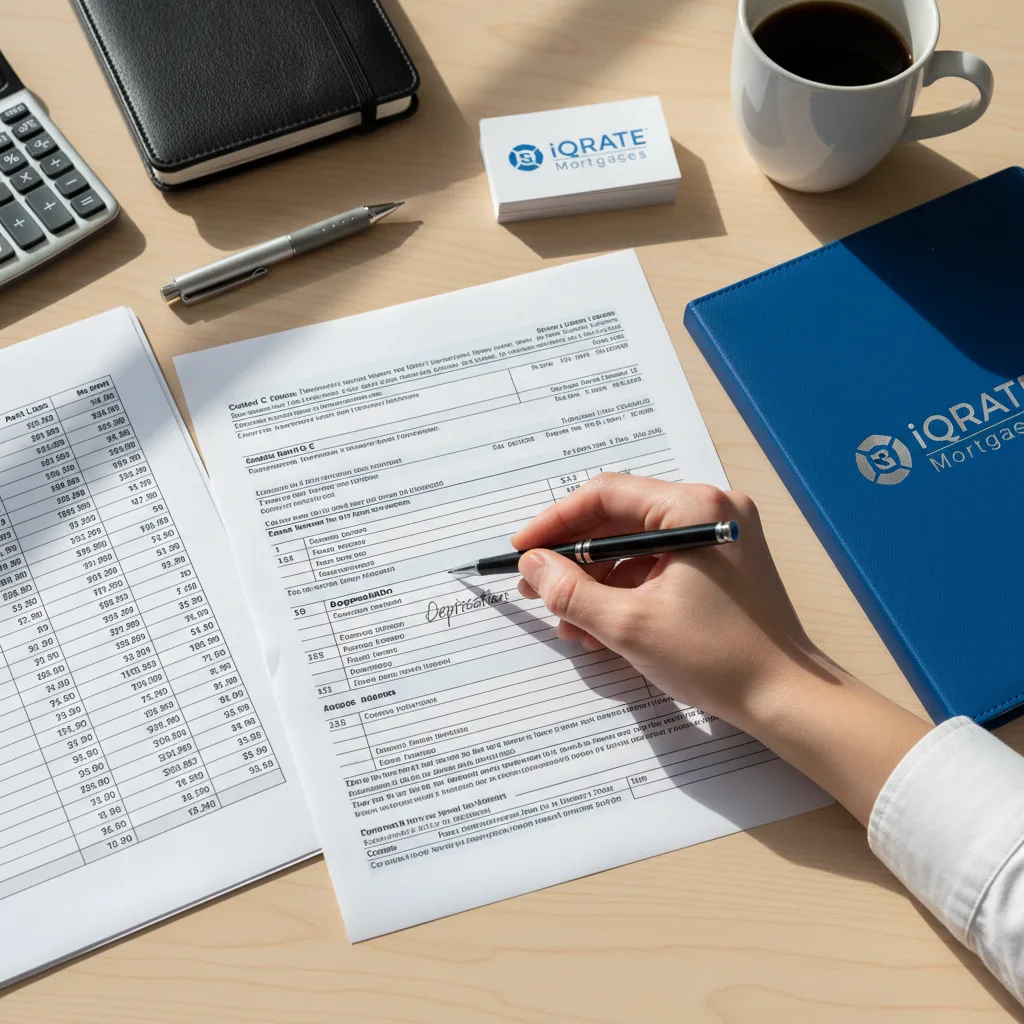
Bank statement loans almost completely ignore your tax returns. Instead of analyzing your net profit after write-offs, lenders assess your business’s cash flow by examining your business bank statements, typically over a 12 or 24-month period.
Here’s how they work:
- Income Calculation: The lender will analyze your total deposits over the selected period. They will then apply an 'expense factor' to the deposits to estimate a qualifying income. (The data, information, or policy mentioned here may vary over time.) For example, if your business has $600,000 in deposits over 12 months, a 50% expense factor would result in a qualifying annual income of $300,000.
- No Tax Returns Needed: You do not need to provide tax returns for income verification, making write-offs irrelevant to the qualification process.
This is an ideal solution for business owners who are highly successful with strong cash flow but also maximize their tax deductions.
How Lenders Analyze Your Business Profit and Loss Statements
A Profit and Loss (P&L) statement, or income statement, provides a real-time snapshot of your business's financial health. While tax returns show a historical, year-end summary, a year-to-date P&L shows the lender your current business trajectory.
Lenders will scrutinize your P&L statement and compare it to previous years' tax returns to look for consistency and trends. Specifically, they are looking for:
- Consistency: Is your current income in line with what you reported in the previous two years? A stable or increasing income trend is highly favorable.
- Declining Income: If your P&L shows that your business's revenue is significantly lower than in previous years, this is a major red flag. The lender will likely use the lower, more recent income figure for qualification and may ask for a detailed explanation.
- Verification: The lender will cross-reference the revenue shown on your P&L with the deposits in your business bank statements to ensure the numbers align. Any major discrepancies must be explained.
Can You Get a Loan if Your Business Shows a Net Loss?
Showing a net loss on your tax return is not an automatic disqualification, especially if your business has substantial non-cash expenses. It all comes down to the math after applying add-backs.
Consider this scenario for a business that shows a net loss:
- Net Loss on Schedule C: -$15,000
- Depreciation on Form 4562: +$50,000
- Business Use of Home Deduction: +$5,000
In this case, the calculation for qualifying income would be: -$15,000 (Net Loss) + $50,000 (Depreciation) + $5,000 (Home Office) = $40,000.
After add-backs, the business demonstrates a positive qualifying income of $40,000 per year, or $3,333 per month. As long as this income is sufficient to meet the lender's debt-to-income (DTI) ratio requirements, you could still be approved for a loan. The key is that the add-backs must be large enough to overcome the net loss and create a positive, stable qualifying income. Understanding how lenders view your self-employed income is the first step. If you're a business owner in Texas, exploring your options with a mortgage expert can clarify your path to homeownership and determine if add-backs or a bank statement loan is the right strategy for you.
Navigating the complexities of self-employed income is our specialty. If you're ready to see how add-backs can strengthen your mortgage application, let our experts provide a clear path forward. Apply now to understand your true borrowing power.
Author Bio
David Ghazaryan is the expert mortgage strategist and founder behind iQRATE Mortgages. With a mission to fund home loans that traditional banks won't touch, David specializes in helping clients with unique financial situations, including those recovering from foreclosure or bankruptcy. He expertly crafts smart, strategic, and stress-free mortgages by leveraging a vast network of over 100 lenders to secure competitive rates for investors and homebuyers alike. Praised for exceptional customer service, David has helped hundreds of families with a 97% satisfaction rate, guiding them to the mortgage they deserve.
References
Fannie Mae: Underwriting Factors for a Self-Employed Borrower









