


Core Differences: FHA 203(k) vs. Conventional Renovation Loan
Both the FHA 203(k) and conventional renovation loans solve the same primary problem: they roll the cost of buying a home and the cost of repairing it into a single mortgage. This is crucial for buying a 'fixer-upper', as it saves you from needing a separate, often high-interest, construction loan. The loan amount is based on the home's 'after-repaired value' (ARV), meaning the lender considers what the home will be worth once your planned renovations are complete.
The fundamental difference lies in who backs the loan.
- FHA 203(k) Loan: This loan is insured by the Federal Housing Administration (FHA), a government agency. This insurance protects the lender if you default, making it possible for them to offer loans to borrowers with lower credit scores and smaller down payments. However, this government backing comes with more regulations and property restrictions.
- Conventional Renovation Loan: These loans, like Fannie Mae's HomeStyle Renovation or Freddie Mac's CHOICERenovation, are not government-insured. They are offered by private lenders who set their own guidelines based on standards from Fannie Mae and Freddie Mac. This generally means stricter borrower requirements (higher credit scores, lower debt-to-income ratios) but greater flexibility in the scope and type of renovations.
Down Payment Requirements in Jacksonville and Miami
The most significant advantage of the FHA 203(k) loan is its low down payment requirement. This makes homeownership accessible to more people, especially first-time buyers who haven't built up substantial savings.
FHA 203(k) Down Payment
You can secure an FHA 203(k) loan with as little as 3.5% down. This percentage is calculated based on the total of the home's purchase price plus the total cost of renovations.
- Example in Jacksonville: You find a home for $250,000 that needs $40,000 in repairs. Your total loan basis is $290,000. Your minimum down payment would be just $10,150 (3.5% of $290,000).

Conventional Renovation Down Payment
For a primary residence, a conventional renovation loan can require as little as 3% to 5% down. (The data, information, or policy mentioned here may vary over time.) However, qualifying for this lowest tier requires a very strong financial profile, including a high credit score (often 700+). Many borrowers will find they need to put down 5% or more. (The data, information, or policy mentioned here may vary over time.)
- Example in Miami: Let's say you're buying a $400,000 property needing $60,000 in renovations. The total loan basis is $460,000. A 5% down payment would be $23,000. If your credit score is lower, the lender might require a 10% down payment, or $46,000. (The data, information, or policy mentioned here may vary over time.)
Comparing Mortgage Insurance Costs Over Time
Mortgage insurance protects the lender, not you. It's a required cost on both loan types if you put down less than 20%, but how it's structured and how long you pay it differs dramatically.
FHA Mortgage Insurance Premium (MIP)
FHA loans come with a costly form of mortgage insurance called MIP. It has two parts:
- Upfront Mortgage Insurance Premium (UFMIP): A one-time fee of 1.75% of the base loan amount, which is typically rolled into your total mortgage balance.
- Annual MIP: Paid monthly for the life of the loan. If your down payment is less than 10%, you will pay this annual premium for the entire loan term. It cannot be removed unless you refinance into a conventional loan.
This lifelong MIP payment is a significant long-term drawback of FHA financing.
Conventional Private Mortgage Insurance (PMI)
Conventional loans use Private Mortgage Insurance (PMI). While the monthly cost can be higher than FHA's MIP for borrowers with lower credit scores, it has a crucial advantage: it's temporary. By law, lenders must automatically cancel your PMI once your loan-to-value (LTV) ratio reaches 78% (meaning you have 22% equity in your home). You can also request to have it removed once you reach 20% equity. This can save you thousands of dollars over the life of the loan.
Approved vs. Prohibited Repairs for Each Loan
Your project's scope is a major deciding factor. FHA prioritizes making a home habitable and safe, while conventional loans offer a blank canvas for upgrades.
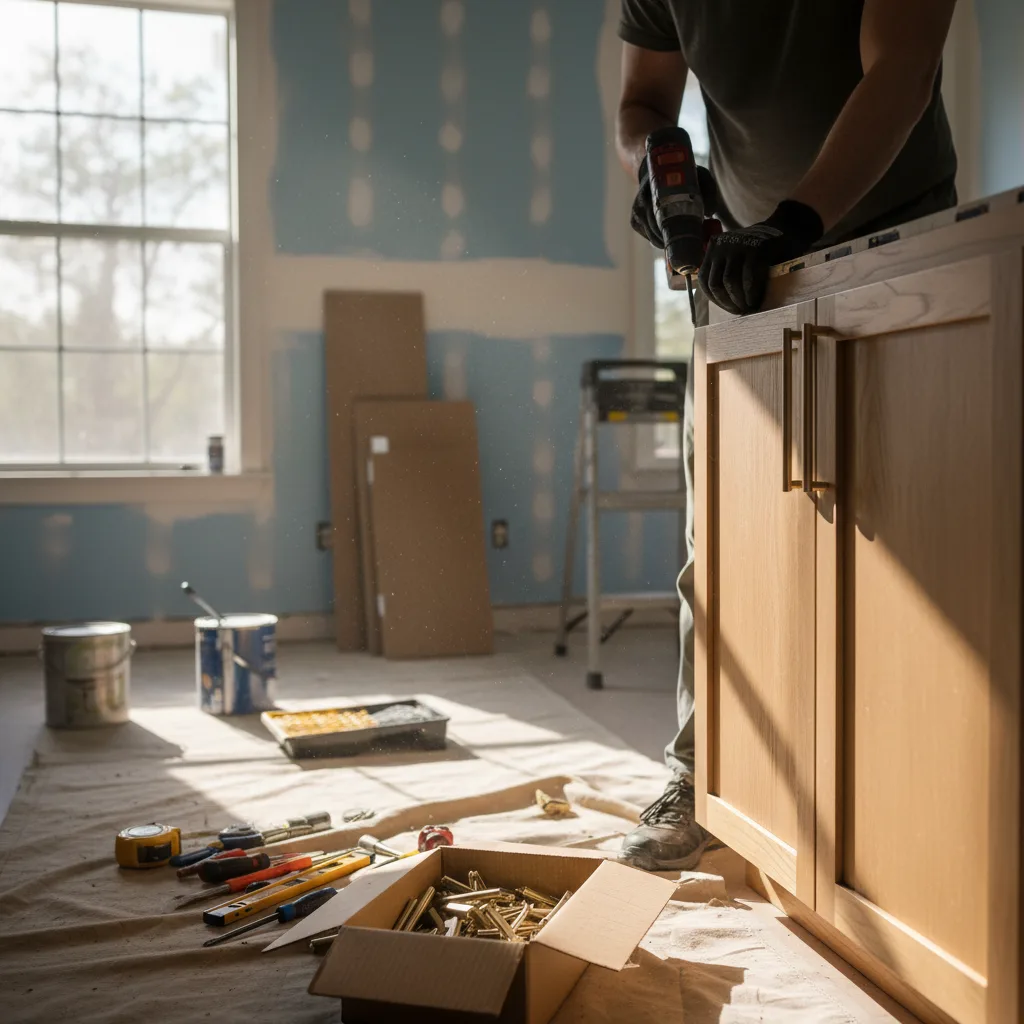
FHA 203(k) Repair Guidelines
There are two types of FHA 203(k) loans, each with its own rules:
- Limited 203(k): For smaller, non-structural projects. Renovations are capped at $35,000. (The data, information, or policy mentioned here may vary over time.) This is ideal for cosmetic work like new flooring, painting, updating a kitchen, or replacing appliances. You cannot use it to move walls or fix foundation issues.
- Standard 203(k): For major projects exceeding $35,000 or involving structural work. You can add rooms, repair a foundation, or completely reconfigure a floor plan. This loan requires you to hire a HUD-approved consultant to oversee the entire project, adding an extra layer of management and cost.
Prohibited FHA Repairs: Luxury items are not allowed. This includes building a swimming pool, an outdoor kitchen, or other high-end amenities that are not essential to the home's function.
Conventional Renovation Repair Guidelines
Conventional renovation loans are far more flexible. You can finance almost any repair or improvement as long as it is permanently affixed to the property and adds value. This includes the 'luxury' items FHA prohibits. If you want to buy a home in Tampa and add a new in-ground pool and outdoor entertainment area, a conventional renovation loan is your only option.
The Approval Process: Speed and Simplicity
Bringing contractors, appraisals, and lenders together for a renovation loan is complex. The added layer of government oversight on an FHA loan makes its process notably slower.
- Conventional Process: This is generally the faster and simpler option. The lender has more control over the timeline. While you still need detailed contractor bids and an ARV appraisal, there is less bureaucratic red tape. A streamlined process means you can close faster and start your project sooner.
- FHA 203(k) Process: This process is more cumbersome. The requirement for a HUD consultant on Standard 203(k) loans adds another party and another schedule to coordinate. The paperwork is more extensive, and the FHA has strict guidelines for contractor eligibility and the disbursement of funds. Expect this process to take longer than a conventional renovation loan.
How the Renovation Loan Appraisal Process Works
The appraisal is the backbone of any renovation loan. Unlike a standard appraisal that assesses a home's current worth, a renovation loan appraisal determines the future value.
Here’s how it works for both loan types:
- Submit Renovation Plans: You provide the lender with a detailed work plan, architectural drawings (if needed), and itemized bids from your licensed contractor.
- Order ARV Appraisal: The lender sends this package to a licensed appraiser.
- Appraiser's Analysis: The appraiser visits the property to assess its current condition. They then use your plans and bids to determine what the home's market value will be after the work is completed. This is the 'after-repaired value' (ARV).
- Loan Amount Determined: Your total loan amount (purchase price + renovation costs) must fall within the lender's loan-to-value limits based on the ARV. For example, if the ARV is $400,000 and the lender's limit is 95% LTV, your maximum loan amount is $380,000.
Can I DIY the Repairs? (Sweat Equity)
Many ambitious homebuyers in Orlando want to save money by doing the work themselves. Lenders refer to this as 'sweat equity', but their willingness to allow it varies.
- FHA 203(k) and DIY: The FHA strongly discourages sweat equity. It is rarely approved. To even be considered, you must be a licensed professional in the trade you plan to perform (e.g., a licensed electrician doing the wiring) and prove you have the time and skill to complete the work in a timely and professional manner. For most borrowers, this is not a realistic option.
- Conventional and DIY: Conventional loans, particularly the Fannie Mae HomeStyle, are more open to sweat equity. (The data, information, or policy mentioned here may vary over time.) The lender can approve a borrower to do some of the work, but you generally cannot finance the cost of your own labor. The loan can cover the cost of materials. The lender will review your qualifications and may limit the scope of work you can perform to ensure the project is completed successfully.
Best Option for a Saint Petersburg Condo Renovation
Renovating a condo presents unique challenges, especially with financing. The choice between FHA and conventional becomes much clearer in this scenario.
- FHA 203(k) for a Condo: This is very difficult. To use an FHA loan, the entire condominium complex must be on the FHA's list of approved projects. Many condo associations have let their FHA approval lapse or never sought it in the first place due to the strict requirements. Finding an FHA-approved condo that also needs renovation can be nearly impossible.
- Conventional for a Condo: This is almost always the better, and often only, choice. As long as the condo association meets standard conventional guidelines (e.g., regarding budget reserves, insurance, and owner-occupancy rates), you can use a conventional renovation loan. This loan also provides the flexibility needed for common condo updates, such as high-end kitchen and bath remodels, which might not be prioritized under FHA guidelines. For a fixer-upper condo in Saint Petersburg, a conventional loan offers a much smoother path to approval. Choosing between an FHA 203(k) and a conventional renovation loan depends entirely on your credit, cash reserves, and the scope of your project. To get a clear, side-by-side comparison for your specific Orlando fixer-upper, connect with a mortgage expert who can analyze your finances and renovation plans to find the most strategic and cost-effective path forward.
Ready to turn that fixer-upper into your dream home? The right financing is key. To understand which renovation loan fits your project and financial profile, take the first step. Apply now for a personalized mortgage consultation.
Author Bio
David Ghazaryan is the expert mortgage strategist and founder behind iQRATE Mortgages. With a mission to fund home loans that traditional banks won't touch, David specializes in helping clients with unique financial situations, including those recovering from foreclosure or bankruptcy. He expertly crafts smart, strategic, and stress-free mortgages by leveraging a vast network of over 100 lenders to secure competitive rates for investors and homebuyers alike. Praised for exceptional customer service, David has helped hundreds of families with a 97% satisfaction rate, guiding them to the mortgage they deserve.
References
HUD FHA 203(k) Rehab Mortgage Insurance









