


How to Know if a Tampa Home is in a Special Flood Hazard Area (SFHA)
Before you can understand the Federal Housing Administration's (FHA) specific rules, you first need to determine if a property is in a Special Flood Hazard Area (SFHA). An SFHA is an area that the Federal Emergency Management Agency (FEMA) has identified as having a 1% or greater chance of flooding in any given year. These zones are typically labeled as Zone 'A' or Zone 'V' on FEMA's Flood Insurance Rate Maps (FIRMs).
There are several ways to check a property's flood zone status in the Tampa Bay area:
- FEMA Flood Map Service Center: This is the official source. You can enter the property address directly into their online portal to view the current flood map and determine its designation.
- Seller's Property Disclosure: In Florida, sellers are required to disclose known defects, which includes information about whether the property lies within a flood zone.
- County Property Appraiser Website: Both the Hillsborough County and Pinellas County property appraiser websites often have mapping tools that include flood zone overlays.
While these tools are excellent for initial research, your lender will perform the official determination. During the mortgage process, they will order a Standard Flood Hazard Determination Form (SFHDF) from a third-party service. This document officially certifies whether the structure is located within an SFHA, and the results are binding for the loan application.
FHA Minimum Property Eligibility in Flood Zones
The FHA insures loans to protect lenders from default, so it imposes strict Minimum Property Standards (MPS) to ensure the homes it finances are safe and structurally sound. For properties in an SFHA, these standards are even more rigorous, as outlined in the HUD Handbook 4000.1.
The Critical Elevation Requirement
The most important FHA rule for a home in a flood zone is this: the lowest floor of the structure must be at or above the 100-year Base Flood Elevation (BFE). The BFE is the computed elevation to which floodwater is anticipated to rise during a 1% annual chance flood.
- For Existing Construction: The home must already meet this requirement. If the lowest floor (including a basement or the floor of an attached garage) is below the BFE, the property is ineligible for FHA financing. There are no exceptions.
- For New Construction: Any new home being built with FHA financing in mind must be designed and constructed with its lowest floor elevated above the BFE. The builder must provide documentation to prove this.

Other Key Eligibility Rules
Beyond just elevation, the FHA requires the following for properties in SFHAs:
- Safe Access: The property must have direct vehicular access that is safe during a base flood event. A home that becomes an 'island' during a flood, cut off from emergency services, will be rejected.
- Proper Foundation: If the home has a crawl space, it must have the required number of flood vents to allow floodwater to flow in and out, equalizing pressure and preventing foundation damage.
- Elevated Utilities: Major mechanical components like HVAC systems, water heaters, and electrical panels must be located and installed above the BFE to prevent failure during a flood.
Is National Flood Insurance Program (NFIP) Coverage Mandatory?
Yes, it is absolutely mandatory. If the property you want to buy with an FHA loan is located in an SFHA, federal law requires you to maintain flood insurance for the entire life of the loan. This is not optional and cannot be waived.
Your standard homeowner's insurance policy does not cover damage from flooding. You must purchase a separate policy, most commonly through the National Flood Insurance Program (NFIP), which is administered by FEMA. The lender will require proof of this insurance policy before closing.
While the NFIP is the most common source, some private flood insurance policies are also acceptable, provided they meet the FHA's minimum requirements for coverage, which must be at least as broad as the standard NFIP policy. The coverage amount must be the lesser of the outstanding loan balance or the maximum limit available from the NFIP.(The data, information, or policy mentioned here may vary over time.)
How an Elevation Certificate Affects Your Tampa Mortgage Approval
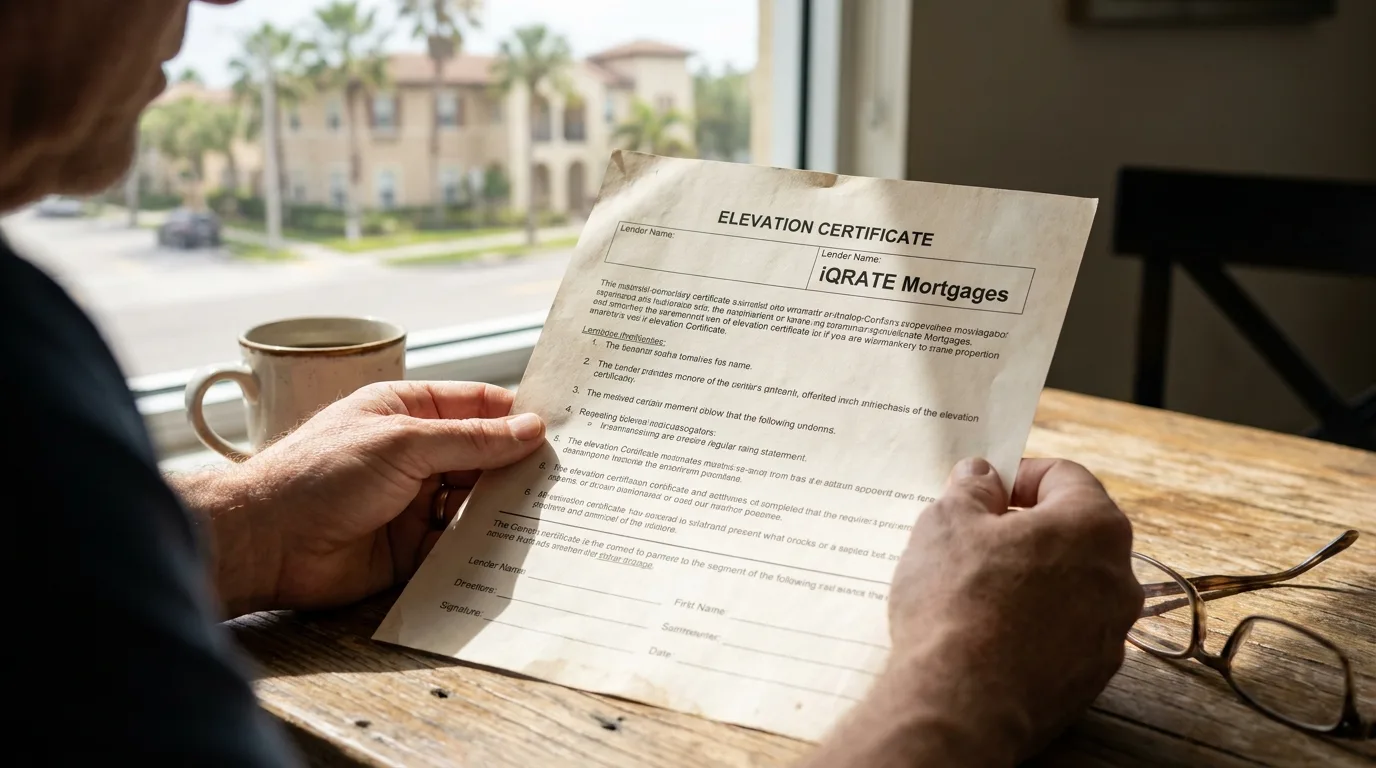
An Elevation Certificate (EC) is a critical document that can make or break your FHA loan approval for a home in a Tampa flood zone. This official form is completed by a licensed surveyor or engineer and details the property's specific elevation data.
What the Elevation Certificate Shows
- The property's exact flood zone.
- The Base Flood Elevation (BFE) for that location.
- The elevation of the home's lowest floor, highest adjacent grade, and lowest adjacent grade.
- The elevation of attached garages, crawl spaces, and key machinery (like air conditioning units).
This certificate is the only way for the FHA appraiser and the lender's underwriter to verify that the home complies with the 'at or above BFE' rule. If you are considering a home in an SFHA, you should ask the seller if they have a recent EC. If not, you may need to pay for one yourself during the inspection period, which can cost several hundred dollars.(The data, information, or policy mentioned here may vary over time.) Without a compliant EC, the loan will be denied.
Will the FHA Finance a Home With Past Flood Damage?
The FHA will consider financing a home that has previously flooded, but only under strict conditions. The primary concern is ensuring the property is now safe, sound, and fully repaired to meet all FHA Minimum Property Standards.
Here's what an underwriter will require:
- Full and Complete Repairs: All damage must be repaired in a professional and workmanlike manner. The FHA appraiser will inspect the property thoroughly, looking for lingering issues like mold, mildew, foundation cracks, or warped flooring.
- Documentation of Repairs: You may be asked to provide documentation proving the repairs were completed correctly. This could include permits from the City of Tampa or Saint Petersburg, receipts from licensed contractors, and insurance claim paperwork.
- Cause of Flooding: The lender will want to understand why the home flooded. Was it a widespread event like a hurricane surge, or is it due to a persistent issue like poor site drainage? A property that floods repeatedly from heavy rain presents a much higher risk and may be deemed ineligible.
Specific Items an Appraiser Checks on a Saint Petersburg Property
When an FHA appraiser visits a waterfront property in Saint Petersburg or a low-lying home in Tampa, they have a specific checklist focused on flood-related risks. They go beyond the standard appraisal to ensure the home is compliant and durable.
The Appraiser's Flood Zone Checklist
- Verify the Elevation Certificate: The appraiser will review the EC to confirm the lowest floor elevation meets FHA requirements.
- Inspect the Foundation: They will look for cracks, shifting, or erosion around the foundation. In homes with crawl spaces, they will confirm the presence and functionality of flood vents.
- Check for Water Intrusion: They will scan for signs of past or present water damage, including water stains on walls, musty odors, mold, or efflorescence (a white, powdery substance) on concrete walls.
- Confirm Elevated Utilities: The appraiser must verify that the electrical panel, water heater, and HVAC systems are all situated above the BFE.
- Assess Site Drainage: The lot must be graded to direct water away from the home's foundation. Any pooling or improper drainage is a red flag.
- Examine the Structure's Overall Condition: The appraiser provides a final assessment of whether the home is safe and habitable, considering all potential flood risks.
If the appraiser notes any deficiencies, such as a missing flood vent or an electrical outlet below the BFE, these items must be repaired and re-inspected before the loan can be approved.
Budgeting for Flood Insurance on Top of Your Mortgage
Flood insurance is a significant and recurring expense that must be factored into your housing budget. The cost is not included in your mortgage interest rate but is added to your monthly payment through an escrow account, just like property taxes and homeowner's insurance.
Several factors determine your annual premium:
- The Home's Flood Zone: High-risk coastal zones (Zone V) are far more expensive to insure than inland riverine zones (Zone A).
- Elevation: The higher the home's lowest floor is elevated above the BFE, the lower the premium.
- Coverage Amount & Deductible: Choosing higher coverage amounts and lower deductibles will increase the cost.
- Building Characteristics: The age of the home, number of floors, and foundation type all play a role.
For a $450,000 home in a Tampa Zone AE, a common flood zone, you could expect an annual premium ranging from $900 to over $4,000.(The data, information, or policy mentioned here may vary over time.) If that premium is $3,000 per year, that adds $250 per month to your total housing payment. This is a crucial calculation when determining affordability. Navigating FHA flood zone rules can be complex. If you're considering a home in Tampa or Saint Petersburg, connect with a mortgage expert to ensure your dream home meets every requirement without any surprises at closing.
Understanding FHA flood zone requirements is a crucial step in your homebuying journey. If you're ready to see where you stand and explore your mortgage options in the Tampa area, our team is here to provide clarity and guidance. Apply now to get started.
Author Bio
David Ghazaryan is the expert mortgage strategist and founder behind iQRATE Mortgages. With a mission to fund home loans that traditional banks won't touch, David specializes in helping clients with unique financial situations, including those recovering from foreclosure or bankruptcy. He expertly crafts smart, strategic, and stress-free mortgages by leveraging a vast network of over 100 lenders to secure competitive rates for investors and homebuyers alike. Praised for exceptional customer service, David has helped hundreds of families with a 97% satisfaction rate, guiding them to the mortgage they deserve.
References









