


Why the FHA Has Strict Rules for Private Roads in Houston
Finding the perfect home in a quiet Houston neighborhood, only to have your FHA loan application hit a wall because of the road it's on, can be incredibly frustrating. The reason for this hurdle isn't to complicate your purchase; it's about risk management. The Federal Housing Administration (FHA) isn't a lender—it's an insurer. It insures your lender against loss if you default on the loan. To protect its financial interest (and ultimately, the taxpayer's), the FHA needs to ensure the property it's backing is a sound, long-term investment.
A home on a private road without a formal, legally binding maintenance agreement presents a significant risk. The FHA is concerned about several key issues:
- Property Access: What happens if the road falls into disrepair? Potholes, flooding, or washouts could make it impossible for you, emergency services, or future potential buyers to access the home. This directly impacts its habitability and safety.
- Property Value: A home with access issues is less desirable. A deteriorated road can significantly lower the property's market value, meaning if you were to default, the lender (and the FHA) might not recoup the loan amount through a foreclosure sale.
- Marketability: Selling a home on a poorly maintained private road is a challenge. It limits the pool of future buyers, especially those who also need FHA financing. The FHA wants to ensure the property can be easily sold in the future without this same obstacle.
In sprawling metro areas like Houston, where you can find diverse property types from dense urban lots to more spread-out suburban parcels, private roads and shared driveways are not uncommon. The FHA's rules are applied uniformly to ensure every property it insures meets a baseline standard for access and stability.
The Essentials of a Private Road Maintenance Agreement
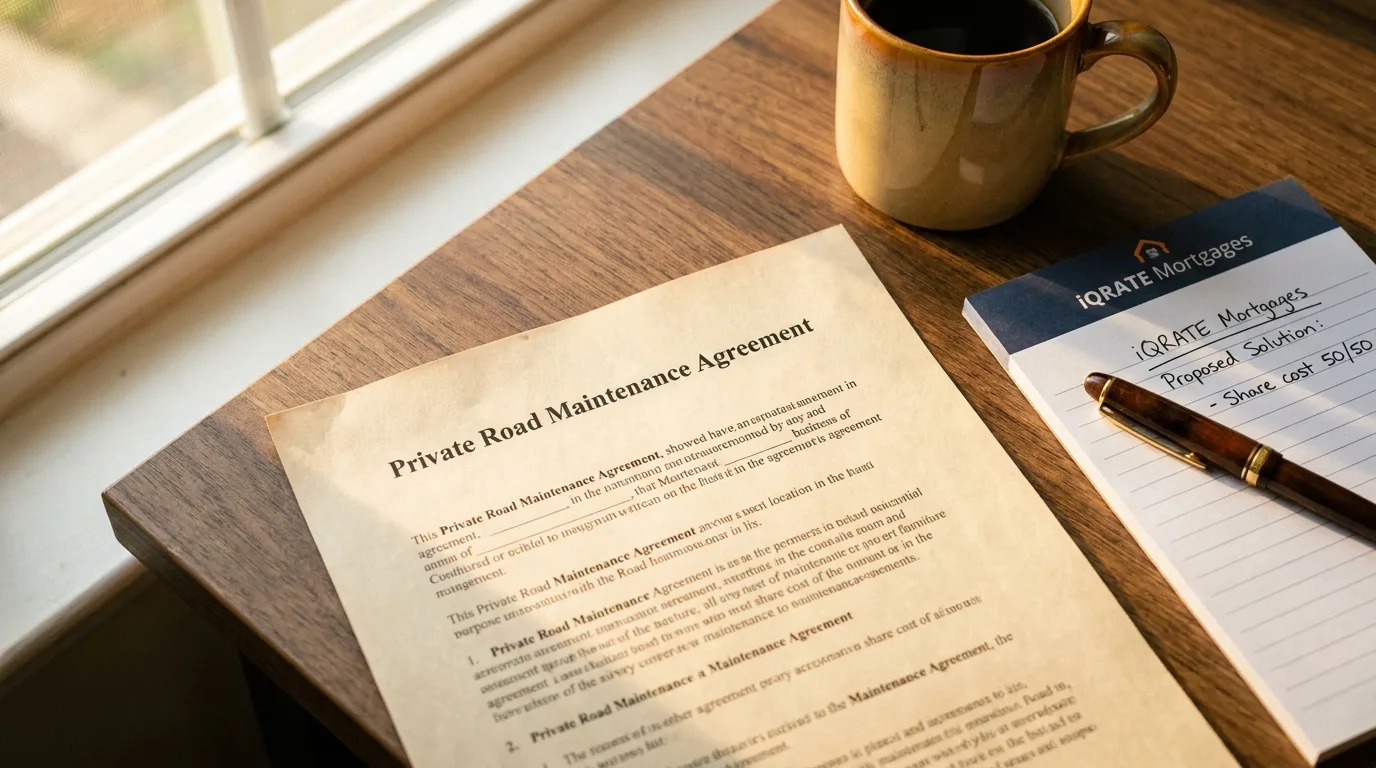
To satisfy FHA requirements, the property must have a legally sound document that proves the road will be taken care of for the life of the loan and beyond. This document is known as a Private Road Maintenance Agreement (PRMA).
What is a Private Road Maintenance Agreement?
A private road maintenance agreement is a formal, written contract between all property owners who use a private road. This legally binding document outlines the responsibilities and financial obligations for the upkeep, repair, and maintenance of that road. It’s not just a casual understanding between neighbors; it must be a recorded document that runs with the land, meaning it is binding on current and future owners of the properties.

What FHA Guidelines Mandate
The FHA, through the HUD Handbook 4000.1, specifies exactly what this agreement must include to be considered valid. A simple handshake deal or an informal neighborhood fund won't suffice. The agreement must:
- Be legally binding and enforceable for all property owners served by the private road.
- Clearly define how maintenance costs are shared equitably among the residents.
- Outline the method for approving and paying for repairs and maintenance.
- Establish a remedy in case of default by any property owner who fails to pay their share.
- Be officially recorded with the appropriate county clerk's office, which would be the Harris County Clerk's Office for properties in Houston and Pasadena.
Without an agreement that meets these specific criteria, an FHA underwriter has no choice but to block the loan from moving forward.
Navigating a Pasadena Property with No Formal Agreement
So, you've been told the Pasadena home you love lacks the required FHA documentation. Don't panic. You have several potential paths forward, though some are more complex than others.
Create a New Agreement: The most direct solution is to create an agreement that meets FHA standards. This involves getting every single property owner who uses the road to agree to the terms, sign the document, and have it legally recorded. This can be a challenging and time-consuming process, as it requires unanimous cooperation from neighbors you haven't even met yet. The seller would need to lead this effort, likely with the help of a real estate attorney.
Look for a Statutory Provision: In some rare cases, state or local laws may provide a legal framework for the maintenance of private roads, which an FHA underwriter might accept in lieu of a formal agreement. However, relying on this is uncertain, and most lenders will still strongly prefer a specific, recorded document. (The data, information, or policy mentioned here may vary over time.)
Switch Your Loan Program: This is often the most practical and efficient solution. If creating an agreement isn't feasible, your next best step is to see if you can qualify for a different type of mortgage, such as a conventional loan, which has more flexible guidelines on this issue.
Switching From an FHA to a Conventional Loan Mid-Purchase
Changing your financing in the middle of a real estate transaction sounds stressful, but it's a common pivot when issues like this arise. With a proactive lender, it can be a smooth transition.
Is It Possible to Change Loans?
Yes, it is absolutely possible to switch from an FHA to a conventional loan while under contract. The key is to act quickly. This change requires you to requalify under the new loan's guidelines, which typically include a higher credit score requirement and potentially a larger down payment. You must coordinate this change with your lender, the seller's agent, and the title company to keep the transaction on track.
Steps to Making the Switch
- Inform Your Lender Immediately: The moment you learn about the private road issue, ask your loan officer to evaluate your eligibility for a conventional loan. They will review your credit score, debt-to-income ratio, and available funds for a down payment.
- Get a New Loan Estimate (LE): Your lender will issue a new LE for the conventional loan. Compare the interest rate, closing costs, and private mortgage insurance (PMI) terms to your original FHA loan.
- Update the Purchase Contract: The contract likely specifies you are seeking FHA financing. You will need to execute an amendment, signed by you and the seller, changing the financing type. Most sellers will agree to this if it means saving the sale.
- Address the Appraisal: In many cases, an FHA appraisal can be converted or transferred for use with a conventional loan, but this depends on the lender's policy. Your loan officer will confirm if a new appraisal needs to be ordered, which could add time and cost to the process. (The data, information, or policy mentioned here may vary over time.)
How Conventional Loans View Properties on Private Roads
Conventional loans, which conform to guidelines set by Fannie Mae and Freddie Mac, offer significantly more flexibility regarding private roads. While they also want to see evidence of a well-maintained and legally accessible property, their rules are not as rigid as the FHA's.
Typically, for a conventional loan, if a formal maintenance agreement exists, the lender will review it to ensure it's adequate. However, if no agreement exists, the loan may still be approved provided:
- The appraiser confirms the road is in acceptable condition and provides marketable access to the property.
- There is evidence of a history of shared maintenance, even if informal.
- The road is privately maintained by a homeowners' association (HOA) with the power to levy assessments for repairs.
For many buyers in Houston or Pasadena who are blocked by the FHA's strict rule, a conventional loan becomes the clear and simple solution to save their home purchase. (The data, information, or policy mentioned here may vary over time.)
Who is Responsible for the Road Maintenance Agreement?
As the buyer, you are not responsible for creating the agreement. The responsibility falls on the property owners who benefit from the road. The seller, who is motivated to close the sale, should take the lead in either providing an existing agreement or attempting to create a new one with their neighbors. Your real estate agent should be instrumental in communicating this need to the seller's agent and helping to negotiate any necessary contract extensions.
Impact on Home Insurance and Property Value in Texas
This issue extends beyond just the mortgage approval. The status of your road can have long-term financial implications.
Long-Term Property Value
A property on a private road with a solid, recorded maintenance agreement is a stable asset. One without it can suffer from a diminished value. When it's time for you to sell, future buyers will face the same financing hurdles you are facing now, shrinking your pool of potential offers and potentially forcing you to sell at a discount.
Securing Homeowners Insurance
Insurance companies also assess risk based on property access. If a fire truck or ambulance cannot reliably reach your home, an insurer may charge higher premiums or, in extreme cases, refuse to issue a policy. Ensuring clear and maintained access is critical for both safety and financial reasons.
Actionable Steps to Save Your Houston Home Purchase
Facing a loan denial is scary, but you have a clear path forward. Follow these steps to get your purchase back on track:
- Confirm the Specific Requirement: Ask your loan officer for the exact FHA underwriter condition related to the private road. Understand precisely what is missing.
- Communicate with Your Team: Immediately inform your real estate agent. They need to talk to the seller's agent to determine if an agreement was simply overlooked or if one truly doesn't exist.
- Explore a Conventional Loan Immediately: This is your most powerful move. Ask your lender to pre-qualify you for a conventional loan. If your credit and down payment meet the criteria, this will likely be the fastest way to solve the problem.
- Negotiate a Contract Extension: If you switch loans or if the seller attempts to create an agreement, you will likely need more time to close. Have your agent draft an addendum to extend the closing date.
- Consult a Real Estate Attorney: If creating a new road agreement is the chosen path, the seller and their neighbors will need a qualified attorney to draft and record the document properly. Facing a roadblock with a private road in Houston doesn't have to end your homeownership dream. Exploring all your lending options is the first step. A mortgage expert can quickly assess your eligibility for a conventional loan and guide you through the switch, ensuring your purchase stays on track.
Don't let a private road issue derail your Houston home purchase. Our team specializes in finding solutions, including a seamless switch to a conventional loan. Let us help you navigate the complexities and secure your dream home. Apply now to get started.
Author Bio
David Ghazaryan is the expert mortgage strategist and founder behind iQRATE Mortgages. With a mission to fund home loans that traditional banks won't touch, David specializes in helping clients with unique financial situations, including those recovering from foreclosure or bankruptcy. He expertly crafts smart, strategic, and stress-free mortgages by leveraging a vast network of over 100 lenders to secure competitive rates for investors and homebuyers alike. Praised for exceptional customer service, David has helped hundreds of families with a 97% satisfaction rate, guiding them to the mortgage they deserve.
References
HUD Handbook 4000.1 (FHA Single Family Housing Policy Handbook)









