


Why FHA Condominium Approval is a Challenge in Miami
When you're looking to buy a condominium in Miami with an FHA loan, you’re not just getting yourself approved; you’re also trying to get the entire building approved. The Federal Housing Administration requires condominium projects to be on its exclusive HUD-approved list. This is a significant barrier for many buyers in South Florida because a vast number of buildings are not on this list.
Why do so many projects fail to get or maintain this approval? The process is demanding and costly for homeowner associations (HOAs). It involves extensive paperwork, legal reviews, and meeting strict federal guidelines. Many HOAs simply don't have the resources, time, or incentive to go through the initial approval process or the required recertification every three years. As a result, homebuyers are often disappointed to find their dream condo is ineligible for FHA financing simply because the HOA never pursued HUD approval.
Key hurdles for FHA condominium approval include:
- Budget Requirements: The building's budget must have adequate reserves set aside for maintenance and capital expenditures, typically at least 10% of the annual budget.
- Owner-Occupancy Ratios: At least 50% of the units in the project must be owner-occupied, a difficult metric to meet in investment-heavy markets like Miami.
- Commercial Space Limits: The total square footage of commercial or non-residential space cannot exceed 50% of the project's total square footage.
- Single Investor Ownership: No single entity, including an investor or developer, can own more than 10% of the individual units.
Because of these stringent rules, a conventional loan often emerges as the more viable and 'safer' option, offering a path to financing that doesn't depend on a federal approval list.
Conventional Loan Reviews: Limited vs. Full
Conventional loans, which are not government-insured, offer a much more flexible approach to condominium approvals. Instead of a single, rigid approval list, conventional loans underwritten to Fannie Mae or Freddie Mac standards use a project review system. This system is broken down into two main types: a Full Review and a Limited Review.
Full Review
A Full Review is the more comprehensive of the two and shares many similarities with FHA requirements. A lender will conduct a thorough investigation of the condominium project's financial health, legal status, and operational stability. This includes scrutinizing the HOA's budget, insurance policies, reserve funds, and pending litigation. A full review is typically required for investment properties or for primary residences with a down payment of less than 10%. Many of the same factors that disqualify a building for FHA, like low reserves or high investor concentration, can also cause it to fail a full conventional review.
Limited Review
A Limited Review is the game-changer for many condominium buyers in Fort Lauderdale. It's a streamlined process that bypasses many of the hurdles of a full review. If your transaction meets certain criteria, the lender can approve the loan without digging deep into the HOA's financials. This makes the approval process faster and significantly increases the chances of closing.
To qualify for a Limited Review, you generally need:
- A sufficient down payment: For a primary residence, you typically need at least 10% down; for a second home, the requirement is usually 25% down.
- To be buying a primary residence or second home: Limited reviews are not available for investment properties.
- The developer has transferred control: The HOA must be managed by the unit owners, not the original builder or developer.
Under a limited review, the lender is primarily concerned with a few key 'red flags', such as the building being involved in litigation, rather than the entire financial profile of the association.
Investor Concentration Rules: FHA vs. Conventional
Investor concentration refers to the percentage of units in a condominium project that are owned by investors who rent them out, versus those occupied by the owners themselves. Lenders see high investor concentration as a risk factor because tenants may not maintain properties as well as owners, and investors are more likely to default on their HOA dues during an economic downturn.
FHA's Stance: FHA has a very strict and non-negotiable rule: at least 50% of the units must be owner-occupied. There is no flexibility on this point. In a market like Miami, where many condominiums are purchased as second homes or rental investments, this rule alone disqualifies a huge number of buildings.
Conventional's Flexibility: Conventional loans are significantly more adaptable. For a Full Review, lenders typically want to see at least 50% owner-occupancy, similar to FHA. However, the major advantage comes with the Limited Review. When a borrower qualifies for a limited review (e.g., by making a larger down payment), the owner-occupancy requirement is often waived entirely. This means you could potentially buy a condo in a Fort Lauderdale building where the majority of units are rentals, something that would be impossible with an FHA loan.
This flexibility makes conventional loans a far safer bet for buyers concerned that a building's high number of tenants could derail their financing.
How High HOA Dues Impact Your DTI in Fort Lauderdale
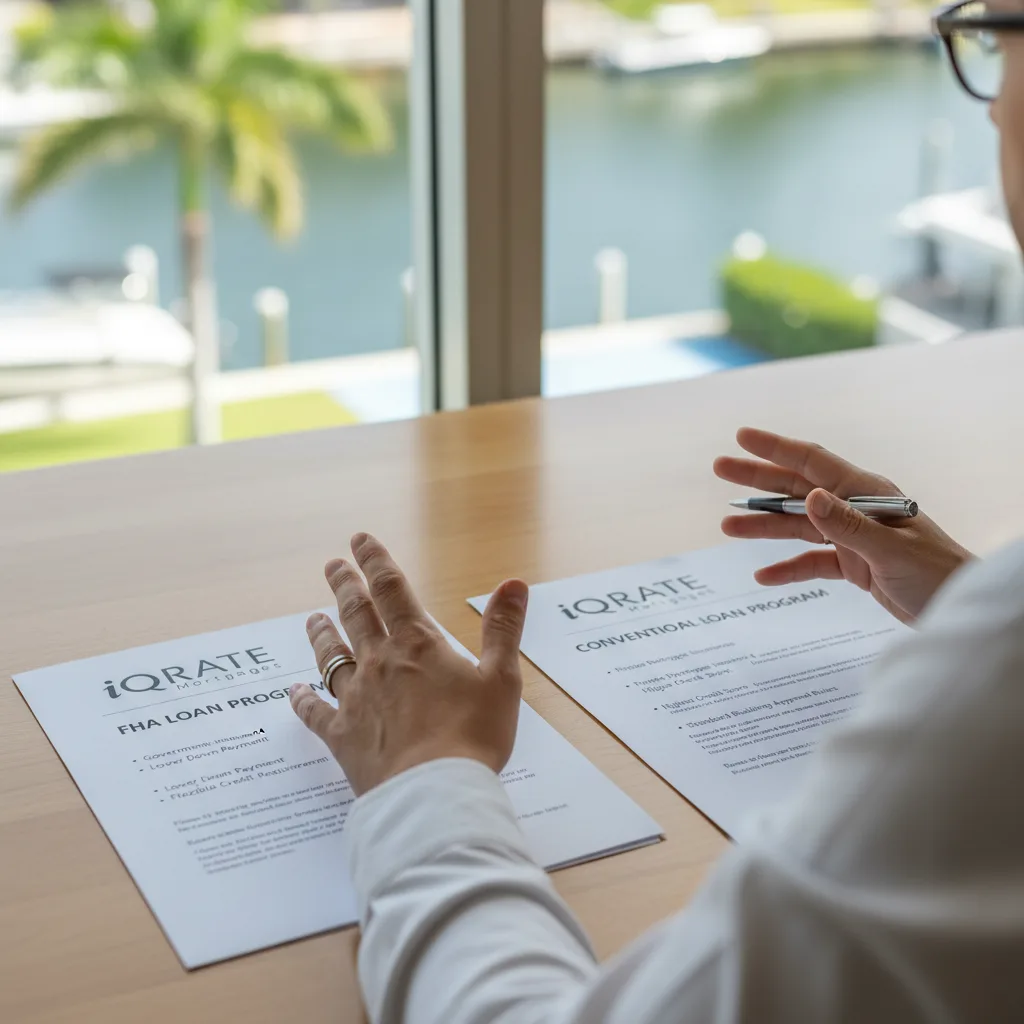
Your Debt-to-Income (DTI) ratio is one of the most important factors in mortgage qualification. It measures your total monthly debt payments against your gross monthly income. Both FHA and Conventional loans have DTI limits, and high HOA dues, which are common in amenity-rich Fort Lauderdale condominiums, can easily push you over the edge.
Lenders calculate your total housing payment by adding the principal, interest, taxes, and insurance (PITI), plus the monthly HOA dues. Let's look at an example:
- Buyer's Gross Monthly Income: $8,000
- Proposed Mortgage (PITI): $2,200
- Car Loan and Credit Cards: $600
- Fort Lauderdale Condo HOA Dues: $750
Calculation:
- Total Monthly Debt: $2,200 (PITI) + $600 (Other Debt) + $750 (HOA) = $3,550
- DTI Ratio: ($3,550 / $8,000) * 100 = 44.375%
In this scenario, the high HOA fee contributes significantly to the DTI. While FHA loans can sometimes allow for DTIs up to 50% or higher in certain cases (The data, information, or policy mentioned here may vary over time.), while conventional loans traditionally capped DTI around 45%, with automated underwriting systems, they can often be approved with a DTI ratio up to 50%. (The data, information, or policy mentioned here may vary over time.) That $750 monthly fee could be the difference between approval and denial. It effectively reduces your purchasing power, as every dollar spent on HOA dues is a dollar you can't borrow for the mortgage itself. Before making an offer, always get the exact HOA fee and have your lender run the numbers to ensure you remain within qualification guidelines.
Which Loan Handles Pending Litigation Better?
Pending litigation is a major red flag for lenders. If a condominium association is being sued, especially for issues related to construction defects or safety, it creates uncertainty about the building's financial stability and the potential for large special assessments on homeowners.
FHA: For FHA loans, any significant pending litigation against the HOA is almost always a deal-breaker. FHA's guidelines are extremely risk-averse, and they will not approve a loan for a unit in a project with ongoing lawsuits concerning the safety, structural soundness, or functional use of the project.
Conventional: Conventional loans offer slightly more leeway, particularly under a Limited Review. While major structural litigation will still prevent financing, lenders may be willing to overlook minor, non-structural lawsuits. For example, if the HOA is involved in a small 'slip and fall' lawsuit that is fully covered by its insurance policy, a conventional lender might still approve the loan. The key is the nature and potential financial impact of the lawsuit. A conventional loan provides a better, though not guaranteed, chance of navigating this issue compared to the rigid stance of the FHA.
Condominium Mortgage Insurance: FHA vs. Conventional
If you put less than 20% down on a loan, you will be required to pay mortgage insurance. The structure and cost of this insurance differ dramatically between FHA and Conventional loans, impacting your long-term financial safety.
FHA Mortgage Insurance Premium (MIP): FHA loans have two types of mortgage insurance. First, there's an Upfront Mortgage Insurance Premium (UFMIP) of 1.75% of the loan amount, which is typically rolled into your loan balance. Second, there's an annual MIP, paid monthly, which currently stands at 0.55% for most borrowers. (The data, information, or policy mentioned here may vary over time.) The critical point is that if you put down less than 10%, this monthly MIP is for the life of the loan. It never goes away unless you refinance.
Conventional Private Mortgage Insurance (PMI): With a conventional loan, you pay Private Mortgage Insurance (PMI). There is no upfront premium. The monthly cost varies based on your credit score and down payment but is often competitive with FHA. The biggest advantage is that PMI automatically cancels once your loan balance drops to 78% of the original property value. You can also request to have it removed once you reach 20% equity.
Example: $400,000 Fort Lauderdale Condominium with 5% Down ($380,000 loan)
- FHA MIP (monthly): ~$174 (and it's permanent)
- Conventional PMI (monthly): ~$140-$200 (depending on credit, and it's temporary) (The data, information, or policy mentioned here may vary over time.)
Over the long term, the conventional loan is financially 'safer' because the PMI eventually disappears, lowering your monthly payment and saving you tens of thousands of dollars over the life of the loan.
Key Questions for the Miami Homeowner Association (HOA)
Before you make an offer on a Miami condominium, doing your homework on the HOA is non-negotiable. Asking the right questions can save you from a potential financial nightmare and a loan denial. Get a copy of the condo documents and ask the property manager or an HOA board member these questions:
- 'What is the current owner-occupancy percentage?'
- 'Are there any pending or anticipated special assessments?'
- 'How much money is currently in the reserve fund? Has a reserve study been completed recently?'
- 'Is the association involved in any pending litigation?'
- 'Are there any rental restrictions, such as a waiting period before an owner can lease their unit?'
- 'What percentage of homeowners are delinquent on their dues?' (More than 15% is a major red flag for lenders).
- 'Can you provide a copy of the current year's approved budget and the master insurance policy?'
How to Check if a Fort Lauderdale Condominium is Approved
Verifying a condominium's loan eligibility can feel daunting, but there are straightforward ways to get answers.
For FHA Loans: The process is centralized and public. You can directly check the HUD database to see if a building is on the approved list.
- Go to the HUD.gov Condominiums search page.
- Enter the state (Florida), county, and the name of the condominium project.
- The search results will show the approval status, including when it was approved and when the approval expires.
If the building is not on this list, you cannot use an FHA loan to buy a unit there.
For Conventional Loans: There is no central public database for conventional loan approvals. The approval is done on a case-by-case basis by the lender for each specific loan transaction. The best and only reliable way to find out is to work with a knowledgeable mortgage lender. An experienced loan officer can quickly run the project's details through Fannie Mae and Freddie Mac's internal systems to determine if it's eligible and whether it will require a full or limited review. They can often give you a preliminary answer in a matter of hours, providing the clarity you need to move forward with confidence.
Securing financing for a condo in Miami or Fort Lauderdale requires more than just a pre-approval; it requires a strategy. To verify your dream condo's eligibility and find the loan that best fits your financial future, take the next step. Apply now to connect with an expert and get the clarity you need to move forward.
Author Bio
David Ghazaryan is the expert mortgage strategist and founder behind iQRATE Mortgages. With a mission to fund home loans that traditional banks won't touch, David specializes in helping clients with unique financial situations, including those recovering from foreclosure or bankruptcy. He expertly crafts smart, strategic, and stress-free mortgages by leveraging a vast network of over 100 lenders to secure competitive rates for investors and homebuyers alike. Praised for exceptional customer service, David has helped hundreds of families with a 97% satisfaction rate, guiding them to the mortgage they deserve.
References
Fannie Mae Condominium Project Standards
CFPB: What are homeowners association (HOA) dues and condo fees?









