


How Lenders Verify Short-Term Rental Income for a DSCR Loan in Austin
Lenders take a cautious and data-driven approach to verifying short-term rental (STR) income for a DSCR loan in Austin. They know the potential for high returns is matched by regulatory risk. Instead of just accepting your projected income, they use a multi-pronged verification process.
First, they will almost always require the property appraisal to include a Comparable Rent Schedule (Form 1007). While this form is traditionally for long-term rentals, the appraiser will use it to establish a baseline long-term market rent. This figure acts as a safety net for the lender. If the STR market collapses or regulations change, they know what the property could earn as a standard rental.
For verifying STR-specific income, lenders rely on a few key sources:
- Third-Party Data: Underwriters use data from services like AirDNA or Mashvisor to pull performance data for comparable STR properties in the specific Austin neighborhood, like Zilker or East Austin. They look at occupancy rates, average daily rates (ADR), and total revenue.
- Lease History (if available): If you have at least a 12 to 24-month history of STR income from the property on platforms like Airbnb or Vrbo, lenders will analyze these statements. They will average the income, often looking at a trailing 12-month period to smooth out seasonality.
- Property Management Projections: A professional STR management company in Austin can provide a 'pro forma' or income projection. While useful, lenders view this as supplementary data and weigh it less heavily than appraisal data or actual performance history.

Example: You project an Austin STR will generate $8,000 per month. The appraiser determines its long-term market rent is $4,500. The lender, using AirDNA data, sees similar properties averaging $7,000. For the DSCR calculation, they will likely use the most conservative figure that is reasonably supported, which might be the $7,000 average or even a blended figure, but rarely your optimistic $8,000 projection. (The data, information, or policy mentioned here may vary over time.)
Can City Rental Restrictions Cause My Dallas DSCR Loan to Be Denied?
Yes, absolutely. City rental restrictions are a primary factor in a lender's risk assessment, and new or unclear rules in Dallas can directly lead to a loan denial. Lenders financing an investment property are underwriting the property's ability to generate income. If a city ordinance jeopardizes that income stream, the loan is no longer a sound investment for them.
Here are specific scenarios where Dallas rental restrictions could trigger a denial:
- Zoning and Overlays: The recent Dallas ordinance restricted STRs to specific zoning districts. If the property you are buying is located in a neighborhood where STRs are now prohibited, a lender will not approve a loan based on STR income projections. The property's primary business model is illegal.
- Licensing and Registration Uncertainty: If a property lacks the required city registration or permits, it's an automatic red flag. Lenders will not fund a loan for a non-compliant business operation. They will require proof of an active and valid STR license before closing.
- Increased 'Headline Risk': Even if a property is currently compliant, ongoing legal challenges or public debate about tightening regulations in a city like Dallas creates 'headline risk'. Some conservative lenders may choose to pause or stop lending on STRs in that market altogether until the regulatory landscape stabilizes, fearing that a future rule change could hurt their investment.
Ultimately, the lender's underwriting model is designed to ensure the Debt Service Coverage Ratio (DSCR) is met for the life of the loan. A municipal ordinance that could slash the property's income directly threatens that ratio, making loan denial a logical outcome. (The data, information, or policy mentioned here may vary over time.)
Does a Property's Homestead Exemption Affect My Investor Loan Approval?
A homestead exemption on a property is a major obstacle for securing a DSCR loan and will almost certainly prevent approval until it is resolved. A homestead exemption legally declares the property as your primary residence to receive a property tax reduction. This directly contradicts the fundamental premise of a DSCR loan, which is designed exclusively for non-owner-occupied investment properties.
When an underwriter sees an active homestead exemption, it signals one of two things, both of which are problematic:
- Occupancy Fraud: The borrower may be trying to live in the property while financing it as an investment, which is a form of mortgage fraud.
- Administrative Error: The exemption was not removed after the property was converted to a rental.
Regardless of the reason, the lender cannot proceed. To secure the DSCR loan, you must provide definitive proof to the title company and lender that the homestead exemption has been formally removed by the county appraisal district (e.g., Dallas Central Appraisal District or Travis Central Appraisal District). The removal must be complete before your loan can close. Attempting to finance an investment property with this exemption is a non-starter for any legitimate lender. (The data, information, or policy mentioned here may vary over time.)
What Is a Rental Survey and How Is It Used for DSCR Qualification in Austin?
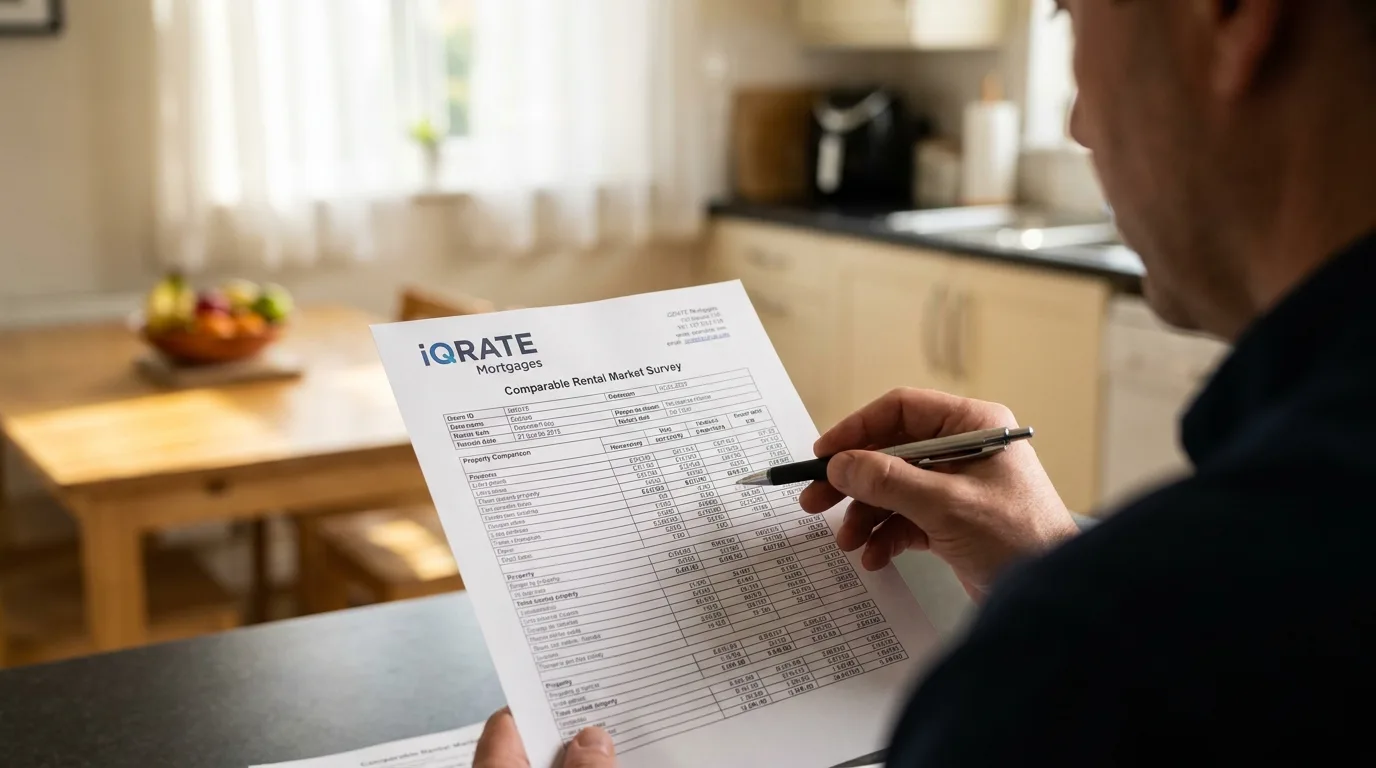
A rental survey, formally known as the Single-Family Comparable Rent Schedule (Form 1007) or Small Residential Income Property Appraisal Report (Form 1025), is a standard part of the appraisal process for an investment property. It is the appraiser's professional opinion of what the subject property would rent for on the open market.
For a DSCR loan qualification in Austin, this document is critical. The market rent determined by the appraiser is the 'income' figure the lender will use in the DSCR calculation. This is especially important for properties without an existing tenant or rental history.
DSCR Formula: Gross Market Rent / PITI (Principal, Interest, Taxes, Insurance)
Here’s how an Austin-based appraiser completes the survey:
- Select Comparables: The appraiser finds at least three similar properties in the same neighborhood (e.g., South Lamar, Allandale) that have recently been rented.
- Analyze Features: They compare features like square footage, number of bedrooms/bathrooms, condition, and amenities (pool, garage, recent updates).
- Make Adjustments: The appraiser adjusts the rental price of the comparable properties up or down to match the subject property. For example, if a comparable has a two-car garage and the subject property only has a carport, a downward adjustment is made.
- Determine Market Rent: Based on the adjusted values of the comparables, the appraiser provides a final, conclusive opinion of the fair market rent. This is the number the underwriter uses.
This independent, third-party valuation prevents borrowers from overstating potential income and ensures the lender is making a decision based on realistic, market-supported data. (The data, information, or policy mentioned here may vary over time.)
How Do I Prove Income Potential on a Property With No Rental History?
Proving income potential on a property with no tenants or rental history, such as a new purchase or a recently renovated property in Dallas, relies almost entirely on the appraisal and its accompanying rental survey. The lender considers the appraiser's opinion of fair market rent as the primary evidence of income potential.
Your personal projections or spreadsheets are not sufficient. The lender needs objective, third-party validation. The Comparable Rent Schedule (Form 1007) is the document that proves the property's earning power.
To support the appraiser's findings and build a stronger case, you can also provide:
- A Signed Lease Agreement: If you have already secured a tenant and have a signed lease that will begin after closing, this is powerful evidence. The lender will use the rent amount from the lease as long as it is reasonably close to the market rent determined by the appraiser.
- Professional Pro Forma: A detailed income and expense projection from a reputable Dallas-area property management company can add credibility, though it remains secondary to the appraisal.
- Market Data: You can provide your own research on rental comps from Zillow, Realtor.com, or other platforms, but be prepared for the lender to defer to their appraiser's official report.
Example: You are buying a renovated duplex in the Bishop Arts district of Dallas. You have no tenants yet. The appraiser analyzes three other rented duplexes nearby and concludes the fair market rent for your property is $5,000 per month. The lender will use $5,000 to calculate your DSCR, regardless of your personal estimate. (The data, information, or policy mentioned here may vary over time.)
Will New Dallas Short-Term Rental Laws Impact My Ability to Refinance?
Yes, new short-term rental laws in Dallas can significantly impact your ability to refinance a property, especially if you are seeking a cash-out refinance. The success of a refinance depends on two factors: the property's appraised value and its income stream. New STR regulations can undermine the income component.
If your property was operating as a profitable STR but new laws make that use non-compliant, its income potential may drop dramatically. For refinancing purposes, the lender will have to re-qualify the property based on the new, legal maximum income it can generate—which would be its long-term rental rate.
Refinance Scenario:
- Original STR Income: $9,000/month
- PITI: $4,500/month
- Original DSCR: 2.0 ($9,000 / $4,500) — Very strong
Now, a new Dallas ordinance makes STRs illegal at this location.
- New Long-Term Rental Income: $5,000/month (determined by a new appraisal)
- PITI: $4,500/month
- New DSCR: 1.11 ($5,000 / $4,500) — Barely qualifies or is denied
Because the DSCR is now much lower, the lender may deny the refinance completely or only approve a smaller loan amount that meets their minimum 1.20 or 1.25 DSCR requirement. Your ability to pull cash out of the property could be eliminated entirely. (The data, information, or policy mentioned here may vary over time.)
Do Lenders Prefer Long-Term or Short-Term Rentals for DSCR Loans?
Generally, lenders prefer long-term rentals (LTRs) for DSCR loans. The preference is rooted in risk management. LTRs, with 12-month leases, represent a stable, predictable, and consistent income stream. This predictability makes it easier for underwriters to model the loan's performance over time.
Short-term rentals (STRs), while potentially more lucrative, come with several layers of risk that make lenders more cautious:
- Income Volatility: STR income can fluctuate wildly with seasons, economic downturns, and local events.
- Regulatory Risk: As seen in Austin and Dallas, city governments can change STR rules, potentially crippling a property's income overnight.
- Management Intensity: STRs require constant, active management, which introduces more operational risk than an LTR with a passive tenant.
Because of this, many DSCR lenders have specific guidelines for STRs. Some will not lend on them at all. Others will use the lower of the projected STR income or the market long-term rent for qualification. This conservative approach protects the lender by ensuring the property can still cover its debt service even if it must be converted to a traditional rental. (The data, information, or policy mentioned here may vary over time.)
What Documents Can I Provide to Show My Austin Rental Complies With Local Rules?
To assure a lender that your Austin rental property is a compliant and therefore stable investment, you need to provide clear, official documentation. An underwriter won't just take your word for it. A complete package demonstrates professionalism and reduces the lender's perceived risk.
Here is a checklist of documents to have ready:
- Short-Term Rental License: Provide a copy of the valid, unexpired STR license issued by the City of Austin. This is the most critical document and is non-negotiable.
- Proof of Hotel Occupancy Tax (HOT) Payments: Show statements or receipts proving you are registered with and remitting taxes to the Texas Comptroller and the City of Austin.
- Certificate of Occupancy: For certain property types or recent constructions, this document proves the building is legally habitable.
- Liability Insurance Certificate: A copy of your insurance policy showing adequate liability coverage, often a requirement for STR licensing.
- Booking and Revenue Statements: Provide at least 12 months of statements from Airbnb, Vrbo, or your property management software to verify the income history and demonstrate consistent operation.
(The data, information, or policy mentioned here may vary over time.)
Navigating the complexities of DSCR loans in dynamic markets like Austin and Dallas requires a skilled partner. If you're ready to finance your next investment property with a clear, regulation-aware strategy, Apply now to connect with an expert who understands the lender's perspective.
Author Bio
David Ghazaryan is the expert mortgage strategist and founder behind iQRATE Mortgages. With a mission to fund home loans that traditional banks won't touch, David specializes in helping clients with unique financial situations, including those recovering from foreclosure or bankruptcy. He expertly crafts smart, strategic, and stress-free mortgages by leveraging a vast network of over 100 lenders to secure competitive rates for investors and homebuyers alike. Praised for exceptional customer service, David has helped hundreds of families with a 97% satisfaction rate, guiding them to the mortgage they deserve.
References
City of Austin - Short-Term Rentals









