


What 'Commingled Funds' Means to an Austin Mortgage Underwriter
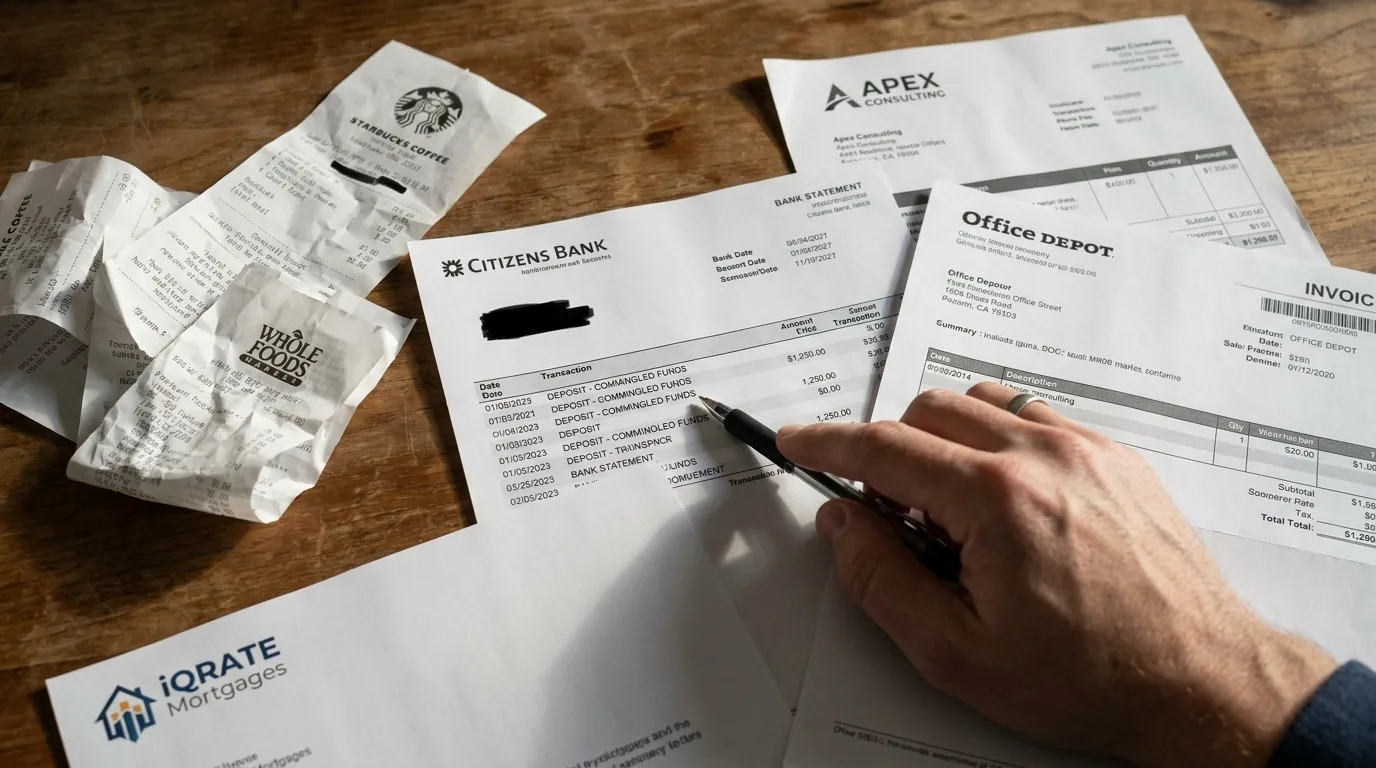
For a self-employed borrower in Austin, the term 'commingled funds' isn't a complex legal concept; it's a practical underwriting problem. It simply means you use a single bank account for both business revenue and personal life. To a mortgage underwriter, whose primary job is to verify income and assess risk, this practice makes your financial life an unreadable mess. They see a chaotic blend of client payments, grocery bills, tax payments, birthday money from a relative, and supply purchases all in one place.
An underwriter’s goal is to confirm two things: the source of your funds and the stability of your income. When funds are commingled, this becomes nearly impossible. Imagine this common scenario for a freelance graphic designer in Austin:
- Week 1: A $4,000 deposit from a corporate client.
- Week 2: A $250 Venmo transfer from a roommate for their share of the rent.
- Week 3: A $1,500 deposit from a new project, plus a $500 Zelle payment from their parents as a gift.
- Week 4: Multiple small payments from various clients totaling $3,000.
From the outside, this account shows $9,250 in deposits. But how much of that is actual, repeatable business income? The underwriter has no way to know. The $250 is a pass-through expense, the $500 is a gift that cannot be used as qualifying income, and the client payments are mixed together. This lack of clarity is the biggest red flag. The underwriter cannot confidently calculate your qualifying income, forcing them to deny the loan application not because you don't make enough money, but because you cannot prove it according to lending guidelines.
Why Lenders Distrust Business and Personal Funds in One Account
Lenders are not trying to be difficult; they are managing risk according to strict industry rules set by entities like Fannie Mae and Freddie Mac. A commingled account creates several specific problems that directly conflict with these underwriting standards.
- Inability to Verify Qualifying Income: The core of any mortgage approval is stable, predictable income. When a business deposit of $5,000 is followed by a personal withdrawal of $3,000 for a vacation, the underwriter can’t determine if the business is truly profitable or if personal cash is being used to keep it afloat. They need to see a clear separation between business revenue and your personal 'paycheck'.
- Unidentifiable Large Deposits: Underwriters must source and document every large, non-payroll deposit. In a commingled account, a $10,000 deposit could be a huge client payment (good) or a personal loan from a relative (bad, as it represents undisclosed debt). Without a clear paper trail tying the deposit to a business invoice, it becomes an unacceptable source of funds.
- Obscured Business Health: A clean business account shows the real cash flow of your enterprise. Lenders want to see healthy revenue coming in and legitimate business expenses going out. If you're constantly transferring personal money into the account to cover business expenses, it signals that the business may not be viable on its own, making your income stream unreliable.
- Risk of Ineligible Down Payment Funds: Money for a down payment must be your own and properly sourced. If your down payment is pulled from a commingled account, the lender can't be sure that part of it wasn't from an undocumented loan or a cash advance, which are not allowed.

For borrowers in competitive markets like Houston, where a strong application is key, a commingled account immediately puts you at a disadvantage. It creates dozens of questions and paperwork requirements that can delay or kill your approval.
Separating Your Funds for a Mortgage Application in Houston
If you're a self-employed professional in Houston planning to buy a home, cleaning up your finances is the single most important step you can take. The process is straightforward but requires discipline. Start this process at least three to six months before you plan to apply for a loan.
- Open a Dedicated Business Bank Account: This is non-negotiable. Go to your bank or a credit union and open a checking account specifically for your business. If your business is an LLC or S-Corp, this is legally required anyway. If you are a sole proprietor, do it for the sake of your mortgage application.
- Route All Business Income to the Business Account: Update all your client invoices with the new account information. All payments—checks, ACH transfers, Stripe payouts, etc.—must go directly into this account. Do not deposit a business check into your personal account, even as a one-time convenience.
- Pay All Business Expenses from the Business Account: Use the debit card or checks from your new business account to pay for software, supplies, contractors, marketing, and any other legitimate business expense. This creates a clean record of your business's true operating costs.
- Pay Yourself a 'Salary': This is the most critical step. Decide on a consistent amount of money to pay yourself and a regular schedule (e.g., $4,000 on the 1st and 15th of every month). Set up an automatic transfer from your business account to your personal account. This transfer now looks like a predictable paycheck to an underwriter, making your income easy to verify.
The Best Way to Document Large Cash Deposits from Clients
In the world of mortgages, 'cash deposit' refers to any non-payroll deposit. For self-employed individuals, this means every client payment. Every single one needs a clear paper trail, especially if it's considered 'large' (typically over 50% of your qualifying monthly income). (The data, information, or policy mentioned here may vary over time.)
Here’s the documentation you'll need for each large deposit:
- A Copy of the Cleared Check: If paid by check, provide a copy of the front and back of the cleared check from your bank statement.
- A Corresponding Invoice: The invoice must match the name and amount on the check. It should be dated and include details of the service provided.
- Proof of Deposit: Provide the bank statement showing the deposit clearing into your business account.
If you are paid digitally through platforms like Stripe, PayPal, or Square, you will need to provide the transaction report from that platform showing the client's payment, the fees deducted, and the net amount that was transferred to your business bank account. The goal is to create an unbroken chain of evidence from the client to your account that the underwriter can easily follow.
How Many Months of Clean Bank Statements Are Required?
Lenders typically require your two most recent months of bank statements for all accounts you are using for the down payment and closing costs. These two months must be pristine—no unexplained large deposits, no NSF fees, and no commingling.
However, for the purpose of verifying your self-employment income, two months is not enough. Underwriters need to see a history of stability. To present the strongest possible case, you should aim for at least six months of cleanly separated bank statements. A twelve-month history is even better.
This longer period allows the underwriter to see the established pattern of your 'salary' transfers from the business account to your personal account. It proves that your income is not a recent, temporary fluke created just to get a mortgage. It demonstrates financial discipline and the long-term viability of your business, significantly reducing the lender's perceived risk.
Can a Letter of Explanation (LOX) Fix Commingled Accounts?
A Letter of Explanation, or LOX, is a tool used to clarify a specific, isolated issue in your financial records. It is not a solution for a chronic problem like commingled funds.
You can effectively use a LOX to explain a single unusual deposit. For example: 'The $2,500 deposit into my personal account on June 5th was the result of selling a personal motorcycle. Please see the attached bill of sale. This is a one-time event and is not part of my regular income.'
Submitting a LOX that says, 'I apologize for my messy bank statements; I use one account for everything,' is counterproductive. You are simply confirming the underwriter’s worst fears in writing. A LOX cannot excuse a pattern of undocumented deposits or an inability to distinguish personal funds from business revenue. The solution is to fix the underlying problem by separating your accounts, not to write a letter excusing it.
Is a Profit and Loss (P&L) Statement Enough If My Bank Statements Are Messy?
No, absolutely not. A Profit and Loss (P&L) statement is a document that you or your accountant prepares. Bank statements are third-party records that are considered the ultimate source of truth by an underwriter. The purpose of reviewing your bank statements is to validate the information on your P&L and tax returns.
If your P&L for March shows $15,000 in revenue, the underwriter will examine your March business bank statement to find deposits totaling $15,000 that are clearly tied to business activity. If they find only $8,000 in identifiable business deposits mixed with random Venmo transfers and cash deposits, they will deem the P&L unreliable and likely deny the loan. The bank statements must support the P&L, not the other way around.
Tools to Keep Business and Personal Finances Separate
Maintaining financial separation doesn't have to be complicated. Using a few simple tools can automate the process and provide the clean documentation lenders need.
- Accounting Software: Services like QuickBooks Self-Employed, Wave, or FreshBooks are designed for freelancers and small business owners. They connect directly to your business bank account, help you categorize expenses, send professional invoices, and generate the P&L statements your lender will require.
- A Dedicated Business Bank Account: As discussed, this is the foundation of financial separation. Choose a bank that offers business accounts with low or no fees and good online tools.
- Payment Processors: Using a dedicated processor like Stripe or Square for all client payments creates an additional layer of clean, downloadable reporting that proves where your money came from. Navigating self-employed mortgage rules can be complex. If you're in Austin or Houston and need to untangle your finances for a loan approval, a mortgage strategist can help you create a clear roadmap to success.
Organizing your finances is the first step toward a successful mortgage application. When you're ready to move forward with clarity and confidence, Apply now to begin the process.
Author Bio
David Ghazaryan is the expert mortgage strategist and founder behind iQRATE Mortgages. With a mission to fund home loans that traditional banks won't touch, David specializes in helping clients with unique financial situations, including those recovering from foreclosure or bankruptcy. He expertly crafts smart, strategic, and stress-free mortgages by leveraging a vast network of over 100 lenders to secure competitive rates for investors and homebuyers alike. Praised for exceptional customer service, David has helped hundreds of families with a 97% satisfaction rate, guiding them to the mortgage they deserve.
References
Fannie Mae: B3-3.2-01, Analyzing Self-Employment Income
CFPB: What documents will I need to provide to my lender to apply for a mortgage?









