


Can I get a DSCR loan for a vacant property in Henderson?
Yes, you absolutely can secure a Debt Service Coverage Ratio (DSCR) loan for a vacant investment property in Henderson, Nevada. This is one of the primary advantages of a DSCR loan. Unlike traditional mortgages that focus on your personal income, a DSCR loan qualifies the property's ability to generate income.
Lenders understand that real estate investors often purchase properties without tenants in place. You might be buying from a previous owner-occupant or acquiring a property that needs minor updates before it is rent-ready. Instead of requiring a signed lease, lenders use a reliable, independent process to forecast the property's earning potential.
This process hinges on projecting the 'market rent', which is the amount the property is expected to rent for based on current local conditions. For an investor eyeing a single-family home in Henderson, the lender's goal is to answer one question: 'What would a tenant realistically pay per month for this specific property?'
The answer comes from professional analysis, not guesswork. The lender will commission an appraisal that includes a detailed rental income analysis. This projected income figure becomes the basis for calculating the DSCR and approving your loan, allowing you to invest without being penalized for a temporary vacancy.
What documents do lenders use to determine market rent in Las Vegas?
When underwriting a DSCR loan for a vacant property in Las Vegas, lenders rely on specific, standardized documents to establish a credible and defensible market rent figure. Your opinion or a Zillow estimate is not sufficient; the data must come from an impartial, professional source.
The primary document is the appraisal report. However, it is a specific component within this report that holds the key to projecting rent:
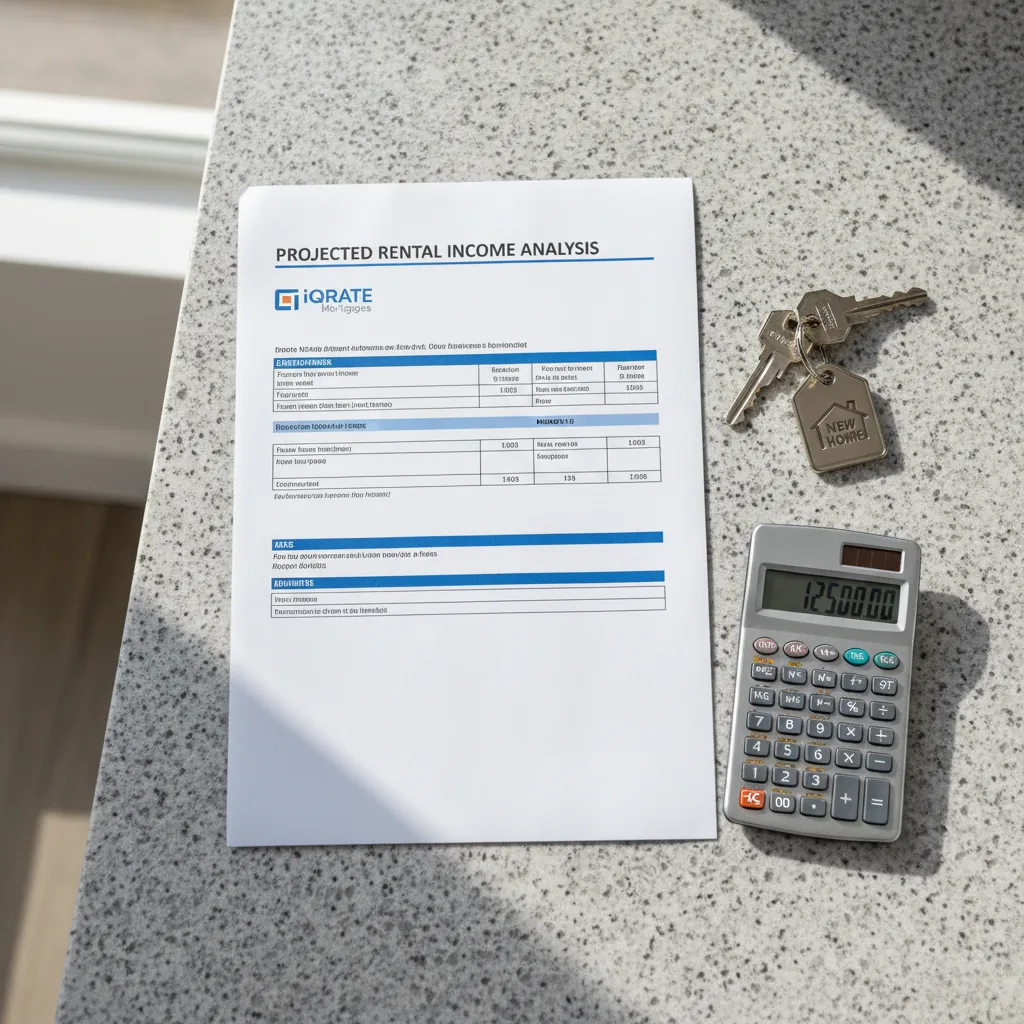
Form 1007 - Single-Family Comparable Rent Schedule: This is the most common tool for single-family residences, townhomes, and individual condos. It is a separate form completed by a licensed appraiser that analyzes comparable rental properties in the immediate vicinity. It is an addendum to the main appraisal form (Form 1004).
Form 1025 - Small Residential Income Property Appraisal Report: This form is used for 2-4 unit properties. It serves a dual purpose: it establishes the property's market value and also analyzes the market rent for each unit based on comparable multi-unit rentals in the area.
In both cases, the appraiser provides a detailed, data-backed opinion of the property's fair market rent. Lenders view this as the most reliable source of information because it is prepared by a state-licensed professional with no vested interest in the transaction beyond providing an accurate assessment. This unbiased opinion protects the lender's investment and gives you a realistic picture of your property's cash flow potential.
How does an appraiser's rental schedule work for my loan approval?
An appraiser’s rental schedule (Form 1007) is a methodical analysis, not a casual estimate. It is the bedrock of the lender's calculation for your DSCR loan approval on a vacant Las Vegas property. Here is a step-by-step breakdown of how it works:
- Selection of Comparable Properties: The appraiser identifies at least three similar properties in the same neighborhood that have been rented recently or are currently listed for rent. For a home in Summerlin, the appraiser will look for other homes in Summerlin with a similar square footage, bedroom/bathroom count, and condition.

Data Collection and Verification: For each comparable property, the appraiser gathers key data:
- Monthly rent amount
- Lease start date
- Property address
- Square footage, room count, and amenities (e.g., pool, garage, updated kitchen)
- Concessions offered (e.g., first month free)
The Adjustment Grid: The appraiser creates a grid comparing your investment property (the 'subject') to the comparables. They then make value adjustments. If a comparable property has a swimming pool and your property does not, the appraiser will subtract value from the comparable's rent to normalize it. If your property has a newly renovated kitchen and the comparable does not, they will add value.
Final Reconciliation: After making adjustments, the appraiser reconciles the data to arrive at a final opinion of market rent for your property. This is the figure the lender will use.
Example in Henderson
Let’s say you are buying a 3-bedroom, 2-bathroom, 1,800 sq. ft. home in Henderson.
- Comparable 1: Rented last month for $2,400. It is nearly identical.
- Comparable 2: Rented for $2,550 but has a pool. The appraiser adjusts its rent down by $100 for the pool, making its adjusted value $2,450.
- Comparable 3: Listed for $2,300. It is slightly smaller and has an older kitchen. The appraiser adjusts its rent up by $75, making its adjusted value $2,375.
Based on these adjusted values ($2,400, $2,450, and $2,375), the appraiser might conclude that the fair market rent for your property is $2,400 per month. This is the income figure your lender will use to calculate your DSCR.
Can I use AirDNA or Mashvisor data for a Summerlin DSCR loan?
This is a common question, especially for investors interested in the lucrative short-term rental (STR) market in areas like Summerlin or near the Las Vegas Strip. The answer is nuanced: it depends entirely on the lender and the type of DSCR loan you are seeking.
For a standard DSCR loan intended for a long-term rental (i.e., a 12-month lease), lenders will almost exclusively rely on the appraiser’s Form 1007. They will not accept data from platforms like AirDNA or Mashvisor to project long-term rent because their underwriting guidelines are built around traditional, stable rental income.
However, for a short-term rental DSCR loan, the story changes. A growing number of niche lenders specialize in financing properties used for platforms like Airbnb and Vrbo. These lenders understand that an appraiser's long-term rental schedule does not capture the true income potential of an STR. In these cases:
- Lenders will often accept and may even require data from platforms like AirDNA. This data provides detailed projections on Average Daily Rate (ADR), occupancy rates, and seasonal revenue trends specific to the property's exact location.
- The lender will use this data to calculate a monthly average income, which then serves as the 'Gross Rental Income' in the DSCR calculation.
- You may need to provide a report from one of these platforms as part of your loan application package.
So, if you are buying a property in Summerlin with plans to use it as a full-time Airbnb, you must seek out a lender who specifically offers STR DSCR loans. A traditional DSCR lender will only qualify you based on its long-term rental potential, which is often significantly lower.
What if the projected rent does not cover the mortgage payment?
When the appraiser's projected rent is not enough to cover the full monthly mortgage payment—including principal, interest, taxes, insurance, and association dues (PITIA)—it means your property has a DSCR below 1.0. This can jeopardize your loan approval, but you may still have options.
The DSCR formula is: Gross Projected Rent / Total Monthly Payment (PITIA)
Let’s say the projected rent for your Las Vegas property is $2,400, but the estimated PITIA is $2,600. Your DSCR would be $2,400 / $2,600 = 0.92x.
If the lender’s minimum required DSCR is 1.0x or higher, this loan would be declined as-is. Here is what you can do:
Increase Your Down Payment: This is the most direct solution. By putting more money down, you reduce the loan amount. A smaller loan means a smaller monthly PITIA payment. In the example above, increasing your down payment might lower the PITIA to $2,300, raising your DSCR to $2,400 / $2,300 = 1.04x, which could secure your approval.
Find a Lender with a Lower DSCR Minimum: Not all lenders are the same. While many prefer a DSCR of 1.25x or higher for the best rates, some specialty lenders offer 'no ratio' or 'low ratio' DSCR loans. They might approve loans with a DSCR down to 0.80x, especially for investors with strong credit and a larger down payment. (The data, information, or policy mentioned here may vary over time.) The trade-off is usually a slightly higher interest rate.
Re-evaluate the Investment: A DSCR below 1.0 indicates negative cash flow from day one. This should be a significant red flag. It might be a sign that you are overpaying for the property or that local rents do not support the current property values. It may be wise to reconsider the purchase or look for a different property with better income potential.
Challenge the Appraisal (Use with Caution): You can request a 'Reconsideration of Value' from the appraiser if you have concrete evidence they missed better, more recent comparable rental data. This is difficult to win, but if there are clear errors, it is a possibility.
How do short-term rental projections differ from long-term leases?
The methodology for projecting income from short-term rentals (STRs) is fundamentally different from that of long-term leases, and it carries different considerations for lenders.
Long-Term Lease Projections:
- Basis: Appraiser’s Form 1007 or an existing 12-month lease.
- Calculation: A single, stable monthly rent amount (e.g., $2,400/month).
- Stability: Considered highly stable and predictable. Lenders typically use 100% of this projected income in their calculations.
- Simplicity: It is a straightforward, widely accepted method.
Short-Term Rental Projections:
- Basis: Data from platforms like AirDNA, Mashvisor, or Vrbo, focusing on historical performance in the specific micro-location.
- Calculation: It is a multi-variable formula: (Average Daily Rate) x (Occupancy Rate %) x 30.4 (days in a month).
- Volatility: Income can fluctuate significantly based on seasonality, local events, and economic conditions. A property near the Las Vegas Convention Center will have very different peak seasons than a quiet residential home.
- Lender Conservatism: Due to this volatility, lenders are more conservative. They may only use 75-90% of the projected STR income for qualification or apply a higher 'vacancy factor' to account for empty nights. (The data, information, or policy mentioned here may vary over time.)
For example, if AirDNA projects an STR in Las Vegas will generate an average of $5,000 per month, an STR DSCR lender might only use $4,000 ($5,000 x 80%) as the qualifying income to ensure there is a buffer for slow months.
What property types in Las Vegas are easiest to qualify with projected rent?
When relying on projected rent for a DSCR loan, some property types in the Las Vegas area are significantly easier to finance than others. The ease of qualification comes down to the availability of reliable, comparable rental data.
Easiest to Qualify:
Single-Family Residences (SFRs): This is the gold standard. In established communities throughout Las Vegas, Henderson, and Summerlin, there is an abundance of rental data for standard 3- and 4-bedroom homes. Appraisers can easily find numerous comparable properties to create a strong, defensible Form 1007.
2-4 Unit Multi-Family Properties: Duplexes, triplexes, and fourplexes are also relatively straightforward. They are common investment properties, and appraisers can typically find sufficient rental comps to complete the Form 1025 appraisal report.
More Difficult to Qualify:
Condominiums in Restrictive HOAs: The main challenge with condos is not the property itself, but the Homeowners Association (HOA) rules. Some HOAs have strict rental restrictions, caps, or minimum lease terms that can hinder an investor. Lenders will scrutinize the HOA documents to ensure it is a viable rental property.
Unique or Luxury Properties: A custom-built, 5,000 sq. ft. luxury home with unique features is much harder to appraise for rent. There are few, if any, direct comparables, making the appraiser’s job more subjective and the lender more cautious.
Properties in Remote or Rural Areas: A home located far from the main suburban centers of Las Vegas may lack rental data. If an appraiser cannot find enough recent rental activity nearby, they cannot complete the rental schedule, which will halt the DSCR loan process. Understanding how lenders will view your vacant investment property is the first step to a successful purchase. If you have questions about qualifying for a DSCR loan in the Las Vegas area, a consultation with a mortgage expert can provide clarity on your specific scenario and financing options.
Ready to explore financing for your vacant investment property in Henderson or Las Vegas? Our specialists can provide clarity on your specific scenario. Apply now to get a clear picture of your DSCR loan options.
Author Bio
David Ghazaryan is the expert mortgage strategist and founder behind iQRATE Mortgages. With a mission to fund home loans that traditional banks won't touch, David specializes in helping clients with unique financial situations, including those recovering from foreclosure or bankruptcy. He expertly crafts smart, strategic, and stress-free mortgages by leveraging a vast network of over 100 lenders to secure competitive rates for investors and homebuyers alike. Praised for exceptional customer service, David has helped hundreds of families with a 97% satisfaction rate, guiding them to the mortgage they deserve.
References
Fannie Mae: Form 1007, Single-Family Comparable Rent Schedule









