


How is the Debt Service Coverage Ratio Formula Calculated in Texas?
A Debt Service Coverage Ratio (DSCR) loan is an asset-based mortgage. Lenders care less about your personal income and more about the investment property's ability to generate enough cash flow to pay for itself. The core of this analysis is the DSCR formula.
The Formula: DSCR = Gross Rental Income / PITI
- Gross Rental Income: This is the total monthly rent you collect from the property. Lenders will verify this using lease agreements and market rent analysis.
- PITI: This acronym stands for the total monthly housing expense: Principal, Interest, Taxes, and Insurance. If the property is part of a homeowners association, the monthly HOA dues are also included in this calculation (often called PITIA).
Many lenders look for a DSCR of 1.25 or higher, though some programs may allow for a ratio as low as 1.00 for strong applicants. (The data, information, or policy mentioned here may vary over time.) This means the property must generate 25% more income than its total monthly expenses. A ratio of 1.0 means the property breaks even, which is often considered too risky for a lender.
Example Calculation
Let's say you're buying a rental property in Round Rock, Texas:
- Monthly Rent:
$3,500 - Principal & Interest:
$2,000 - Monthly Insurance:
$150 - Monthly Property Taxes:
$650
Total PITI = $2,000 + $150 + $650 = $2,800
DSCR = $3,500 / $2,800 = 1.25
In this scenario, the property just meets the minimum requirement. The cash flow is sufficient to cover the debt service according to the lender's standards.
Why Do High Property Taxes in Austin Put My Loan at Risk?
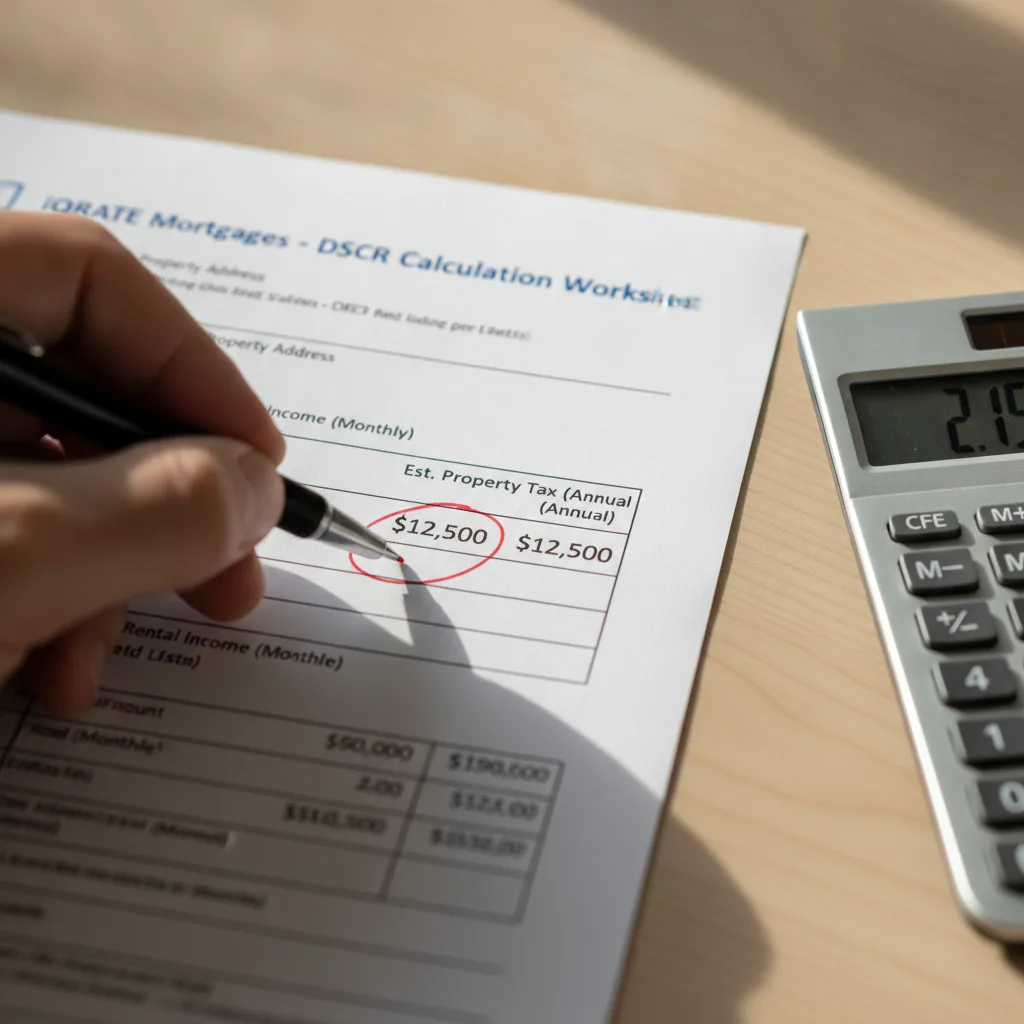
Texas is known for not having a state income tax, but it compensates with some of the highest property tax rates in the nation. For real estate investors in high-value markets like Austin, this can be a major hurdle for DSCR loan approval. High property taxes directly inflate the 'T' in PITI, which can easily push an otherwise profitable property's DSCR below the required threshold.
Consider an investment property in Austin with a market value of $500,000. The average effective tax rate in Travis County can be around 1.8% or higher. (The data, information, or policy mentioned here may vary over time.)
- Annual Property Tax:
$500,000 * 1.8% = $9,000 - Monthly Property Tax:
$9,000 / 12 = $750
This $750 monthly expense is a significant fixed cost. If the principal, interest, and insurance total $2,500, your total PITI becomes $3,250. To achieve a 1.25 DSCR, you would need to collect at least $3,250 * 1.25 = $4,062.50 in monthly rent. If the market rent for that property is only $3,800, your DSCR would be $3,800 / $3,250 = 1.17, and the loan would likely be denied.
Can I Use a Lower Estimated Tax Number for the Calculation?
No. This is a common question from investors hoping to make the numbers work, but lenders are strict on this point. Lenders will not use a hypothetical or optimistic tax figure. For underwriting, they will use one of two sources:
- Existing Properties: The lender will pull the most recent official tax bill from the county appraisal district. This is a non-negotiable, verifiable number.
- New Construction: For new builds without a tax history, lenders will use a conservative estimate based on the sales price multiplied by the local tax rate. They often err on the higher side to mitigate risk.
Attempting to use a lower number will be rejected by the underwriter and can delay or kill your loan application. Lenders must verify all components of PITI with third-party documentation.
Will a Larger Down Payment Help My Property Cash Flow for the Bank?
Absolutely. A larger down payment is one of the most effective strategies to overcome a low DSCR caused by high property taxes. It directly reduces the loan amount, which in turn lowers the 'Principal' and 'Interest' components of your PITI payment.
Let's revisit the Austin example where the DSCR was 1.17 and the loan was denied.
- Original Purchase Price:
$500,000 - Original Down Payment (20%):
$100,000 - Original Loan Amount:
$400,000(P&I of ~$2,648 at 7%) (The data, information, or policy mentioned here may vary over time.) - Total PITI:
$2,648 (P&I) + $750 (T) + $200 (I) = $3,598 - DSCR with
$3,800Rent:$3,800 / $3,598 = 1.05(Even worse than the first calculation)
Now, let's see what happens if you increase the down payment to 30%:
- New Down Payment (30%):
$150,000 - New Loan Amount:
$350,000(P&I of ~$2,328 at 7%) (The data, information, or policy mentioned here may vary over time.) - New Total PITI:
$2,328 (P&I) + $750 (T) + $200 (I) = $3,278 - New DSCR with
$3,800Rent:$3,800 / $3,278 = 1.16
Even with a 30% down payment, it's still not enough. To reach a 1.25 DSCR, you would need rent of $3,278 * 1.25 = $4,097.50. This illustrates just how impactful Texas property taxes are and why stress-testing your numbers is critical.
How Do Lenders Account for Future Property Tax Increases?
Lenders primarily base their DSCR calculation on the current property tax assessment. They are underwriting the loan based on the property's financial performance at the time of closing. While they are aware that taxes can and do increase, they do not typically project future tax liabilities into the initial DSCR calculation.
The risk of future tax increases falls on you, the investor. This is why it's crucial to build your own buffer into your cash flow projections. Do not assume that because the property qualifies today, it will remain as profitable in three to five years. Savvy investors in places like Dallas and Austin model a 3-5% annual increase in taxes and insurance to ensure their investment remains sound long-term.
Are There Investor Loan Programs That Ignore Property Taxes?
No. Any legitimate loan program that is based on the property's income, like a DSCR loan, must include property taxes and insurance in its calculation. These are fundamental expenses of owning real estate, and ignoring them would be a reckless lending practice.
Some other types of financing, such as hard money loans or certain business lines of credit, might focus more on the property's after-repair value (ARV) than on its cash flow. However, these are typically short-term loans with high interest rates and are not a substitute for a long-term DSCR mortgage. For any long-term rental financing, PITI is a mandatory part of the equation.
How Much Rental Income Is Needed to Offset Taxes in Dallas?
Let's create a clear scenario for an investment property in Dallas, which also has high property tax rates. The key is to work backward from the lender's required DSCR.
Property & Loan Details:
- Purchase Price:
$400,000 - Down Payment (25%):
$100,000 - Loan Amount:
$300,000 - Interest Rate:
7.25%on a 30-year term (The data, information, or policy mentioned here may vary over time.) - Principal & Interest (P&I):
$2,046 - Estimated Annual Insurance:
$2,160(or$180/month) - Dallas County Tax Rate (approx.):
2.2%(The data, information, or policy mentioned here may vary over time.)
Step 1: Calculate the Monthly Tax Burden
- Annual Property Tax:
$400,000 * 2.2% = $8,800 - Monthly Property Tax:
$8,800 / 12 = $733
Step 2: Calculate the Total Monthly PITI
- Total PITI =
$2,046 (P&I) + $733 (Taxes) + $180 (Insurance) = $2,959
Step 3: Determine the Required Rent for a 1.25 DSCR
- Minimum Required Monthly Rent = Total PITI * 1.25
- Minimum Required Monthly Rent =
$2,959 * 1.25 = $3,698.75
To get approved for this DSCR loan on a $400,000 property in Dallas, you must be able to demonstrate a verified lease or a strong market rent appraisal showing the property can command at least $3,700 per month in rent.
Should I Protest My Property Taxes Before Applying for the Loan?
Yes, protesting your property taxes can be a very smart move, but timing is everything. A successful tax protest lowers your property's assessed value, which directly reduces your annual tax bill. This lowers the 'T' in your PITI and can significantly improve your DSCR.
However, you should have the results of a successful protest in hand before you apply for the DSCR loan. The mortgage process moves quickly, and a lender will not wait for your protest to be resolved. They will underwrite the loan based on the most recent official tax bill on record.
If you successfully protest your taxes and receive a new, lower assessment from the county, provide this official documentation to your loan officer at the beginning of the application process. This will ensure they use the correct, lower figure in the DSCR calculation, increasing your chances of approval. Navigating high Texas property taxes for a DSCR loan requires careful planning. If you're analyzing an investment property in Austin or Dallas, contact a mortgage specialist who understands the local market and can help you structure your loan for success.
Understanding how Texas property taxes affect your DSCR is the first step. The next is getting an expert analysis on your specific investment. If you're ready to see how your numbers stack up, Apply now to get a personalized assessment from a mortgage specialist.
Author Bio
David Ghazaryan is the expert mortgage strategist and founder behind iQRATE Mortgages. With a mission to fund home loans that traditional banks won't touch, David specializes in helping clients with unique financial situations, including those recovering from foreclosure or bankruptcy. He expertly crafts smart, strategic, and stress-free mortgages by leveraging a vast network of over 100 lenders to secure competitive rates for investors and homebuyers alike. Praised for exceptional customer service, David has helped hundreds of families with a 97% satisfaction rate, guiding them to the mortgage they deserve.
References









