


Why FHA Mortgage Insurance Lasts Longer Than PMI
Many homebuyers in Texas, especially first-timers, leverage Federal Housing Administration (FHA) loans for their accessible down payment requirements. However, this benefit comes with a significant cost: the FHA Mortgage Insurance Premium (MIP). Unlike the Private Mortgage Insurance (PMI) on conventional loans, which automatically cancels once you reach 22% equity, FHA MIP has stricter rules.
For most FHA loans originated after June 3, 2013, with a down payment of less than 10%, the annual MIP is required for the entire life of the loan. This policy was implemented to protect the FHA fund against defaults. Even if your Houston home appreciates significantly and your equity grows, the monthly MIP payment remains unless you take specific action.
There are two parts to FHA MIP:
- Upfront Mortgage Insurance Premium (UFMIP): A one-time charge, typically 1.75% of the loan amount, paid at closing or rolled into the mortgage balance.
- Annual Mortgage Insurance Premium (MIP): Paid monthly as part of your mortgage payment. The rate varies but is often around 0.55% of the loan balance annually for a 30-year loan with minimum down payment. (The data, information, or policy mentioned here may vary over time.)
The Key to MIP Removal: Loan-to-Value (LTV) Ratio
To get rid of FHA MIP, the most critical number to understand is your loan-to-value (LTV) ratio. This ratio compares the amount you owe on your mortgage to your home's current appraised value. It's calculated like this:
LTV = (Current Mortgage Balance / Current Appraised Home Value) x 100
The goal is to get your LTV to 80% or lower. This means you have at least 20% equity in your home. Reaching this milestone is the primary trigger that allows you to refinance into a conventional loan without needing to pay for any mortgage insurance, effectively eliminating the FHA MIP payment for good.

Is Refinancing My Only Option to Remove FHA MIP in Houston?
For the vast majority of FHA borrowers, yes, refinancing into a non-FHA loan (like a conventional mortgage) is the only practical way to eliminate MIP. If you secured your FHA loan after June 3, 2013, and put down less than 10%, you are required to pay MIP for the full loan term.
There is one key exception:
- If you made a down payment of 10% or more, your FHA MIP is scheduled to automatically cancel after 11 years. While this is better than a lifetime requirement, 11 years is still a long time to pay an extra fee. Many homeowners in this situation still choose to refinance sooner once they hit 20% equity to start saving earlier.
When to Refinance Your Dallas FHA Loan for Maximum Savings
The best time to refinance is when several financial factors align in your favor. Rushing the process without meeting the right criteria can be counterproductive. Consider refinancing your Dallas FHA loan when:
- You Have 20% Equity: Rising home values in Dallas and the surrounding areas have helped many FHA borrowers reach the 20% equity mark faster than they expected. You can estimate your home's value using online tools, but a formal appraisal will be required during the refinance process.
- Your Credit Score Has Improved: A higher credit score (ideally 680+) will help you qualify for the best interest rates on a new conventional loan. (The data, information, or policy mentioned here may vary over time.)
- Interest Rates Are Favorable: Compare your current FHA interest rate to the conventional rates available. The goal is to secure a new rate that, combined with the MIP savings, results in a lower overall monthly payment.
Qualification Checklist: Refinancing Out of an FHA Loan
Before you start the application process, ensure you meet the general requirements for a conventional refinance. This move is essentially replacing your government-backed FHA loan with a new loan from a private lender.
Credit Score Requirements
Most lenders look for a minimum credit score of 620 for a conventional loan. However, to secure the most competitive interest rates and have a smoother approval process, a score of 700 or higher is recommended. If your score has improved since you first bought your home, you're in a strong position.
Home Equity and LTV Rules
The non-negotiable requirement is having at least 20% equity in your home, which corresponds to an 80% LTV ratio. If your LTV is higher than 80%, you would still be required to pay PMI on the new conventional loan, defeating the primary purpose of the refinance. For example, if your Houston home is now worth $400,000, your mortgage balance must be $320,000 or less to qualify.
Will My New Interest Rate Be Higher?
This is a common and valid concern. Your new interest rate is not guaranteed to be lower than your original FHA rate. It depends entirely on the market conditions at the time you refinance and your personal financial profile (credit score, debt-to-income ratio).
However, even if the new conventional rate is slightly higher, the math can still work out in your favor. The savings from eliminating the monthly MIP payment often outweighs a minor increase in the interest rate. It's crucial to calculate the total new payment (principal, interest, taxes, and insurance) and compare it to your current FHA payment.
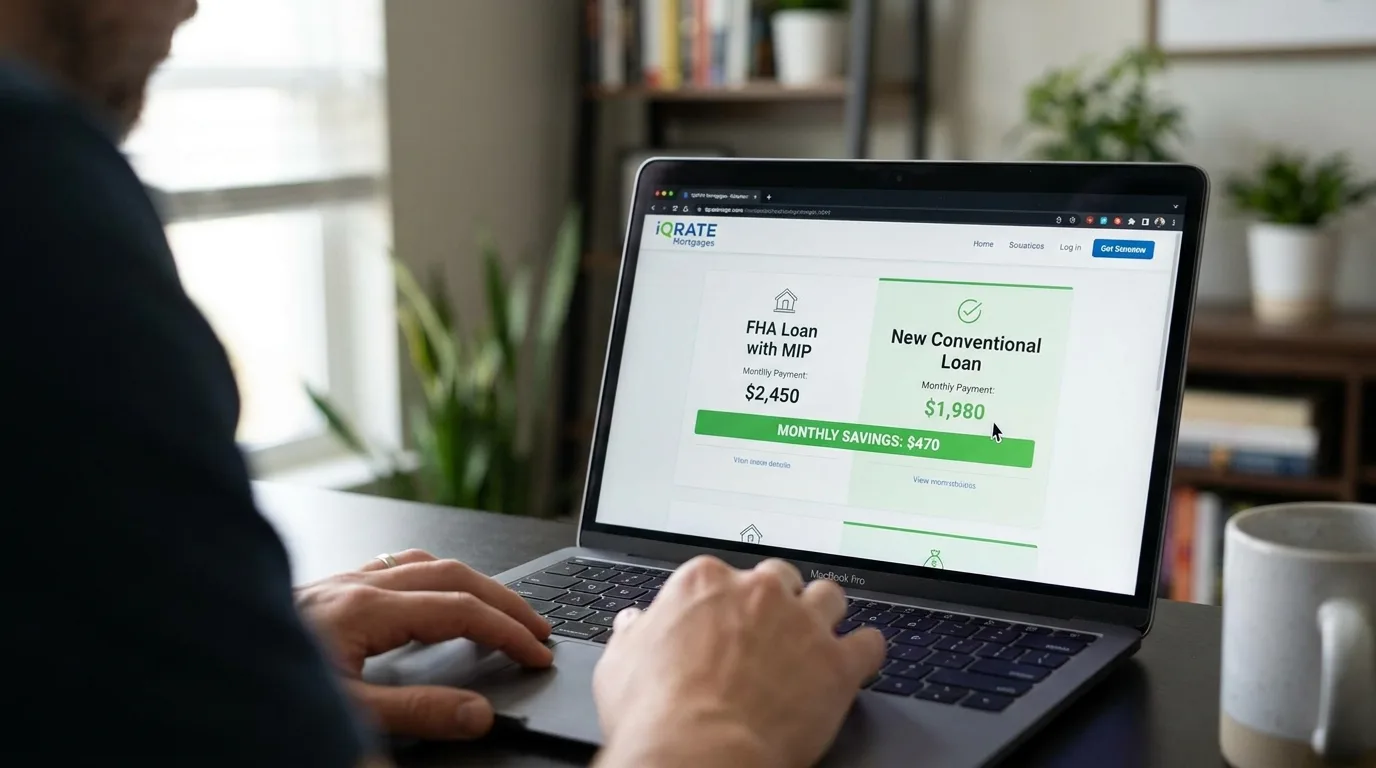
Calculating Your Potential Monthly Savings in Texas
Let's look at a realistic example for a homeowner in the Houston area to see how the savings add up.
Original Houston FHA Loan:
- Original Loan Amount: $350,000
- Current Balance: $335,000
- Annual MIP Rate: 0.55%
- Monthly MIP Payment: ($335,000 x 0.0055) / 12 = $153.54
Refinance Scenario:
- Home's Current Value: $425,000
- Equity: $90,000 (21.1%)
- New Conventional Loan: Refinance for $335,000
- New Monthly MIP/PMI Payment: $0
In this scenario, by refinancing into a conventional loan, the homeowner saves $153.54 every month, which amounts to $1,842.48 per year. Over the remaining life of the loan, these savings can easily exceed $50,000.
What Are the Closing Costs for an FHA-to-Conventional Refinance?
Refinancing is not free; you will have to pay closing costs, just as you did with your original mortgage. These costs typically range from 2% to 5% of the new loan amount and cover fees such as:
- Appraisal Fee: To confirm your home's current market value.
- Lender Origination Fees: For processing and underwriting the new loan.
- Title Insurance and Search Fees: To ensure the property title is clear.
- Recording Fees: Paid to the county to record the new mortgage.
For a $335,000 refinance, you could expect closing costs between $6,700 and $16,750. (The data, information, or policy mentioned here may vary over time.) You can pay these costs out of pocket or, in some cases, roll them into the new loan balance. Be sure to calculate your 'break-even point'—the number of months it will take for your monthly savings to cover the closing costs.
Tired of paying FHA mortgage insurance on your Texas home? See if a conventional refinance is the right move to lower your monthly payment. Apply now to have a knowledgeable mortgage strategist run the numbers and guide you toward significant savings.
Author Bio
David Ghazaryan is the expert mortgage strategist and founder behind iQRATE Mortgages. With a mission to fund home loans that traditional banks won't touch, David specializes in helping clients with unique financial situations, including those recovering from foreclosure or bankruptcy. He expertly crafts smart, strategic, and stress-free mortgages by leveraging a vast network of over 100 lenders to secure competitive rates for investors and homebuyers alike. Praised for exceptional customer service, David has helped hundreds of families with a 97% satisfaction rate, guiding them to the mortgage they deserve.
References
HUD: FHA Mortgage Insurance Premiums









