


Is my VA loan entitlement gone if my ex-spouse keeps the house?
No, your VA loan entitlement is not gone forever, but it is tied up in the property your ex-spouse now owns. This is a critical distinction that causes a lot of confusion for veterans in Texas. Your VA entitlement is a guarantee the Department of Veterans Affairs provides to your mortgage lender, not a cash loan. When you used it to buy your home, a portion of that guarantee was committed to that specific mortgage.
Until that original loan is paid off or handled in a specific way, that portion of your entitlement remains unavailable for a new purchase. The good news is that you have a clear path to restore it and use your hard-earned benefit again.
Think of it in two parts:
- Basic Entitlement: This is typically $36,000. It's the primary amount of your VA guarantee.
- Bonus (or Tier 2) Entitlement: This is an additional amount that allows veterans to purchase homes above the standard conforming loan limit, effectively offering a $0 down payment option on higher-priced homes. If you have enough bonus entitlement remaining, you might be able to buy another home even before your original entitlement is restored, though this can be complex.
Your entitlement is not a one-time use benefit. The goal after a divorce is to legally and financially detach your entitlement from the old property so it can be fully applied to a new home purchase.
What is the difference between a one-time restoration and a full restoration?
Understanding the two types of restoration is crucial for planning your next move. The right path depends entirely on what happens to the original VA loan on the home your ex-spouse now possesses.
Full Restoration of Entitlement
This is the most common and ideal scenario. A full restoration returns your VA entitlement to its complete, pre-loan status, as if you had never used it before. You regain the ability to purchase a new home with a $0 down payment, subject to lender approval.
To qualify for a full restoration, one of the following must occur:
- The original VA loan is paid in full: This usually happens when your ex-spouse sells the property or, more commonly, refinances the mortgage into their own name using a different loan type (like a Conventional or FHA loan).
- Another eligible veteran assumes the loan: If your ex-spouse is also an eligible veteran, they can formally substitute their own VA entitlement for yours, freeing yours up completely.
Example: You and your spouse bought a home in San Antonio for $350,000 with a VA loan. In the divorce, your spouse keeps the home. To achieve a full restoration, your ex-spouse must secure a new mortgage in their name only, which pays off and closes the original VA loan. Once that transaction is complete and documented, you can apply to have your entitlement fully restored.

One-Time Restoration of Entitlement
This is a special provision that allows a veteran to restore their entitlement once in their lifetime, even if the original VA loan has not been paid off. It's designed for situations where the veteran had to sell the home due to circumstances beyond their control, like a permanent change of station (PCS), but the loan was assumed by a non-veteran buyer.
In a divorce context, this is less common and generally not the preferred route. It can be used if the property was disposed of but the loan wasn't paid off due to a specific event like a foreclosure or deed-in-lieu. Because it is a one-time-only option, most veterans save it for a true financial hardship scenario rather than a divorce settlement. For nearly all divorce situations, pursuing a full restoration is the standard and repeatable process.
What is VA Form 26-1880 and when do I need to use it?
VA Form 26-1880, titled 'Request for a Certificate of Eligibility' (COE), is the official document you use to communicate with the VA about your home loan benefits. While it's most commonly used by first-time VA loan applicants to get their initial COE, it's also the exact form you'll use to request the restoration of your entitlement after a divorce.
You need to submit this form when you are ready to have your entitlement restored. You will not submit it during the divorce proceedings but after the condition for restoration has been met (i.e., your ex-spouse has successfully refinanced the home).
When filling out the form for restoration, you'll need to provide:
- Your personal and service information.
- Information about the previous VA loan: This includes the VA loan number, property address, and the date the loan was closed.
- Proof of property disposal: This is the most important part for post-divorce restoration. You will need to attach a copy of the final closing statement (often called a HUD-1 or Closing Disclosure) from your ex-spouse's refinance. This document proves the original VA loan was paid in full.
Your mortgage lender can help you complete and submit VA Form 26-1880 along with the required documentation. They will typically handle this process as part of your pre-approval for your next home purchase in Killeen or elsewhere in Texas.
Does my ex-spouse need to refinance the original VA loan in San Antonio?
Yes, absolutely. For you to get a full restoration of your VA entitlement, your legal and financial liability for that original mortgage must be eliminated. The cleanest and most definitive way to achieve this is for your ex-spouse to refinance the mortgage.
This means they will apply for a new loan in their name only. This new loan pays off and closes the existing VA loan, severing your connection to the debt and the property. The divorce decree alone, which awards the house to them and may order them to make the payments, is not enough for the VA. The VA's guarantee remains attached to that loan as long as your name is on it.
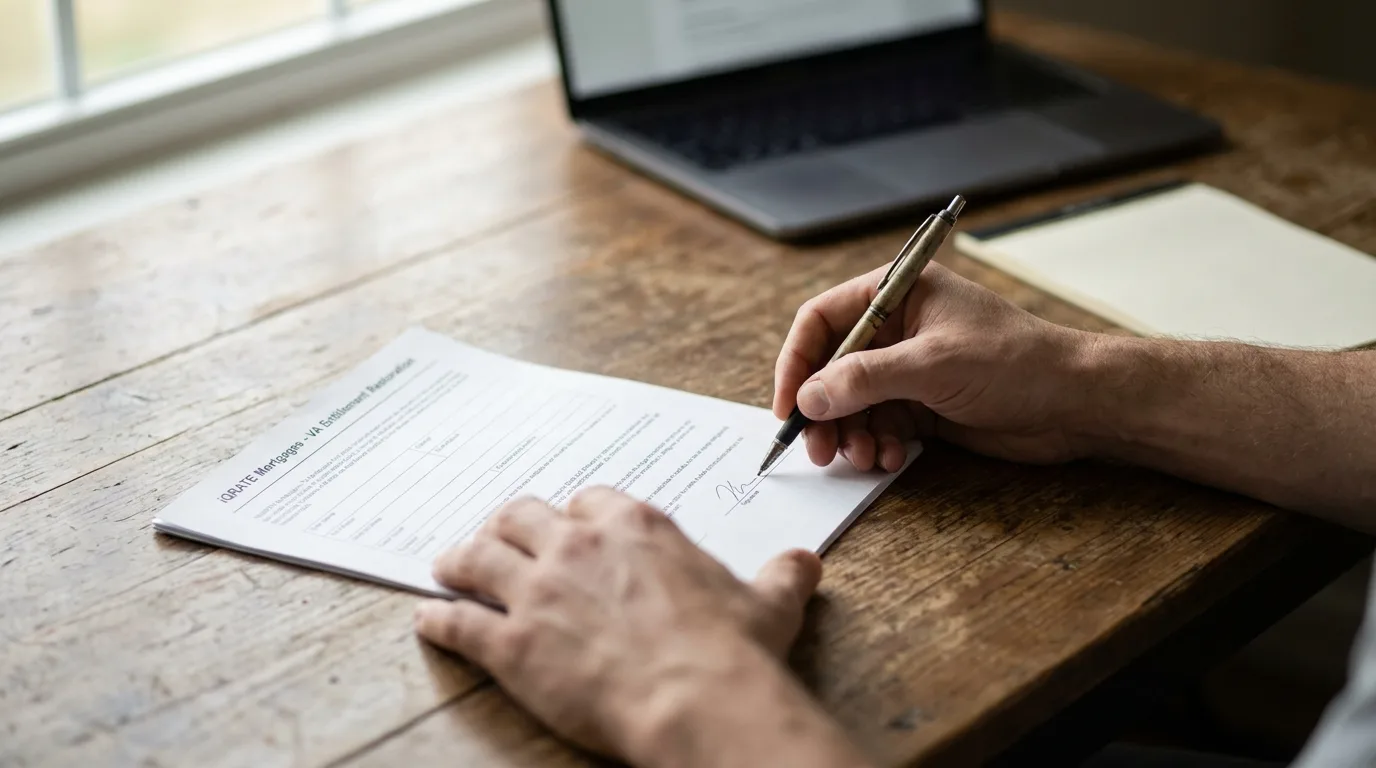
If your ex-spouse cannot qualify for a refinance on their own, it creates a significant problem. In this scenario, your entitlement will remain tied to that property, and you will not be able to get a full restoration. The only other option would be for them to sell the house, which would also pay off the VA loan and free up your entitlement. This is a critical point of negotiation during the divorce proceedings.
How long does the entitlement restoration process take for veterans?
The timeline can vary significantly and depends on two main factors: your ex-spouse's cooperation and the VA's processing times.
- The Refinance (The Longest Part): The biggest variable is how quickly your ex-spouse can complete the refinance of the original mortgage. A standard refinance can take anywhere from 30 to 60 days, assuming they have their finances in order and qualify easily. If there are delays or qualification issues, this step can take much longer.
- VA Processing (The Shorter Part): Once the refinance is complete and you have the closing documents, the actual request to the VA is relatively fast. Your lender can often submit the request electronically through the VA's WebLGY system. In many cases, an updated Certificate of Eligibility showing the restored entitlement can be generated in a matter of days, sometimes even minutes.
However, if the case requires manual review by the VA, it could take a few weeks. The key is to have all your documentation in perfect order—specifically, the proof that the original loan has been paid in full.
Can I start the home buying process in Killeen while waiting for restoration?
Yes, you might be able to, but it depends on your remaining bonus entitlement. This is a more advanced strategy and requires careful calculation by an experienced mortgage lender.
If the original loan on your San Antonio home was relatively small compared to the current home prices in Killeen, you may have enough secondary (bonus) entitlement left over to purchase a new home with a $0 down payment. The VA calculates this based on the current conforming loan limit.
Hypothetical Example:
- Let's say the conforming loan limit is $766,550. (The data, information, or policy mentioned here may vary over time.)
- The VA guarantees 25% of the loan amount.
- Your maximum entitlement would be 25% of $766,550, which is $191,637.50.
- Your original loan used $75,000 of your entitlement.
- You would have $116,637.50 of remaining entitlement.
This remaining entitlement could be enough to secure a $0 down payment loan on a new home up to $466,550 ($116,637.50 x 4). However, starting a new home purchase before the restoration is complete adds a layer of complexity. It is often simpler and cleaner to wait for the full restoration to be finalized before making an offer on a new property.
What happens if the original loan was assumed by my ex-spouse?
Loan assumption is different from refinancing. An assumption is when someone takes over the payments and terms of the existing mortgage. In a divorce, this is only a viable path for restoring your entitlement if your ex-spouse is also an eligible veteran with their own VA entitlement.
This process is called a Substitution of Entitlement. Your veteran ex-spouse would formally apply to substitute their VA entitlement for yours on the existing loan. If the VA approves, their entitlement becomes attached to the loan, and yours is freed, allowing you to apply for a full restoration.
A non-veteran ex-spouse cannot assume a VA loan in a way that restores your entitlement. While the VA allows for certain assumptions by non-veterans, it does not release the original veteran's entitlement. If your ex-spouse is not a veteran, refinancing or selling are the only two paths to full restoration.
Where can I check my current available VA loan entitlement?
The best way to get a definitive answer on your current entitlement status is to obtain an updated Certificate of Eligibility (COE). This document will show the VA what entitlement you have used and what is currently available.
There are a few ways to get your COE:
- Through a VA-approved Lender: This is the fastest and easiest method. When you start the home buying process, your mortgage officer can use the VA's online system to get your COE, often instantly.
- Online via the eBenefits Portal: You can log into your eBenefits account on the official VA website and request your COE directly.
- By Mail: You can complete VA Form 26-1880 and mail it to the VA's regional loan center, though this is the slowest method.
Your COE is the ultimate source of truth for your benefit. It will clearly state your basic entitlement and whether you have previously used your benefit, guiding you and your lender on the next steps for your new home purchase. Navigating VA loan rules after a divorce can feel overwhelming. If you're a veteran in Texas looking to understand your options for restoring your entitlement and buying your next home, it's wise to speak with a mortgage professional who specializes in VA loans. They can review your specific situation, pull your Certificate of Eligibility, and provide a clear roadmap.
Ready to take the next step and see how your restored VA entitlement can work for your future home purchase? Get a clear picture of your options and buying power. Apply now to connect with a VA loan specialist who can guide you through the process.
Author Bio
David Ghazaryan is the expert mortgage strategist and founder behind iQRATE Mortgages. With a mission to fund home loans that traditional banks won't touch, David specializes in helping clients with unique financial situations, including those recovering from foreclosure or bankruptcy. He expertly crafts smart, strategic, and stress-free mortgages by leveraging a vast network of over 100 lenders to secure competitive rates for investors and homebuyers alike. Praised for exceptional customer service, David has helped hundreds of families with a 97% satisfaction rate, guiding them to the mortgage they deserve.
References
VA Home Loan Entitlement | U.S. Department of Veterans Affairs
How To Request A VA Home Loan Certificate of Eligibility (COE) | U.S. Department of Veterans Affairs








