


Conventional Investor Loan Waiting Periods After Bankruptcy
For real estate investors in Nevada, recovering from a bankruptcy is a significant financial milestone. You have rebuilt your savings, identified promising opportunities in the Las Vegas market, and are ready to start acquiring assets again. However, when you approach traditional lenders for a conventional investment property loan backed by Fannie Mae or Freddie Mac, you often hit a wall known as a 'seasoning period'. These are mandatory waiting times after a significant derogatory credit event.
These waiting periods are not suggestions; they are firm rules that most conventional lenders must follow. Understanding them is key to realizing why alternative financing is so critical for investors looking to move quickly.
Chapter 7 Bankruptcy Waiting Period
A Chapter 7 bankruptcy, which involves the liquidation of assets to pay off debts, requires the longest waiting period. For a conventional investment property loan, you must typically wait a full four years from the date of the discharge. A discharge is the court order that releases you from liability for your debts; it is not the same as the filing date. This four-year clock can feel like an eternity, especially in a dynamic and appreciating real estate market like Las Vegas, where opportunities can disappear in months, not years.
Chapter 13 Bankruptcy Waiting Period
A Chapter 13 bankruptcy involves a reorganization and repayment plan over three to five years. The conventional waiting period rules here are slightly more nuanced:
- After Discharge: You must typically wait two years from the date your Chapter 13 plan was discharged.
- After Dismissal: If your case was dismissed without a discharge (meaning you failed to complete the plan), the waiting period resets to four years from the dismissal date.
For an investor eyeing a property in Henderson, a two-to-four-year delay means missing out on potential appreciation and cash flow while waiting for a calendar date to pass.
How DSCR Loans Bypass Personal Income Hurdles in Las Vegas
This is where the Debt Service Coverage Ratio (DSCR) loan changes the game for investors with a bankruptcy in their past. A DSCR loan is a type of non-qualified mortgage (Non-QM) designed specifically for real estate investors. Its primary qualification method sidesteps the biggest hurdles of conventional lending: personal income verification and debt-to-income (DTI) ratios.
Instead of scrutinizing your W-2s, tax returns, and personal bank statements, a DSCR lender focuses on one central question: Does the investment property generate enough income to cover its own mortgage payment and expenses?
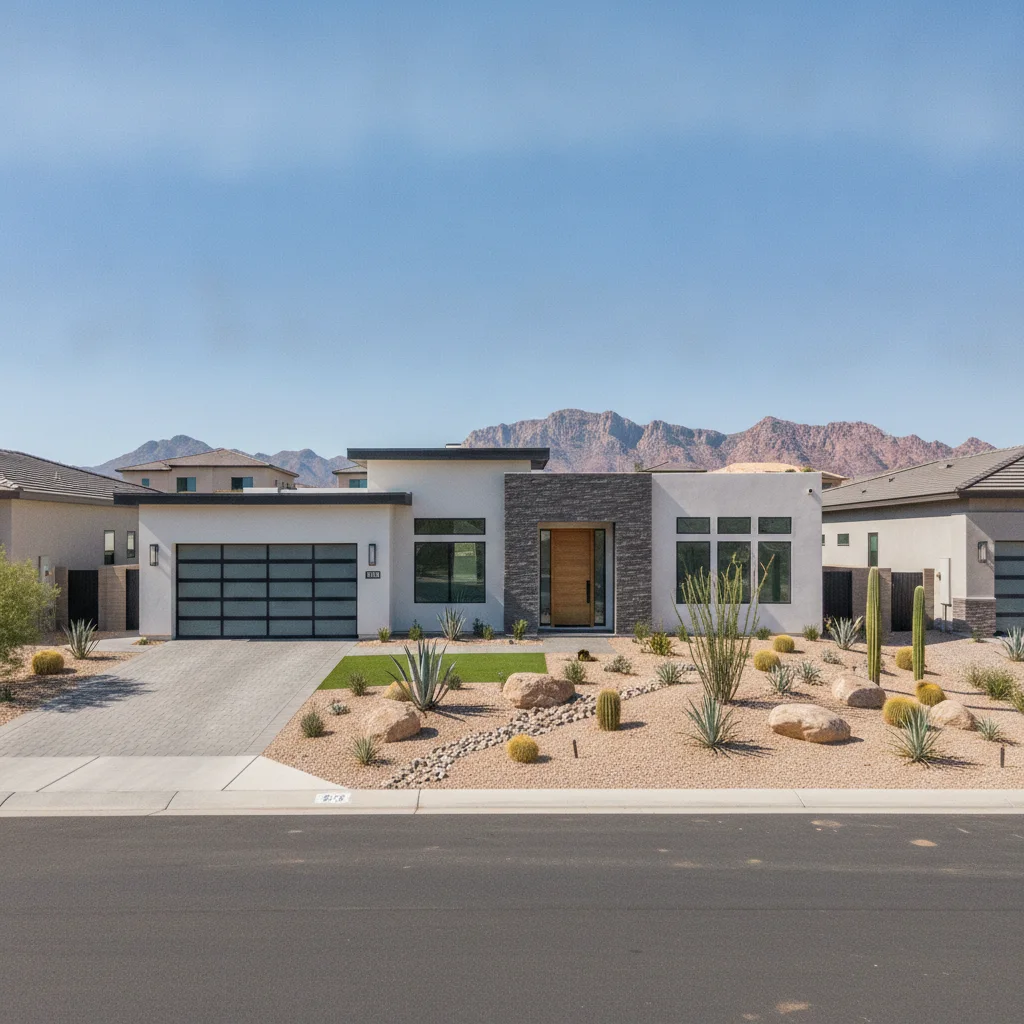
The loan is underwritten as a business-purpose loan. The property itself is the business, and its rental income is its revenue. As long as the property's revenue can 'service' the debt, the lender is satisfied. This approach is a perfect fit for investors who have a strong eye for profitable deals but whose personal financial history might not meet the rigid standards of conventional underwriting due to a past bankruptcy. You are essentially approved based on the quality of your investment decision, not your personal financial past.
Are DSCR Loan Credit Score Requirements More Lenient?
Yes, DSCR loan programs generally offer more lenient credit score requirements compared to conventional loans. While a conventional investor loan might require a FICO score of 720 or higher for the best terms, many DSCR lenders can work with scores significantly lower.
It is common to find DSCR programs that accept credit scores down to 640, and some specialized lenders may even consider scores as low as 620. (The data, information, or policy mentioned here may vary over time.) This flexibility is a direct reflection of the loan's risk assessment. The lender places more weight on the property's cash flow and the amount of equity you have (your down payment).
However, this leniency comes with a trade-off. Your credit score still matters and directly impacts the terms you are offered. An investor with a 640 FICO score will likely receive a higher interest rate and may be required to make a larger down payment (e.g., 30% down) compared to an investor with a 740 FICO score (who might qualify with 20-25% down). (The data, information, or policy mentioned here may vary over time.) The stronger the property's cash flow (a higher DSCR), the more it can help offset a lower credit score.
The Minimum Wait Time for a DSCR Loan After Bankruptcy
This is the most significant advantage for investors in Las Vegas. While conventional loans enforce a rigid two-to-four-year waiting period, DSCR lenders are far more flexible. The 'seasoning' requirements for a bankruptcy can be dramatically shorter. In many cases, DSCR lenders may only require that the bankruptcy has been discharged. There are programs available that have zero seasoning requirements after a Chapter 7 or 13 discharge. (The data, information, or policy mentioned here may vary over time.)
Other, more conservative DSCR lenders might require a one or two-year waiting period after the discharge date. (The data, information, or policy mentioned here may vary over time.) Even in this more stringent scenario, a two-year wait is half the time required by Fannie Mae after a Chapter 7 bankruptcy. This accelerated timeline allows a savvy investor to re-enter the Henderson rental market and begin building their portfolio years ahead of schedule, capturing equity and cash flow that would otherwise be lost.
Calculating the Debt Service Coverage Ratio on a Henderson Rental
The DSCR calculation is the heart of the underwriting process. It is a straightforward formula that determines if the property is self-sustaining.

The Formula: DSCR = Gross Monthly Rental Income / Monthly PITIA
- Gross Monthly Rental Income: This is the total rent collected. If the property is vacant, the lender will use the fair market rent determined by an appraiser on a Form 1007.
- Monthly PITIA: This stands for the total monthly housing expense: Principal, Interest, Taxes, Insurance, and Association (HOA) dues.
Most lenders require a DSCR of 1.25 or higher. (The data, information, or policy mentioned here may vary over time.) A ratio of 1.0 means the rent exactly covers the expenses, leaving no room for error or vacancy. A ratio below 1.0 means the property loses money each month. Some lenders may offer programs with a DSCR as low as 1.0, but this typically requires a larger down payment or higher credit score. (The data, information, or policy mentioned here may vary over time.)
Example Calculation for a Henderson Property
Let's imagine you've found a single-family rental in Henderson, Nevada.
- Projected Gross Monthly Rent: $2,800
- Estimated Monthly Principal & Interest: $1,650
- Estimated Monthly Property Taxes: $250
- Estimated Monthly Homeowner's Insurance: $100
- Monthly HOA Dues: $150
Total Monthly PITIA = $1,650 + $250 + $100 + $150 = $2,150
DSCR Calculation: $2,800 / $2,150 = 1.30
With a DSCR of 1.30, this property easily qualifies under most DSCR loan programs. The lender sees that the property generates 30% more in income than is needed to cover its debt and core expenses, making it a solid investment.
Will My Interest Rate Be Higher After a Bankruptcy?
It is important to set realistic expectations. Yes, the interest rate on a DSCR loan obtained shortly after a bankruptcy will almost certainly be higher than a conventional investment property loan. Lenders use a system called risk-based pricing. A recent bankruptcy, even a discharged one, signals a higher level of risk to the lender.
To compensate for this increased risk, the lender charges a higher interest rate. The final rate you receive will be influenced by several key factors:
- Credit Score: The higher your current score, the lower your rate.
- Loan-to-Value (LTV): A larger down payment (lower LTV) reduces the lender's risk and can result in a better rate. Putting 30% down is better than 25%.
- DSCR: A property with a very high DSCR (e.g., 1.50+) may qualify for a better rate than a property that just barely qualifies at 1.25.
- Time Since Bankruptcy: An investor who is two years post-discharge will likely get a better rate than someone who is only three months post-discharge.
Think of this higher rate not as a penalty, but as the cost of opportunity. It allows you to acquire a cash-flowing asset years sooner, enabling you to start building equity and benefit from market appreciation immediately.
Essential Documents for Proving a Property's Income Potential
Because the loan focuses on the property, the required documentation is also property-centric. You will generally need to provide:
- For a New Purchase:
- Fully Executed Purchase Contract: The signed agreement between you and the seller.
- Appraisal Report with a Rent Schedule (Form 1007): If the property is vacant, a licensed appraiser will determine its fair market rent. This is what the lender will use for the DSCR calculation.
- Existing Lease Agreement: If the property is already tenant-occupied, you will provide the current lease to prove the rental income.
- For a Refinance:
- Current Lease Agreements and Rent Roll: A rent roll is a simple document listing all units, tenant names, rent amounts, and lease end dates.
- Property Appraisal: To determine the current market value.
In addition, you will still need to provide standard documents like personal identification, proof of funds for the down payment and closing costs (via bank statements), and documentation for the entity you are using to purchase (if buying in an LLC).
Using a DSCR Loan to Acquire a Property Portfolio
DSCR loans are not just for single-property purchases; they are an exceptional tool for scaling a real estate portfolio, especially in a market with diverse opportunities like the greater Las Vegas area. Conventional lending rules, set by Fannie Mae and Freddie Mac, typically limit an individual to a maximum of ten financed properties. This can be a major roadblock for serious investors.
DSCR loans have no such limitations. Because they are underwritten based on the performance of each individual property and do not add to your personal debt-to-income ratio, you can theoretically use them to acquire an unlimited number of rental properties. You could finance a property in Las Vegas, another in Henderson, and a third in Summerlin, with each loan standing on its own merits. This allows you to grow your portfolio as quickly as you can find profitable deals, without being constrained by arbitrary limits.
Furthermore, for more experienced investors, some lenders offer portfolio DSCR loans. This is a single, larger 'blanket' mortgage that can cover multiple properties at once, simplifying payments and loan management significantly.
Don't let a past bankruptcy sideline your investment goals in Nevada. A DSCR loan might be your fastest path to funding a profitable rental property in Las Vegas or Henderson. To explore your options and see if you qualify, you can Apply now and connect with a mortgage strategist about your specific scenario.
Author Bio
David Ghazaryan is the expert mortgage strategist and founder behind iQRATE Mortgages. With a mission to fund home loans that traditional banks won't touch, David specializes in helping clients with unique financial situations, including those recovering from foreclosure or bankruptcy. He expertly crafts smart, strategic, and stress-free mortgages by leveraging a vast network of over 100 lenders to secure competitive rates for investors and homebuyers alike. Praised for exceptional customer service, David has helped hundreds of families with a 97% satisfaction rate, guiding them to the mortgage they deserve.
References









