


Understanding Permanent Discount Points
When securing a mortgage, you have the option to pay for 'discount points' at closing. In simple terms, discount points are a form of prepaid interest. You pay a lump sum to the lender upfront, and in exchange, they give you a lower interest rate for the entire duration of your loan. This is a permanent reduction, not a temporary one.
The cost is standardized: one point is equal to 1% of the total loan amount. So, for a $500,000 home loan in Las Vegas, one discount point would cost you $5,000 at the closing table. This cost is part of your closing costs.
How Points Affect Your Loan
The primary benefit is the long-term savings. A lower interest rate means a lower monthly mortgage payment and less total interest paid over the life of the loan. The exact rate reduction you get per point varies by lender and market conditions, but a common estimate is that one point might lower your rate by 0.25%. (The data, information, or policy mentioned here may vary over time.)
Example:
- Loan Amount: $500,000
- Original Interest Rate: 6.75%
- Monthly Principal & Interest (P&I): $3,242
Let's say you decide to buy two discount points.
- Cost of Points: 2% of $500,000 = $10,000
- New Interest Rate (estimated): 6.25% (a 0.50% reduction)
- New Monthly P&I: $3,079
In this scenario, paying $10,000 upfront saves you $163 per month. The critical question then becomes how long it takes for those monthly savings to cover the initial cost of the points. This is known as the 'breakeven point', a crucial factor we will explore further.

How a Temporary Rate Buydown Works
A temporary rate buydown functions very differently. Instead of a permanent rate reduction paid for by you, a buydown is a temporary interest rate subsidy, almost always paid for by the home seller as a concession. It lowers your interest rate for a set period, typically the first one to three years of your loan.
The most common structure is the 2-1 buydown. Here’s how it works:
- Year 1: Your interest rate is reduced by 2% from the note rate.
- Year 2: Your interest rate is reduced by 1% from the note rate.
- Year 3 and Onward: You pay the full, original note rate for the remainder of the loan term.
Who Pays and How?
The seller pays for the total cost of the interest savings upfront at closing. This money is placed into a separate escrow account managed by the lender. Each month, the lender draws from this account to subsidize your payment, making up the difference between your temporarily 'bought-down' rate and the actual note rate. You, the buyer, get the immediate benefit of a significantly lower payment for two years without paying for it yourself.
Example using the same Henderson property:
- Loan Amount: $500,000
- Note Interest Rate: 6.75%
- Full Monthly P&I: $3,242
With a seller-paid 2-1 buydown:
- Year 1 Rate: 4.75% | Monthly P&I: $2,608 ($634 in monthly savings)
- Year 2 Rate: 5.75% | Monthly P&I: $2,918 ($324 in monthly savings)
- Year 3+ Rate: 6.75% | Monthly P&I: $3,242
The total cost to the seller for this buydown would be the sum of the savings over 24 months: ($634 x 12) + ($324 x 12) = $7,608 + $3,888 = $11,496. The seller pays this amount at closing so you can enjoy a more manageable payment as you settle into your new home.
When Do Discount Points Make Financial Sense in Las Vegas?
Paying for permanent discount points is a long-term financial strategy. The decision hinges entirely on your breakeven point—the moment your accumulated monthly savings equal the upfront cost of the points. If you plan to stay in the home well beyond this point, buying down the rate is a winning move.
Let's calculate the breakeven point from our earlier example:
- Upfront Cost of Points: $10,000
- Monthly Savings: $163
- Breakeven Calculation: $10,000 / $163 per month = 61.3 months
It would take just over five years to recoup the initial $10,000 investment. Therefore, if you are confident you will keep this specific mortgage on your Las Vegas home for more than five years, paying points will save you money. Every month you stay past that 61-month mark, you are realizing pure savings.
This strategy is ideal for buyers who:
- Are purchasing their 'forever home' or plan to stay for at least 7-10 years.
- Do not anticipate refinancing in the near future.
- Have the available cash for closing costs and prefer long-term savings over short-term payment relief.
Negotiating a Seller-Paid Buydown in the Las Vegas Market
Negotiating a seller-paid buydown is most effective in a balanced or buyer's market where sellers are more motivated to make a deal. It's a powerful tool because it addresses the buyer's primary concern—affordability—without requiring the seller to slash their asking price.
Here’s how to approach the negotiation:
- Frame it as a Win-Win: Explain to the seller, through your real estate agent, that offering a buydown makes their home more attractive to a wider pool of buyers. It directly tackles the challenge of higher interest rates. A buyer who can more comfortably afford the monthly payment is a stronger, more reliable buyer.
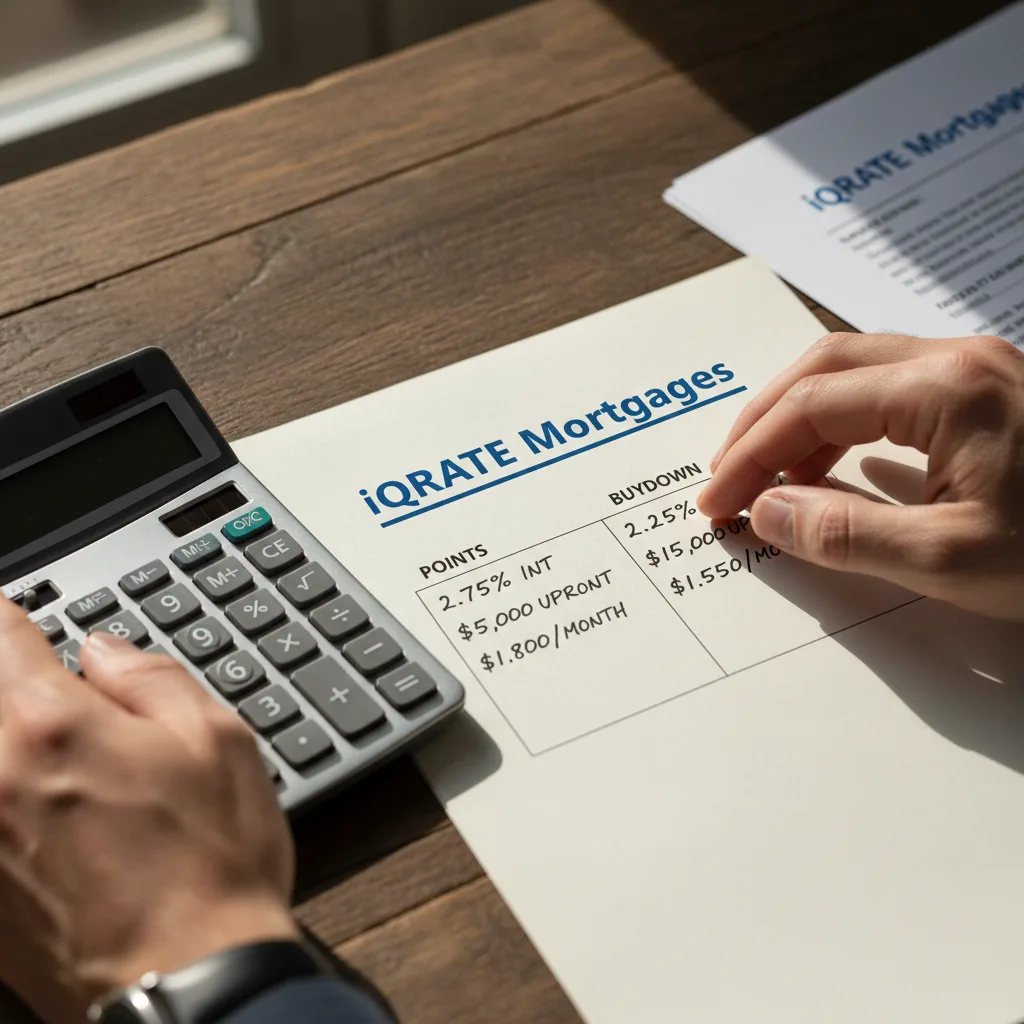
Show the Math: The cost of a buydown is often significantly less than a price reduction. In our example, the buydown cost the seller $11,496. To achieve a similar monthly payment reduction for the buyer through a price drop, the seller might have to lower the price by $30,000 or more. The buydown is a more financially efficient concession for the seller.
Structure the Offer Correctly: Your purchase offer should explicitly state that the seller will contribute a specific amount or percentage towards a 'temporary interest rate buydown' for the buyer. Your lender can provide the exact cost and language needed to include in the contract, ensuring everything is clear and legally sound.
Understand Concession Limits: Lenders have rules about how much a seller can contribute to a buyer's closing costs and prepaids. For conventional loans, these limits typically range from 3% to 9% of the purchase price, depending on your down payment amount. (The data, information, or policy mentioned here may vary over time.) A buydown falls under this concession limit, so ensure your total request doesn't exceed the allowable amount.
Points vs. Buydowns: A Long-Term Cost Comparison
Let's put the two strategies side-by-side over different time horizons for a home in Henderson to see which one yields better results.
Scenario: $500,000 loan at a 6.75% note rate.
Strategy 1: Buyer Pays 2 Points ($10,000 cost)
- New Rate: 6.25% (permanent)
- Monthly Payment: $3,079
- Cost to Buyer: $10,000
Strategy 2: Seller-Paid 2-1 Buydown ($11,496 cost)
- Year 1 Payment: $2,608
- Year 2 Payment: $2,918
- Year 3+ Payment: $3,242
- Cost to Buyer: $0
Analysis:
- After 2 Years: The buydown buyer has saved $11,496 in payments and paid nothing out of pocket. The points buyer has paid $10,000 and saved only $3,912 ($163 x 24), for a net cost of $6,088.
- After 5 Years (60 months): The buydown buyer's total savings remain at $11,496. The points buyer has now saved $9,780 ($163 x 60), nearly breaking even on their $10,000 investment.
- After 10 Years (120 months): The buydown buyer's savings are still $11,496. The points buyer has now saved $19,560 ($163 x 120), resulting in a net gain of $9,560. From this point forward, the advantage of paying points grows every month.
The Best Strategy for a Shorter Stay in Henderson
If you anticipate selling your home or refinancing within a few years, the temporary buydown is unequivocally the superior strategy. Paying for permanent discount points is a long-term investment. If you sell before reaching the breakeven point—which was over five years in our example—you will have lost money on the transaction.
A seller-paid buydown provides maximum financial benefit in the short term with zero upfront cost to you. The significant payment reduction in the first two years frees up cash flow that can be used for home improvements, building savings, or other investments.
Furthermore, there's a hidden benefit: if you sell your Henderson home or refinance your mortgage before the two-year buydown period is over, the remaining funds in the lender's subsidy account are typically applied directly to your outstanding principal loan balance. You don't lose the money the seller contributed.
Locating the Buydown in Your Closing Documents
Transparency is legally required in a mortgage transaction. The details of your buydown will be clearly disclosed in your closing paperwork.
Primarily, you need to review the Closing Disclosure (CD), a five-page document you receive at least three business days before your closing date. On page 2, in Section L: Seller Credits, you will see a line item detailing the seller's contribution. It may be labeled 'Seller-Paid Buydown' or 'Seller Concession for Buydown' and will list the exact dollar amount the seller is paying.
Additionally, you will sign a Buydown Agreement at closing. This is a separate legal document that outlines the specific terms of the arrangement:
- The starting note interest rate.
- The reduced interest rate for year one and year two.
- The total amount deposited by the seller into the buydown account.
- The date your payments will adjust to the full note rate.
Always review these documents carefully with your loan officer to confirm that the terms match the purchase agreement you negotiated. Unsure if points or a buydown is right for your Nevada home purchase? A mortgage strategist can analyze your timeline and financial goals to find the most effective solution for your specific situation.
Feeling clearer about your options? Whether you're considering a long-term stay or need short-term savings, the right mortgage strategy can make all the difference. Apply now to have one of our experts analyze your specific situation and guide you toward the best financial path for your new home.
Author Bio
David Ghazaryan is the expert mortgage strategist and founder behind iQRATE Mortgages. With a mission to fund home loans that traditional banks won't touch, David specializes in helping clients with unique financial situations, including those recovering from foreclosure or bankruptcy. He expertly crafts smart, strategic, and stress-free mortgages by leveraging a vast network of over 100 lenders to secure competitive rates for investors and homebuyers alike. Praised for exceptional customer service, David has helped hundreds of families with a 97% satisfaction rate, guiding them to the mortgage they deserve.
References
CFPB - What are discount points and lender credits?









