


Why Lenders See a 'Reset' in Your Income History
You've successfully run your business for years, built a solid income, and finally decided to restructure from a sole proprietorship to an S-Corporation. It was a smart move for tax and liability purposes. But when you apply for a mortgage in Los Angeles, the lender tells you your business is only a few months old and you don't have the required two-year history. This is a common and incredibly frustrating roadblock for entrepreneurs.
From a lender's perspective, a new business entity is exactly that: new. An underwriter, who must follow strict guidelines set by entities like Fannie Mae and Freddie Mac, sees your S-Corp as a brand-new company with no track record. Your personal name operating as a sole proprietorship is legally distinct from '[Your Business Name], Inc.' They aren't allowed to assume they are the same operation, even if it's obvious to you. Their primary concern is risk, and a business without a two-year history is, by default, considered a higher risk. Your job is to provide irrefutable proof that erases that perceived risk by linking the old and new entities into one continuous story of success.
Proving Your S-Corp is a Continuation of Your Business
To overcome the 'new business' objection, you must proactively provide a package of documents that paints a clear, unbroken picture of your business operations. You are essentially proving to the underwriter that the only thing that changed was the legal structure on paper, not the income-generating activity. Gathering these documents before you even apply will save you weeks of frustrating back-and-forth.
Your goal is to demonstrate continuity in several key areas:
- Ownership: You were the 100% owner of the sole proprietorship, and you are now the 100% owner of the S-Corporation.
- Operations: You provide the same services or products to the same type of clientele.
- Industry: The nature of your business has not changed.
- Management: You are still the one in charge, making the decisions.
Key documents to assemble include:
- A Detailed Letter of Explanation: A letter written by you, explaining the 'when' and 'why' of the business structure change.
- The CPA Letter: This is the most critical document and is non-negotiable. It must be written and signed by your CPA. (More on this below.)
- Business Formation Documents: Your Articles of Incorporation for the new S-Corp.
- Tax Returns: Your last two years of personal tax returns (Form 1040), which will include the Schedule C from your sole proprietorship, plus any business returns filed for the S-Corp (Form 1120-S).
- Bank Statements: Statements from both the old business account and the new S-Corp account.
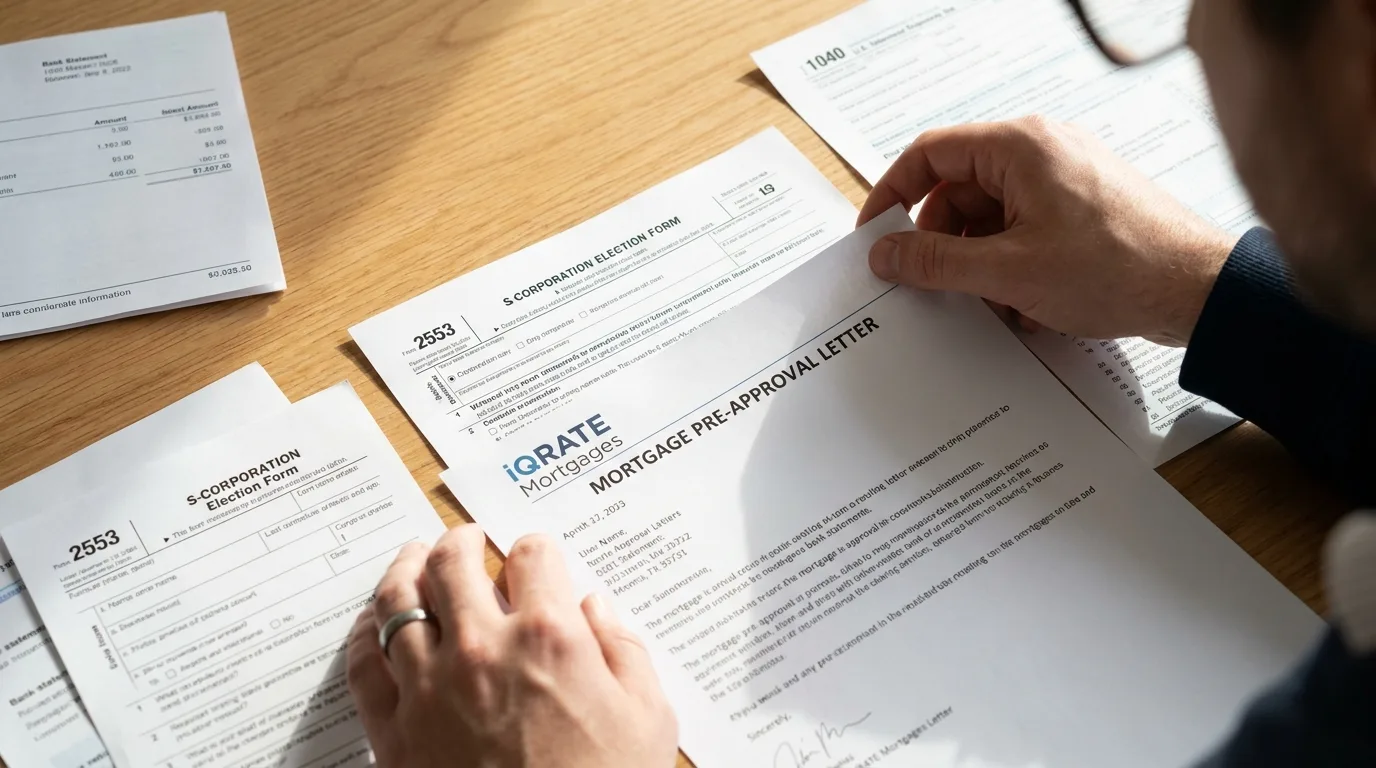
The Critical CPA Letter for Your Anaheim Mortgage
Underwriters place immense weight on statements from a licensed, third-party professional like a Certified Public Accountant (CPA). A vague or poorly worded letter from your accountant will be rejected. It needs to be explicit, confident, and directly address the underwriter's primary concerns about continuity. If you're seeking a mortgage in a competitive market like Anaheim, a strong CPA letter can be the single document that gets your loan approved.
Essential Language for Your CPA's Letter
Work with your CPA to draft a letter on their official letterhead that includes the following specific points and phrases. The underwriter is looking for this exact language.
- Direct Confirmation of Continuity: 'I, [CPA Name], certify that [Your Name]'s new business, [S-Corporation Name], formed on [Date], is a direct continuation of the formerly operated sole proprietorship, [Your Name DBA Old Business Name].'
- Purpose of Change: 'The business structure was changed for tax and liability purposes only. The fundamental nature of the business operations has remained unchanged.'
- Consistency of Operations: 'The business continues to offer the same [services/products] to the same client base and is managed and operated by [Your Name] in the same capacity as prior to the incorporation.'
- Ownership Confirmation: 'The borrower, [Your Name], maintains 100% ownership and control of the new S-Corporation, identical to their previous role in the sole proprietorship.'
- Access to Funds: 'The borrower has full and unrestricted access to the income and assets of the business.'
Managing Bank Statements from Both Business Entities
Yes, you absolutely need to provide bank statements from both the old sole proprietorship account and the new S-Corporation account. This is not optional. Underwriters use these statements to follow the money and verify that the income stream was uninterrupted during the transition.
Provide at least 12 months of statements from the old business account leading up to the change. Then, provide every statement generated for the new S-Corp account since its creation. This allows the underwriter to see consistent revenue deposits from clients before, during, and after the legal restructuring. It proves that the S-Corp wasn't funded by a loan or a sudden, unsourced cash injection, but by the ongoing operations of your established business.
How Long as an S-Corp Before Lenders Get Comfortable?
The beauty of this documentation strategy is that it can eliminate any waiting period. If you can successfully prove continuity, a good lender can use the income history from your sole proprietorship immediately. You should not have to wait two years. The goal is to make the underwriter comfortable enough to blend the history of the two entities into a single, two-year-plus timeline.
The Ideal Documentation Timeline
If you have all the documents listed above, including a strong CPA letter, you can apply for a mortgage the day after you incorporate. However, if you lack this evidence, lenders will default to their standard guidelines, which typically require a one-to-two-year history for the new S-Corp before they will consider its income for mortgage qualification. (The data, information, or policy mentioned here may vary over time.)
What if I Moved from 1099 to a W-2 in My Own S-Corp?
This is a common and highly positive scenario for mortgage qualification. As a sole proprietor, all your income was essentially '1099' income reported on a Schedule C. When you form an S-Corp, IRS rules require you to pay yourself a 'reasonable salary' via a W-2. This is fantastic from a lender's perspective.
W-2 income is considered stable and predictable. An underwriter can easily verify your salary with paystubs and your company's tax filings. This salary will form the base of your qualifying income. In addition to your W-2 wages, the lender can also add any additional profit the business earns, which is passed through to you on a Schedule K-1. The combination of W-2 income and K-1 distributions often results in a higher and more stable qualifying income than the profit shown on a Schedule C.
Documenting Your Unchanged Role in the Irvine Business
Beyond the CPA letter, you can further solidify your case by showing your role has remained constant. For an entrepreneur in a dynamic area like Irvine, showcasing professional consistency is key. These documents support the narrative that you are, and always have been, the engine of the business.
- Operating Agreement: The S-Corp's operating agreement should clearly list you as the managing member or president.
- Business Licenses: Show the old license under your name and the new one under the S-Corp name, both for the same address and business activity.
- Company Website: Your 'About Us' or 'Team' page should clearly feature you as the founder and principal.
- Professional Liability Insurance: If applicable, show that the policyholder simply changed from your personal name to the S-Corp name, with you still listed as the primary insured professional.

Can Lenders Use My Sole Proprietorship Tax Returns?
Yes. In fact, they must use your prior sole proprietorship tax returns to approve the loan. This entire strategy is designed to convince the lender to use your Schedule C from the year(s) before you incorporated and combine it with your current S-Corp income (W-2 and K-1) to calculate a stable, two-year average income.
Calculating Your Qualifying Income: An Example
Let's break down how an underwriter would calculate your monthly income for a home in Irvine:
- Year 1 (Pre-S-Corp): Your Form 1040, Schedule C shows a net profit of $180,000.
- Year 2 (Post S-Corp): You paid yourself a W-2 salary of $90,000. Your business had additional profits, and your Schedule K-1 shows pass-through income of $110,000. Total Year 2 income is $90,000 + $110,000 = $200,000.
- Two-Year Total: $180,000 (Year 1) + $200,000 (Year 2) = $380,000.
- Average Monthly Income: $380,000 / 24 months = $15,833 per month.
Without proving continuity, the lender would only see the new S-Corp and might deem your income history insufficient. With the correct documentation, you can use your full, successful track record to qualify. If you're a California entrepreneur navigating a mortgage after a business restructure, the rules can feel confusing. A mortgage strategist specializing in self-employed scenarios can help you package your file correctly the first time. Reach out to discuss your specific situation and ensure your business's success translates into homeownership.
Ready to turn your business success into your dream home? Don't let a change in business structure stand in your way. Apply now to get a personalized assessment from a mortgage strategist who specializes in complex income scenarios.
Author Bio
David Ghazaryan is the expert mortgage strategist and founder behind iQRATE Mortgages. With a mission to fund home loans that traditional banks won't touch, David specializes in helping clients with unique financial situations, including those recovering from foreclosure or bankruptcy. He expertly crafts smart, strategic, and stress-free mortgages by leveraging a vast network of over 100 lenders to secure competitive rates for investors and homebuyers alike. Praised for exceptional customer service, David has helped hundreds of families with a 97% satisfaction rate, guiding them to the mortgage they deserve.
References
Fannie Mae: Underwriting Factors for a Self-Employed Borrower









