

Why Lenders in San Diego Might Ignore Your SAVE Plan Payment
The Saving on a Valuable Education (SAVE) plan is a game changer for millions of Americans with federal student loans, often reducing monthly payments to a manageable amount, sometimes even to zero. However, when you apply for a mortgage in competitive California markets like San Diego, this financial relief can become a major underwriting headache. The core issue is a disconnect between your actual monthly payment and the potential risk a lender sees.
Mortgage lenders operate on guidelines set by agencies like Fannie Mae, Freddie Mac, and the Federal Housing Administration (FHA). These guidelines are designed to ensure you can afford the home loan both today and in the future. Lenders get nervous about income-driven repayment (IDR) plans like SAVE because the payment is not fixed. It is tied to your income and could increase significantly if your earnings rise. They worry that a borrower who qualifies based on a $50 monthly student loan payment might struggle if that payment later adjusts to $500.
To mitigate this perceived risk, some underwriters default to an outdated, and typically higher, calculation instead of using the actual payment amount shown on your credit report. For a homebuyer in San Diego with a $200,000 student loan balance and a $50 SAVE plan payment, a lender incorrectly applying old rules might ignore the $50 and instead calculate a hypothetical payment of $1,000 (0.5% of the balance) for debt-to-income purposes, potentially ending the homeownership dream before it starts.
The Lender's Calculation for Income-Driven Repayment Plans
How your student loan debt is calculated depends entirely on the type of mortgage you are seeking. Conventional and government-backed loans have distinct rules, and knowing the difference is crucial for your application's success.
Conventional Loan Guidelines (Fannie Mae & Freddie Mac)
For conventional loans, the rules are generally favorable for borrowers on IDR plans. The key is what appears on your credit report. (The data, information, or policy mentioned here may vary over time.)
- If your payment is greater than zero: Lenders are permitted to use the actual, documented monthly payment from your student loan servicer. If your SAVE plan payment is $75 per month, and this amount is reflected on your credit report and student loan statement, the underwriter can use $75 in your debt-to-income (DTI) calculation. This is the best-case scenario.
- If your payment is zero: Lenders are permitted to use the $0 payment as long as it is documented on the credit report. If the credit report shows a $0 payment, the lender can use $0 for DTI calculations. The 0.5% rule only applies if the credit report does not reflect a monthly payment at all.
Example: A homebuyer in Fresno has a $120,000 student loan balance and qualifies for a $0 monthly payment under the SAVE plan. When applying for a conventional loan, the lender's underwriter should use the documented $0 payment. This means no additional student loan debt is added to her DTI ratio. However, if a lender misapplies an outdated rule, they might incorrectly calculate a payment of $600 ($120,000 x 0.005), which would negatively impact her borrowing power.
FHA Loan Guidelines
FHA loans, while popular for their lower down payment requirements, now have more borrower-friendly rules regarding student loan debt that align closely with conventional loans. (The data, information, or policy mentioned here may vary over time.)
FHA guidelines require lenders to use the monthly payment amount reported on the credit report, even if that amount is zero. The 0.5% of the outstanding loan balance rule is a fallback option used only if the credit report does not show a monthly payment for the loan.
This means that for FHA borrowers, the low or zero-dollar payment from the SAVE plan can be used. If you have a documented payment of $0, the lender can use $0 in the DTI calculation.
Example: A first-time homebuyer in Sacramento is applying for an FHA loan. He has a $90,000 student loan balance and a $0 SAVE plan payment. The FHA underwriter will use the documented $0 SAVE plan payment. No monthly student loan debt will be included in his DTI calculation, significantly improving his qualification chances.
How a Zero Dollar Student Loan Payment Impacts Your Fresno Home Loan
Your Debt-to-Income (DTI) ratio is arguably the most important number in your mortgage application. It represents the percentage of your gross monthly income that goes toward paying your monthly debt obligations. Lenders use it to assess your ability to manage monthly payments and repay your mortgage. Most lenders want to see a DTI ratio at or below 43-45% for conventional loans. (The data, information, or policy mentioned here may vary over time.)
Let's illustrate the impact of the $0 SAVE payment rule with a realistic scenario for a homebuyer in Fresno.
Borrower Profile:
- Gross Monthly Income: $8,000
- Other Monthly Debts (Car Loan, Credit Cards): $1,200
- Student Loan Balance: $150,000
- Actual SAVE Plan Payment: $0
Scenario 1: Applying with a Lender Using Current FHA & Conventional Guidelines The lender correctly uses the $0 payment shown on the credit report.
- Total Monthly Debt: $1,200 (Car + Credit Cards) + $0 (Student Loan) = $1,200
- DTI Ratio: ($1,200 / $8,000) = 15% This borrower has significant purchasing power and can easily qualify for a substantial home loan.
Scenario 2: Applying with a Lender Using Outdated Guidelines The lender incorrectly applies an old 0.5% rule to the $0 payment.
- Calculated Student Loan Payment: $150,000 x 0.005 = $750
- Total Monthly Debt: $1,200 (Other Debts) + $750 (Student Loan) = $1,950
- DTI Ratio: ($1,950 / $8,000) = 24.4% While still a healthy DTI, her purchasing power has been significantly reduced by the phantom $750 debt payment. This incorrect calculation becomes even more severe for borrowers with higher debt loads or lower incomes, potentially pushing their DTI over the qualification threshold.
Essential Documentation to Verify Your Student Loan Terms
You cannot expect a mortgage underwriter to take your word for it. To ensure your actual SAVE plan payment is used, you must provide clear and official documentation. Being proactive here can save you weeks of back-and-forth.
Prepare the following documents:
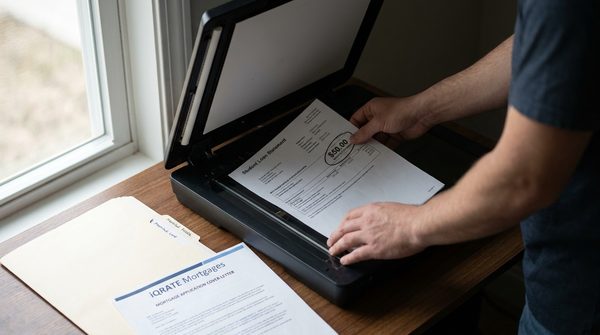
- Your Most Recent Student Loan Statement: This is the most critical document. It must clearly show your name, the loan account number, the outstanding balance, the name of your repayment plan (e.g., 'SAVE'), and your actual monthly payment amount.
- A Letter from Your Student Loan Servicer: If your statement is unclear or doesn't contain all the required information, request a formal letter from your servicer that explicitly confirms your payment terms.
- Your Credit Report: The lender will pull this themselves, but you should obtain a copy beforehand from all three bureaus. Ensure the payment amount and loan balance reported by your servicer match what appears on your credit report. Discrepancies can cause major delays.
- Proof of Payment (Optional but helpful): Providing a bank statement showing you have made the low monthly payment can add another layer of verification for a skeptical underwriter.

Challenging a Lender Who Calculates Your Debt Incorrectly
If you've provided all the proper documentation for your conventional loan application and the lender still insists on using an outdated 0.5% rule on your SAVE payment, you have the right to challenge their calculation. Many loan officers are not experts in the nuances of student loan underwriting.
Follow these steps:
- Ask for the Specific Guideline: Politely ask the loan officer to show you the specific agency guideline they are following. Request the section number from the Fannie Mae or Freddie Mac selling guide.
- Reference the Correct Rule: For a conventional loan with a payment reported on the credit report (even $0), you can point to the Fannie Mae Selling Guide section B3-6-05, which states the lender can use that payment.
- Provide Your Documentation Again: Resubmit your clear, official student loan statement and highlight the section showing your actual monthly payment.
- Escalate if Necessary: If the loan officer remains inflexible, ask to have your file reviewed by a senior underwriter or their manager. Often, a more experienced professional will understand the correct application of the rule.
- Find a New Lender: Your final and most powerful option is to walk away. A mortgage broker who works with dozens of lenders is often your best advocate. They know which lenders have underwriting teams that are adept at handling IDR plans and can place your loan with a company that will calculate your DTI correctly from the start.
Future Mortgage Qualification and Student Loan Forgiveness
For many on the SAVE plan, the ultimate goal is loan forgiveness after 20-25 years of payments. This long-term plan generally does not negatively affect your mortgage qualification today, as long as the current payment is handled correctly.
Once your student loans are officially forgiven, the debt is eliminated. It will no longer appear on your credit report or be a factor in any future mortgage applications, which will significantly improve your DTI ratio. Concerns about a 'tax bomb', where the forgiven amount is treated as taxable income, have been temporarily addressed. The American Rescue Plan Act of 2021 made federal student loan forgiveness tax-free at the federal level through 2025. (The data, information, or policy mentioned here may vary over time.) It is important to stay updated on this legislation and consult a tax professional, as state tax laws may vary.
Ultimately, being on the SAVE plan is a smart financial move. The key is to partner with a mortgage professional who understands how to navigate the specific underwriting rules so your responsible financial planning is rewarded, not penalized.
If your lender is misinterpreting your SAVE plan payments, don't let it stop your homeownership journey in San Diego or Fresno. Work with a mortgage expert who understands the guidelines. Apply now to get an accurate assessment of your qualifications.
Author Bio
David Ghazaryan is the expert mortgage strategist and founder behind iQRATE Mortgages. With a mission to fund home loans that traditional banks won't touch, David specializes in helping clients with unique financial situations, including those recovering from foreclosure or bankruptcy. He expertly crafts smart, strategic, and stress-free mortgages by leveraging a vast network of over 100 lenders to secure competitive rates for investors and homebuyers alike. Praised for exceptional customer service, David has helped hundreds of families with a 97% satisfaction rate, guiding them to the mortgage they deserve.
References
Fannie Mae Selling Guide: Student Loans
HUD Handbook 4000.1 (FHA Single Family Housing Policy Handbook)
Consumer Financial Protection Bureau (CFPB): Buying a house with student loan debt