


How Lenders Calculate Annual Income for Seasonal Properties
When you apply for a Debt Service Coverage Ratio (DSCR) loan, the lender’s primary concern is the property's ability to generate enough income to cover its own debt. For a traditional long-term rental, this is straightforward. For a seasonal rental in a market like Las Vegas or near Lake Tahoe in Incline Village, the calculation becomes more nuanced.
Lenders do not simply look at peak-season revenue and approve the loan. Instead, they focus on a projected annual income. The underwriter’s goal is to smooth out the peaks and valleys of seasonal demand to arrive at a stable, predictable monthly average. They need to be confident the property can support its mortgage payment (PITI: Principal, Interest, Taxes, and Insurance) throughout the entire year.
The most common method for this is through a specialized appraisal report, often a Small Residential Income Property Appraisal Report (Form 1025) or a Single-Family Comparable Rent Schedule (Form 1007). The appraiser analyzes comparable short-term rental properties in the immediate area to determine a fair market rent. They consider factors like:
- Seasonality: They will look at historical data for similar vacation rentals to understand occupancy rates during high season (e.g., major holidays, conferences in Las Vegas) and low season (e.g., the summer heat).
- Property Type and Amenities: A condo with a pool and a view will have a different income profile than a suburban single-family home.
- Comparable Data: They will pull data from at least three similar, nearby rental properties to establish a reliable income baseline.
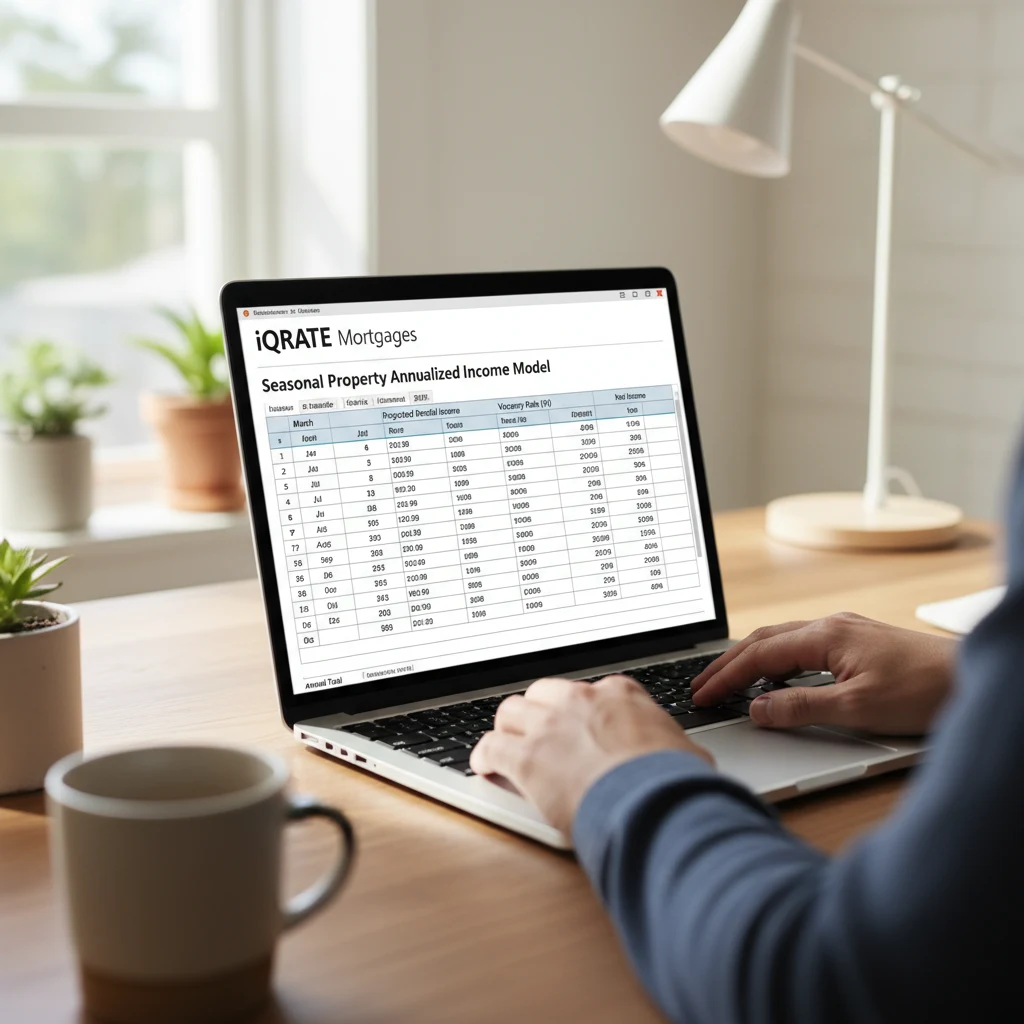
Example: Let's say a property in Stateline is projected to generate $8,000 per month during the peak ski season (4 months) and only $3,000 per month in the off-season (8 months).
- Peak Income: $8,000 x 4 months = $32,000
- Off-Season Income: $3,000 x 8 months = $24,000
- Total Annual Income: $32,000 + $24,000 = $56,000
- Average Monthly Income for DSCR calculation: $56,000 / 12 = $4,667
The lender will use this $4,667 figure, not the $8,000 peak figure, to calculate your DSCR.
What Data Do Underwriters Use to Project Off-Season Vacancy?
Projecting vacancy is just as important as projecting income. An underwriter cannot rely on an investor's optimistic forecast. They require objective, third-party data to determine a realistic vacancy rate, which is then factored into the gross income calculation.
The primary source is the appraiser's market analysis. Appraisers have access to Multiple Listing Service (MLS) data, local market trend reports, and specialized real estate analytics platforms. For short-term rentals, they increasingly rely on data from companies like AirDNA, Mashvisor, or Rabbu, which aggregate performance data from platforms like Airbnb and Vrbo.
This data provides critical insights into:
- Historical Occupancy Rates: What was the average occupancy for similar properties in this specific neighborhood over the last 12-24 months?
- Seasonal Fluctuations: The data clearly shows when demand drops. For a property in Incline Village, this might be during the 'shoulder seasons' between the summer lake rush and the winter ski season.
- Market Saturation: Is the area oversaturated with vacation rentals, potentially driving down occupancy for everyone?
After determining the gross potential rent, the appraiser will apply a vacancy and credit loss factor. For long-term rentals, this might be 5-10%. For a seasonal vacation rental, it could be significantly higher, perhaps 20-40%, depending on the market's volatility. This adjusted income figure is what the lender uses for the final DSCR calculation.
Can I Use My Own Rental History From a Similar Property in Las Vegas?
While providing your own performance data from a similar rental property you own in Las Vegas can be helpful, it will not be the primary source for the lender's calculation. Lenders must use impartial, third-party data to mitigate risk and comply with underwriting guidelines.
Your historical data is considered supplementary evidence. It can strengthen your application by demonstrating your experience and success as a real estate investor in that specific market. If your numbers are strong and align with the appraiser’s independent analysis, it adds a layer of confidence to your loan file. However, if your personal data shows significantly higher income than the appraiser's market data, the lender will almost always defer to the more conservative, third-party figures.
The appraisal is the cornerstone of the income validation process for a DSCR loan. Your track record is a positive factor for you as a borrower, but the property's income potential must be verified independently.
Are Reserve Requirements Higher for Vacation Rental DSCR Loans?
Yes, absolutely. Lenders view seasonal vacation rentals as having a higher risk profile than standard long-term rental properties due to their income volatility. To offset this risk, they typically require the borrower to have more cash reserves.
Reserves are liquid funds you have available after closing to cover the property's expenses during vacancies or unexpected repairs. For a standard DSCR loan, a lender might require 3 to 6 months of PITI in reserves.
For a seasonal property in a market like Stateline, a lender may require anywhere from 6 to 12 months of PITI in reserves. (The data, information, or policy mentioned here may vary over time.) These funds must be in a verifiable account (like a checking, savings, or non-retirement investment account) and seasoned for at least 60 days.

Why the higher requirement? The lender wants to see that you can comfortably make the mortgage payments during the slow winter months if rental income dips below the break-even point. Having substantial reserves proves you have the financial stability to weather the off-season without defaulting on the loan.
How Do High Homeowner Association Fees in Incline Village Affect the Calculation?
High Homeowner Association (HOA) fees have a direct and significant impact on the DSCR calculation. Many desirable condo and townhome communities in places like Incline Village come with substantial HOA fees that cover amenities like landscaping, snow removal, security, and pool maintenance. These fees are a core part of the property's monthly obligations and are always included in the 'debt' portion of the DSCR formula.
The DSCR formula is: Gross Monthly Rental Income / Monthly PITI(A) Where PITI(A) = Principal + Interest + Taxes + Insurance + HOA fees (Association Dues).
Let’s run an example to see the impact:
- Projected Average Monthly Rent: $6,000
- Monthly Principal & Interest: $3,500
- Monthly Property Taxes: $500
- Monthly Insurance: $150
- Total P+I+T+I: $4,150
Scenario 1: No HOA Fee
- DSCR = $6,000 / $4,150 = 1.45 This is a very strong DSCR that most lenders would approve easily.
Scenario 2: With a $700 Monthly HOA Fee
- Total Monthly Debt = $4,150 (PITI) + $700 (HOA) = $4,850
- DSCR = $6,000 / $4,850 = 1.24 This DSCR is still acceptable for many lenders (who often look for a ratio of 1.20 or higher), but it's much tighter. (The data, information, or policy mentioned here may vary over time.) If the lender's minimum was 1.25, this property would no longer qualify. High HOA fees directly reduce the property's net cash flow and can be the single factor that makes or breaks a deal.
Will Lenders Use AirDNA or Rabbu Reports for Seasonal Forecasts?
Yes, lenders and their appointed appraisers frequently use data from platforms like AirDNA, Rabbu, and Mashvisor to inform their seasonal forecasts. However, they will not simply accept a report that you, the borrower, provide. Instead, this data is integrated into the appraiser's official analysis.
Appraisers use these tools to cross-reference their own research and gain a deeper understanding of short-term rental market dynamics. They use the data to validate:
- Average Daily Rates (ADR)
- Occupancy Rates by month and season
- Revenue Per Available Room (RevPAR)
- Booking lead times
This data helps the appraiser produce a more accurate and defensible Form 1007 or 1025. The final income figure presented to the lender is the appraiser's professional opinion, supported by a combination of MLS data, market knowledge, and analytics from these third-party platforms. In short, the data is used, but it must be filtered through the formal, independent appraisal process.
What Happens if the Property Fails the DSCR Test in the Winter Months?
This is a common misconception about how DSCR is calculated for seasonal properties. The property does not need to pass the DSCR test on a month-to-month basis. Lenders underwrite the loan based on the annualized or averaged monthly income.
They understand that a ski cabin in Stateline will have negative cash flow in May and that a Las Vegas rental might be slower in August. The critical question is whether the high-season income is strong enough to lift the annual average above the required DSCR threshold.
Going back to our first example:
- Average Monthly Income: $4,667
- Monthly PITI: $3,500
- DSCR = $4,667 / $3,500 = 1.33
Even though the property might only generate $3,000 in revenue during an off-season month (which would fail to cover the $3,500 PITI), the loan is still approved because the annualized performance is strong. This is precisely why lenders demand higher cash reserves—to ensure you can cover the PITI shortfall during those predictable slow periods using your own funds, knowing that the profitable peak season will ultimately balance the books for the year. Analyzing the viability of a seasonal rental requires a deep understanding of lender expectations. If you're considering a vacation property in Nevada and want to ensure it qualifies for a DSCR loan, consulting with a mortgage strategist can help you navigate the underwriting process with confidence.
Ready to see if your vacation rental investment qualifies? Navigating seasonal income calculations is our specialty. Apply now to get a clear picture of your DSCR loan options.
Author Bio
David Ghazaryan is the expert mortgage strategist and founder behind iQRATE Mortgages. With a mission to fund home loans that traditional banks won't touch, David specializes in helping clients with unique financial situations, including those recovering from foreclosure or bankruptcy. He expertly crafts smart, strategic, and stress-free mortgages by leveraging a vast network of over 100 lenders to secure competitive rates for investors and homebuyers alike. Praised for exceptional customer service, David has helped hundreds of families with a 97% satisfaction rate, guiding them to the mortgage they deserve.
References
Consumer Financial Protection Bureau - What is an appraisal?









