


Why Mortgage Lenders Are Cautious About Cryptocurrency Assets
When you're applying for a jumbo loan to purchase a luxury property in Miami, lenders scrutinize every aspect of your financial profile. Their primary concern is risk management, and cryptocurrency introduces variables they are not comfortable with. Unlike a savings account or a 401(k) statement, crypto assets present unique challenges tied to federal regulations and market behavior.
Lenders' caution stems from three core issues:
Market Volatility: The value of cryptocurrencies can fluctuate dramatically in a short period. A lender needs assurance that the funds for your down payment and closing costs will be stable and sufficient when it's time to close. If you have $500,000 in Ethereum earmarked for a down payment, its value could drop significantly overnight, jeopardizing the entire transaction. Lenders cannot underwrite a loan based on an asset that lacks a stable, predictable value.
Source of Funds and Anti-Money Laundering (AML) Rules: Federal laws, like the Bank Secrecy Act, require financial institutions to verify the origin of large sums of money to prevent money laundering and other illicit activities. The decentralized and sometimes anonymous nature of crypto makes it difficult to establish a clear, legitimate paper trail. Lenders must prove to regulators that your down payment did not come from illegal sources, and a transfer from an unknown digital wallet is a major red flag.
Lack of Standardized Regulation: While the regulatory landscape is evolving, the cryptocurrency market doesn't have the same robust oversight as traditional banking or stock markets. This lack of a unified regulatory framework makes many conventional lenders, especially those dealing with multi-million dollar jumbo loans in Palm Beach, hesitant to accept crypto-derived assets without extensive proof of their legitimate origin.
The Required 'Seasoning' Period for Liquidated Crypto Funds
After you've converted your cryptocurrency to U.S. dollars, the funds must go through a process called 'seasoning'. This is a non-negotiable step for virtually all mortgage lenders.
Seasoning refers to the period the money must sit in a verifiable bank account, like a checking or savings account, before it can be used for a mortgage transaction. The standard seasoning period is 60 days. (The data, information, or policy mentioned here may vary over time.) Lenders will request your last two full months of bank statements to see that the funds have been in your account for this duration.
The purpose of seasoning is to demonstrate that the funds are yours, stable, and not a last-minute loan from an un-disclosed source. However, it's a common misconception that once the funds are seasoned, the inquiry into their origin stops. This is not true for large deposits originating from crypto sales.
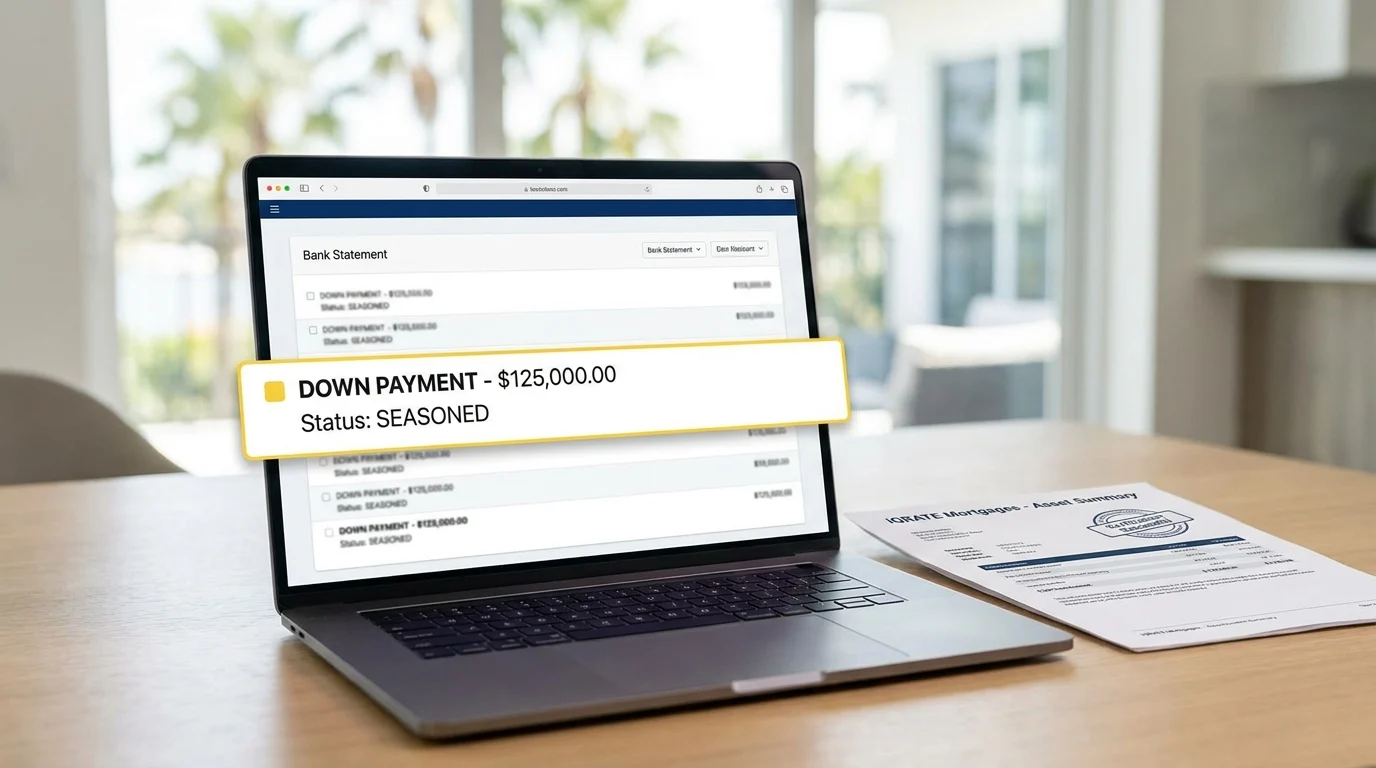
Even after 60 days, any large, unusual deposit will be flagged by the underwriter. You will still be required to source the origin of that deposit. The seasoning period simply makes the funds eligible for use; it does not erase the need to prove where they came from. Therefore, you must be prepared to provide a complete paper trail of the crypto liquidation, no matter how long the money has been in your account.
What Specific Documents Prove the Source of Funds?
To create the clear, unbroken paper trail that a mortgage underwriter requires, you must meticulously document every step of the process. Simply showing a large wire transfer from a crypto exchange is not enough. You need to prove ownership of the crypto and document its entire journey into your bank account.
Prepare to provide the following:
- Crypto Exchange Statements: You'll need statements from the exchange (e.g., Coinbase, Kraken) showing your ownership of the crypto assets before the sale. This should include your name and account details.
- Transaction History: A detailed report showing the exact transaction of selling the cryptocurrency for U.S. dollars. This report must include the date, time, amount of crypto sold, the exchange rate, and the resulting dollar amount.
- Transfer Confirmation: A receipt or confirmation from the crypto exchange showing the transfer of the liquidated funds from your exchange account to your personal bank account. This document must clearly show the destination bank account number and your name.
- Bank Statements: Your bank statement showing the corresponding deposit from the crypto exchange. The amount on the bank statement must match the amount on the transfer confirmation precisely.
Example Scenario: A homebuyer in Miami wants to use proceeds from a Bitcoin sale for a $400,000 down payment. They must provide:
- A Coinbase account statement showing they held the Bitcoin.
- The trade confirmation for selling the Bitcoin on a specific date for $405,000.
- The wire transfer confirmation from Coinbase to their Chase bank account for $405,000.
- The Chase bank statement showing the receipt of the $405,000 wire from Coinbase.
This creates an undeniable chain of evidence for the underwriter.
Which Crypto Exchanges Provide the Best Documentation for Lenders?
Not all crypto exchanges are created equal when it comes to documentation. For the purposes of a mortgage application, especially a jumbo loan in a competitive market like Palm Beach, you must use a reputable, U.S.-based exchange that complies with KYC (Know Your Customer) regulations.
Lenders overwhelmingly prefer exchanges that can provide clear, PDF-based statements and transaction histories that look similar to traditional brokerage statements. These platforms are accustomed to providing documentation for tax and financial purposes.
Top choices for mortgage documentation include:
- Coinbase: Widely regarded as one of the most compliant and user-friendly platforms for generating tax documents and transaction reports.
- Kraken: Another highly-regarded U.S. exchange known for its robust security and clear reporting features.
- Gemini: Known for its strong focus on security and regulatory compliance, making its documentation reliable for financial verification.
Avoid using decentralized exchanges or peer-to-peer transactions, as documenting the source of funds from these platforms is nearly impossible and will almost certainly be rejected by a mortgage underwriter.
How to Handle Taxes on Crypto Gains During the Loan Process
The IRS treats cryptocurrency as property, meaning any profit from selling it is a taxable capital gain. This has a direct impact on your mortgage application.
When you liquidate crypto for your down payment, the lender will consider the tax liability you've incurred. They need to ensure you have sufficient remaining assets to pay the taxes without depleting the funds needed for closing costs and required reserves.
Let's say you sell crypto for a $200,000 profit. Depending on your income and how long you held the asset, you might owe a significant amount in capital gains tax (e.g., 15-20% or more). (The data, information, or policy mentioned here may vary over time.) An underwriter will see this $30,000 to $40,000 tax liability as a future debt. You must demonstrate that you have additional funds set aside to cover this obligation. Failing to account for taxes can lead to your loan being denied for insufficient reserves.

It's highly advisable to consult with a tax professional to calculate your estimated tax liability before you apply for the loan. Provide this calculation to your mortgage lender along with proof of the additional funds you have reserved to pay the taxes.
Should I Liquidate All Funds at Once or in Smaller Amounts?
This decision involves a trade-off between market risk and documentation simplicity.
- Liquidating All at Once: The primary advantage is simplicity. You create one clean, large transaction that is easy to document. You have a single trade confirmation, a single wire transfer, and a single deposit to track. This significantly simplifies the paper trail for the underwriter. The downside is market risk; if you liquidate on a down day, you lock in a lower value.
- Liquidating in Smaller Amounts: This strategy allows you to potentially take advantage of market fluctuations (dollar-cost averaging out). However, it creates a much more complex paper trail. Each sale and transfer must be meticulously documented. For example, liquidating funds in five separate transactions means you need to provide five complete sets of documentation. This can frustrate underwriters and increase the chances of a document being missed or questioned.
For the sake of a smooth mortgage process, liquidating all required funds in one single transaction is strongly recommended. The goal is to make the underwriter's job as easy as possible.
Can I Use a Crypto-Backed Loan for My Palm Beach Down Payment?
No, you generally cannot use a loan taken out against your crypto assets for a down payment. This is a critical distinction. Mortgage guidelines require that a down payment comes from your own assets, not from another loan. Using a crypto-backed loan for a down payment is considered 'borrowed funds', which is prohibited. (The data, information, or policy mentioned here may vary over time.)
Furthermore, the payments on that crypto-backed loan would be counted as a debt in your debt-to-income (DTI) ratio, potentially making it harder for you to qualify for the jumbo loan itself. The only path recognized by nearly all mortgage lenders is the full liquidation of the crypto assets into U.S. dollars, followed by the seasoning period.
Common Mistakes That Get Crypto-Sourced Funds Rejected
Navigating this process for a high-value home in Miami or Palm Beach leaves no room for error. Here are the most common mistakes that can derail your jumbo loan application:
- Incomplete Paper Trail: The number one reason for rejection. This includes missing transaction receipts, providing screenshots instead of official PDF documents, or having mismatched names or amounts between statements.
- Liquidating Too Late: Starting the liquidation and seasoning process less than 60-90 days before you plan to close is a recipe for disaster. The mortgage process takes time, and you need the funds fully seasoned and verified well before your closing date.
- Co-mingling Funds: Depositing the liquidated crypto funds into an account with frequent, large, and undocumented deposits and withdrawals makes it impossible for an underwriter to track the specific funds.
- Ignoring Tax Liability: Failing to show you have separate, sufficient funds to cover the capital gains tax from the crypto sale will lead to the underwriter rejecting your assets due to insufficient reserves.
- Using Obscure Exchanges: Transferring funds from a non-compliant, offshore, or little-known exchange is an immediate red flag for money laundering and will likely result in a swift denial. Using cryptocurrency for a jumbo loan down payment is a complex process that requires expert guidance. If you're considering purchasing a property in Florida and need to navigate the liquidation and documentation process, working with a mortgage strategist who understands these unique asset types is crucial. A specialist can help you structure the transaction correctly from the start to ensure a smooth path to closing.
Navigating a mortgage with unique assets like cryptocurrency requires precision and expertise. If you're ready to structure your finances for a successful home purchase, let's start the conversation. Apply now to partner with a strategist who understands the complexities of your financial portfolio.
Author Bio
David Ghazaryan is the expert mortgage strategist and founder behind iQRATE Mortgages. With a mission to fund home loans that traditional banks won't touch, David specializes in helping clients with unique financial situations, including those recovering from foreclosure or bankruptcy. He expertly crafts smart, strategic, and stress-free mortgages by leveraging a vast network of over 100 lenders to secure competitive rates for investors and homebuyers alike. Praised for exceptional customer service, David has helped hundreds of families with a 97% satisfaction rate, guiding them to the mortgage they deserve.
References
CFPB - What documents will I need to provide for my mortgage application?









