


Understanding the VA IRRRL vs. a Standard Refinance
Finalizing a divorce involves separating assets and liabilities, and the shared mortgage is often the largest financial obligation to address. For veterans with a VA home loan, the process has a unique and powerful tool: the Interest Rate Reduction Refinance Loan (IRRRL). Understanding how this differs from a standard refinance is key to a smooth transition.
The VA IRRRL: A Streamlined Path
The VA IRRRL is often called a 'streamline' refinance for good reason. Its primary purpose is to help a veteran refinance an existing VA loan to a lower interest rate and, consequently, a lower monthly payment. The defining features include:
- Reduced Paperwork: Lenders require significantly less documentation compared to a new loan.
- No Appraisal (Usually): In most cases, the VA does not require a new appraisal, saving you time and money.
- No Income Re-qualification (Usually): If your new payment is not increasing by 20% or more, the lender typically does not need to perform a full income and credit re-qualification. This is a major advantage for those whose financial picture has changed post-divorce.
The Standard Refinance: A Complete Reset
A standard or 'credit-qualifying' refinance, whether for a rate-and-term adjustment or a cash-out, is essentially a brand-new loan application. This process involves:
- Full Underwriting: The lender must verify your income, assets, employment, and credit history from scratch.
- Mandatory Appraisal: A new appraisal is required to determine the home's current market value.
- Debt-to-Income (DTI) Scrutiny: Your DTI ratio is thoroughly analyzed to ensure you can handle the new loan on your own.
For a veteran simply looking to remove an ex-spouse in Jacksonville and satisfy a court order, the complex and costly nature of a standard refinance is often unnecessary. The IRRRL provides a specific, efficient exception for this exact scenario.
Using an IRRRL to Transfer Property After a Divorce
Yes, a VA IRRRL can be used to remove an ex-spouse from a VA loan, even though the program typically prohibits receiving cash out. The VA recognizes divorce as a special circumstance. The primary goal is not to extract equity but to transfer the property and the loan obligation from two parties to one, as mandated by a divorce decree.
This is one of the few situations where the IRRRL process is permitted to secure a 'buyout'. The veteran retaining the home refinances the existing VA loan into their name exclusively. This action formally releases the departing ex-spouse from all future mortgage liability, which is a critical step in legally separating your finances. Without this step, your ex-spouse would remain financially tied to the property, impacting their ability to secure future loans and leaving them vulnerable if payments are missed.
The Role of 'Novation' in Your VA Loan Transfer
In the legal and financial world, the term you will encounter during this process is 'novation'. Novation is not just removing a name from a document; it is the act of substituting one party in a contract with another, thereby creating a new contract.
When you use a VA IRRRL to remove an ex-spouse, you are performing a novation. The original loan agreement, which listed you and your ex-spouse as co-borrowers, is completely replaced by a new loan agreement that lists only you. This new loan pays off and closes the old one.

The result is a clean break. The novation ensures that:
- The veteran keeping the home assumes full legal and financial responsibility for the mortgage.
- The ex-spouse is fully and legally released from the debt obligation.
- The terms of the divorce decree regarding the property are satisfied.
Lenders in Pensacola and across Florida are familiar with this process. It is the official mechanism for transferring a VA loan from joint ownership to sole ownership post-divorce.
Critical Language Your Divorce Decree Must Contain
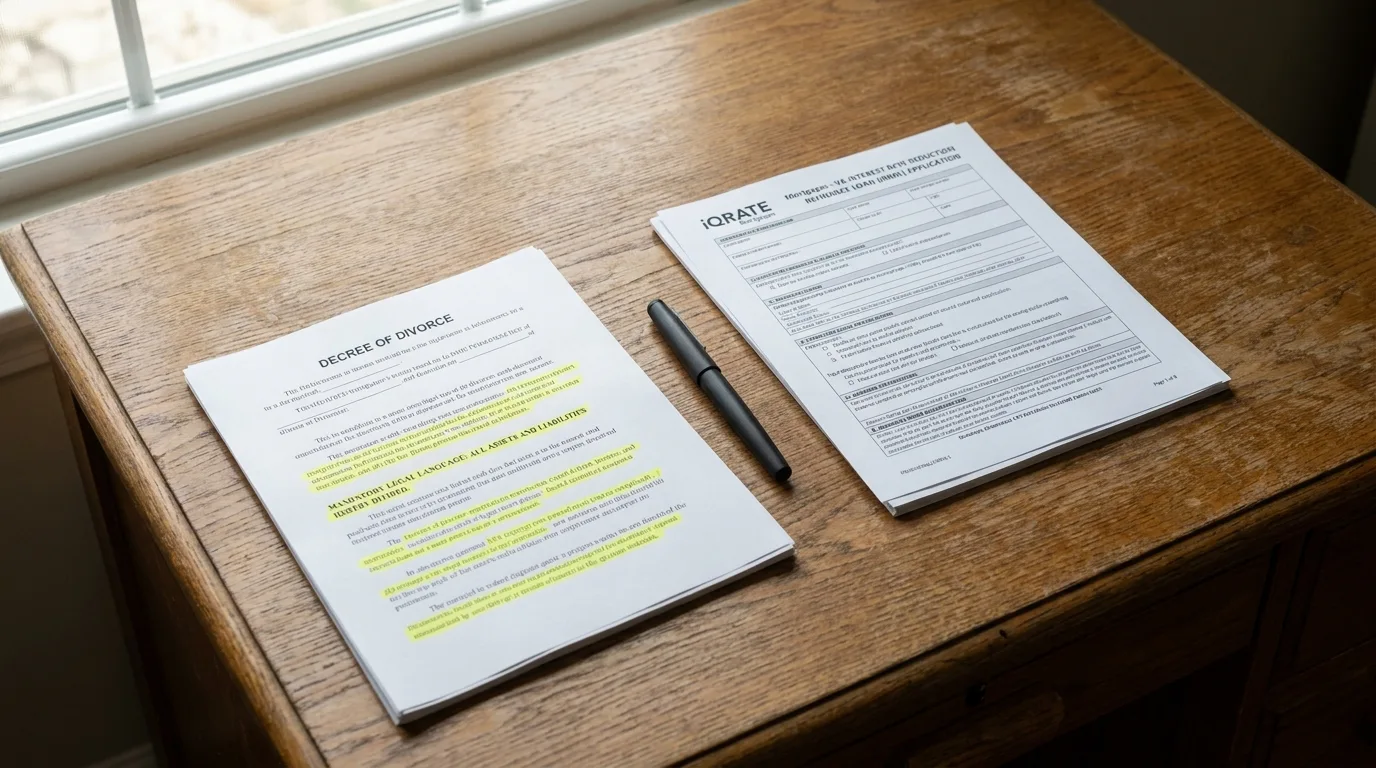
This is the most critical component of the entire process. Your lender cannot proceed with the IRRRL if your divorce decree is vague or missing specific language. Before your decree is finalized, you and your attorney must ensure it contains clear, actionable instructions. A poorly written decree will bring the entire refinance process to a halt.
Your final divorce decree must include the following:
- Specific Award of Property: The decree must explicitly state that the home is awarded to you, the veteran who will be retaining the mortgage. Include the full legal address of the property.
- Mandate to Refinance: It must contain a clause ordering you to refinance the existing mortgage to remove the ex-spouse's name from the loan and the title. Simply stating one person gets the house is not enough.
- Clear Deadlines: The document should specify a timeframe for the refinance to be completed (e.g., 'within 90 days of the final judgment'). This creates a legal imperative that lenders need to see.
- Release of Liability: The language must clearly state that upon completion of the refinance, the departing ex-spouse is to be held harmless and released from any and all liability associated with the original mortgage.
Consulting with a family law attorney in Florida who understands real estate and mortgage requirements is essential. Getting this language right before a judge signs off will save you months of delays and potential legal fees down the road.
Re-Qualifying for the Loan in Jacksonville
While a key feature of the IRRRL is the 'streamline' nature without re-qualification, the divorce scenario is slightly different. Because the loan is moving from being supported by two incomes to just one, the lender must perform due diligence to ensure you can afford the payment solo.
This is not a full, start-from-scratch qualification like a standard refinance, but it is a necessary check. The lender will need to verify:
- Sufficient Solo Income: You must demonstrate that your individual income is enough to cover the mortgage payment (Principal, Interest, Taxes, and Insurance - PITI) plus any other debts.
- Acceptable DTI Ratio: Your debt-to-income ratio will be calculated based on your sole income. The VA guidelines are generally flexible, but the lender needs to be confident you are not overextended. (The data, information, or policy mentioned here may vary over time.)
For example, if your total mortgage payment on your Jacksonville home is $2,500 and your other monthly debts (car loan, credit cards) total $500, your total monthly debt is $3,000. The lender will verify that your gross monthly income is sufficient to keep your DTI within VA-approved limits, ensuring a sustainable financial future in the home.
Closing Costs for a Divorce-Related IRRRL
There is no such thing as a truly 'no-cost' loan. However, the VA IRRRL allows for a 'no cash at closing' transaction. All allowable fees and costs associated with the refinance can be rolled into the new loan amount. This is incredibly helpful when finances may be tight after a divorce.
Typical closing costs include:
- VA Funding Fee: For an IRRRL, this fee is 0.5% of the loan amount for all veterans, regardless of service history or down payment. This fee goes directly to the VA to keep the program running.
- Lender Origination Fee: This covers the lender's administrative costs for processing the loan.
- Title and Recording Fees: Costs associated with ensuring the title is clear and recording the new deed and mortgage with the county.
- Other Third-Party Fees: This may include courier fees or other minor administrative costs.
On a $400,000 loan balance for a home in Pensacola, the 0.5% VA Funding Fee would be $2,000. This amount, plus the other costs, can be added to your new loan balance, meaning you likely won't need to bring any cash to the closing table. (The data, information, or policy mentioned here may vary over time.)
The Timeline for Removing an Ex-Spouse in Pensacola
A VA IRRRL is significantly faster than a standard refinance. Assuming your divorce decree is finalized and correctly worded, you can expect a timeline of approximately 21 to 30 days from application to closing.
Here’s a realistic breakdown:
- Application and Document Submission (1-3 Days): You'll complete the loan application and provide the lender with your finalized divorce decree, pay stubs, and any other requested documents.
- Lender Processing and Underwriting (5-15 Days): The underwriting team reviews your file, with a special focus on the divorce decree's language and your ability to carry the payment alone.
- Closing Disclosure and Final Approval (3-5 Days): You will receive a Closing Disclosure to review at least three days before signing.
- Signing and Funding (1-2 Days): You sign the final loan documents, and the new loan is funded, officially paying off the old mortgage.
(The data, information, or policy mentioned here may vary over time.)
Impact on Your Ex-Spouse's VA Entitlement
This is a critical point that often causes confusion. When you and your veteran ex-spouse originally took out the loan, you likely both used a portion of your VA loan entitlement. Simply refinancing the loan into your name alone with an IRRRL does not automatically restore your ex-spouse's entitlement.
To restore the departing veteran's entitlement for their future use, you—the veteran retaining the home—must complete a Substitution of Entitlement (SOE). This is a separate but concurrent process where you formally request that the VA substitute your ex-spouse's entitlement with your own on the loan.
Your mortgage lender can help you complete the necessary paperwork (VA Form 26-1880, Request for a Certificate of Eligibility). Completing the SOE is a crucial courtesy that allows your ex-spouse to regain their full VA home loan benefit, a significant advantage for their financial future.
Navigating a divorce is complex, but securing your home's future can be straightforward with the right guidance. If you're ready to move forward, understanding your specific options is the most critical step. Take control of your financial future and apply now to get a clear plan for your VA IRRRL.
Author Bio
David Ghazaryan is the expert mortgage strategist and founder behind iQRATE Mortgages. With a mission to fund home loans that traditional banks won't touch, David specializes in helping clients with unique financial situations, including those recovering from foreclosure or bankruptcy. He expertly crafts smart, strategic, and stress-free mortgages by leveraging a vast network of over 100 lenders to secure competitive rates for investors and homebuyers alike. Praised for exceptional customer service, David has helped hundreds of families with a 97% satisfaction rate, guiding them to the mortgage they deserve.
References
VA Interest Rate Reduction Refinance Loans (IRRRLs)









