


What to Do First After Receiving PCS Orders Mid-Loan?
Receiving Permanent Change of Station (PCS) orders while you are under contract to buy a home is a stressful but manageable situation. The absolute first step is to communicate immediately and clearly. Do not wait. As soon as you have the official orders in hand, you must notify your entire homebuying team.
Your team includes:
- Your Mortgage Lender: They are your most critical point of contact. Your lender needs to know about the change in your circumstances to adjust the underwriting and closing process. They will need a copy of your official orders to verify the new duty station and timeline.
- Your Real Estate Agent: Your agent will communicate with the seller's agent to explain the situation. A proactive agent can negotiate on your behalf, especially regarding timelines and contract contingencies.
- The Title Company or Closing Attorney: They prepare the final closing documents and will need to know if a Power of Attorney or a remote closing process is required.
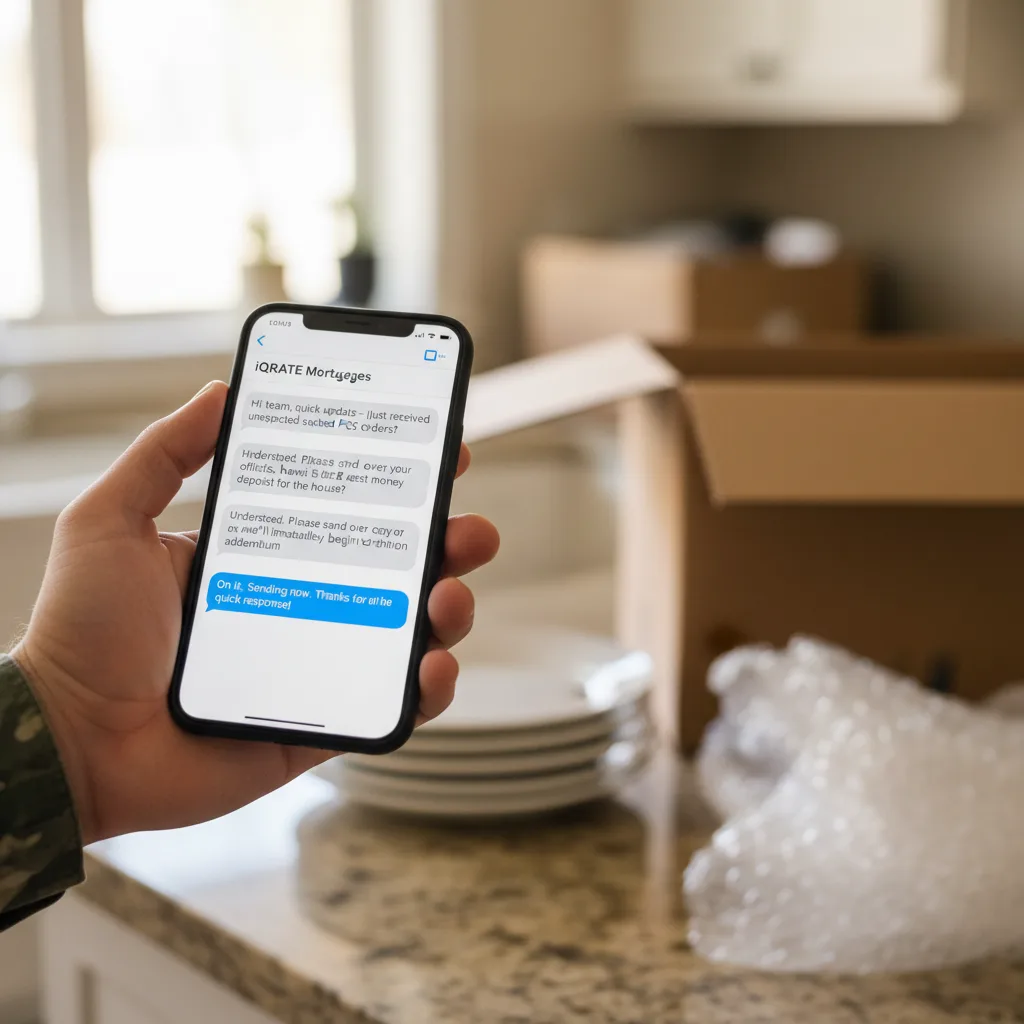
Providing a complete copy of your PCS orders is non-negotiable. This document is the official proof your lender needs to justify changes to your loan file, such as adjusting income calculations for a new Basic Allowance for Housing (BAH) rate or coordinating a closing for a service member who is no longer physically present.
How to Use a Military Power of Attorney for Closing
A Power of Attorney (POA) is a legal document that gives a designated person, known as the 'attorney-in-fact', the authority to act on your behalf in specific matters. For military members, a POA is an essential tool for closing on a home when you cannot be physically present.
However, not all POAs are created equal. Lenders and title companies have strict requirements.
- General POA: This grants broad authority and is almost never accepted for a real estate transaction. It lacks the specific details required to legally transfer property.
- Specific POA: This is what you need. It grants narrow authority for a single purpose. For a home loan closing, it must include the full property address, the exact loan amount, and the legal names of all parties. It explicitly authorizes your attorney-in-fact to sign all mortgage-related documents.

Your best resource for obtaining a compliant POA is your installation's legal assistance office (JAG). They understand the requirements for real estate transactions. The most important step is to get the draft POA to your lender and title company for approval before you sign it and leave. They will review it to ensure it meets their legal and compliance standards. Once approved, your attorney-in-fact, often your spouse, can legally sign the closing documents.
Can My Spouse Close on the Home in El Paso If I Have Already Left?
Yes, absolutely. This is one of the most common scenarios for military families facing a PCS during a home purchase. If you are buying a home near Fort Bliss in El Paso, but your orders require you to depart before the closing date, your spouse can finalize the purchase using a lender-approved Specific Power of Attorney.
Here’s how it works in practice:
- You execute a Specific POA naming your spouse as your attorney-in-fact.
- The lender and title company approve the POA document well in advance of closing.
- On closing day, your spouse attends the closing appointment.
- When signing the documents, your spouse will sign their own name and then sign your name, followed by ', by [Spouse's Name], as Attorney-in-Fact'.
This process also satisfies the VA's occupancy requirement. The VA requires that the veteran intends to personally occupy the property as their primary residence. When a spouse moves into the home, it fulfills this requirement, even if the service member's arrival is delayed due to military duties. Lenders understand this and will document the loan file with a copy of your PCS orders to explain the temporary separation.
How Lenders Handle Out-of-State Income Verification
When you receive PCS orders, your income structure, particularly your housing allowance, will change. Lenders are well-versed in this process and focus on verifying stable, reliable, and continuing income.
Your Leave and Earnings Statement (LES) remains the cornerstone of income verification. The lender will use it to confirm your base pay, time in service, and other entitlements. When you PCS, the key change is your Basic Allowance for Housing (BAH). The lender will require your PCS orders to confirm your new duty station. From there, they will use the official Department of Defense BAH calculator for that specific location, such as Austin or El Paso, to determine your new income for debt-to-income (DTI) ratio calculations.
For example, if you are moving to a higher cost-of-living area like Austin, your BAH will increase, which may improve your DTI ratio. The lender will document this future income as long as it is verified by your official orders. This ensures your loan qualification remains sound despite the move.
Protecting Your Earnest Money Deposit in Austin with Contract Clauses
Your earnest money deposit (EMD) is a significant amount of cash, typically 1-3% of the purchase price, that you put down to show the seller you are a serious buyer. (The data, information, or policy mentioned here may vary over time.) For a $450,000 home in Austin, this could be between $4,500 and $13,500. Losing it due to a PCS is a major concern.
This is where a Military Clause becomes your most important protection. This is a specific addendum or contingency added to your purchase contract. It gives you the right to terminate the contract without penalty and have your EMD returned if you receive official military orders that prevent you from completing the purchase. This could be due to a PCS to a different state, a deployment, or a change in duty station that makes the home impractical.
Crucially, this clause must be negotiated and included in the contract from the very beginning. You cannot add it after the fact. When making an offer on a home, especially in a competitive market, your real estate agent should explain to the seller's agent why this clause is a non-negotiable requirement for a military buyer. It provides a vital safety net against the uncertainties of military life.
How Remote and Mail-Away Closings Work for Military Members
When you can't be present for closing, technology and logistics offer solutions beyond the POA. Two primary methods are used:
Mail-Away Closing: This is the traditional remote option. The title company overnights the full package of closing documents to your location, whether you are at a temporary duty station or have already arrived at your new post. You must find a qualified notary public, sign all the documents in their presence, and overnight the package back. The biggest drawback is the time delay. This process can add several days to the closing timeline and requires careful coordination to avoid missing deadlines.
Remote Online Notarization (RON): This is the modern, faster, and more efficient solution. Using a secure audio-visual platform, you connect with a notary public online. You verify your identity digitally and sign the documents electronically while the notary observes and applies their digital seal. Texas is a RON-approved state, making this an excellent option for military members buying in places like El Paso or Austin. It eliminates shipping delays and can be done from anywhere with a stable internet connection. Be sure to confirm with your lender and title company that they are equipped for a RON closing.
Will My Interest Rate Lock Expire If My Move Is Delayed?
An interest rate lock is a lender's guarantee to hold a specific interest rate for you for a set period, typically 30 to 60 days. If your closing is delayed because of your PCS, you risk the lock expiring. If it expires, you may be subject to the current, potentially higher, market rates.
However, lenders are often more flexible with military service members who have official orders. When you first inform your lender about your PCS, you should also discuss your rate lock expiration date.
Many lenders offer a rate lock extension. This may come with a small fee, often calculated as a percentage of the loan amount per day. (The data, information, or policy mentioned here may vary over time.) In some cases, especially when the delay is clearly due to military duty, a good lender may offer a short-term extension for free as a courtesy. The key, as always, is proactive communication. Do not let the rate lock expire before talking to your lender about an extension.
Required Military Documents for Your Lender
To ensure your VA loan process proceeds smoothly after receiving PCS orders, you will need to provide a specific set of documents. Having these ready will prevent underwriting delays.
- Official PCS Orders: This is the most critical document. It validates the entire reason for the changes to your loan file.
- Leave and Earnings Statement (LES): Your most recent LES is needed to verify your current pay and allowances. Your lender will also want the first LES you receive after arriving at your new duty station to confirm the updated BAH.
- Statement of Service: If you are still on active duty, your commander may need to sign a Statement of Service. This letter confirms your name, rank, date of entry into service, and other details. It's often required early in the process but may be re-verified.
- VA Certificate of Eligibility (COE): This document proves to the lender that you meet the VA's minimum service requirements to be eligible for the VA loan benefit.
- Military Power of Attorney: If you are using a POA for closing, the lender and title company will need the final, approved, and executed copy for the file. Navigating a VA loan during a PCS can be complex. If you have orders to Texas or elsewhere, connect with a mortgage strategist who understands military life to ensure a smooth closing and protect your interests.
Navigating a VA loan during a PCS is complex, but you don't have to do it alone. Our mortgage strategists specialize in the unique needs of military families. To ensure a smooth closing and protect your interests, Apply for a Mortgage today and get the expert guidance you deserve.
Author Bio
David Ghazaryan is the expert mortgage strategist and founder behind iQRATE Mortgages. With a mission to fund home loans that traditional banks won't touch, David specializes in helping clients with unique financial situations, including those recovering from foreclosure or bankruptcy. He expertly crafts smart, strategic, and stress-free mortgages by leveraging a vast network of over 100 lenders to secure competitive rates for investors and homebuyers alike. Praised for exceptional customer service, David has helped hundreds of families with a 97% satisfaction rate, guiding them to the mortgage they deserve.
References
VA Lenders Handbook Chapter 3: VA-Guaranteed Loan
Consumer Financial Protection Bureau - The closing process: a step-by-step guide









