


The Truth Behind 'No-Cost' VA Streamline Refinancing
As a veteran homeowner, you've likely received mailers, emails, and calls about a 'no-cost' VA Interest Rate Reduction Refinance Loan (IRRRL). The promise is tempting: lower your interest rate and monthly payment without paying a dime out of pocket. However, the term 'no-cost' is one of the most misleading phrases in the mortgage industry. A refinance always has costs, including lender fees, title insurance, and government funding fees. (The data, information, or policy mentioned here may vary over time.)
So, where do these costs go? There are two common ways lenders structure a so-called 'no-cost' deal:
- Financed Closing Costs: This is the most common tactic. The lender takes all the closing costs and adds them to your new loan amount. If you have a $350,000 mortgage and the refinance costs are $6,000, your new loan balance becomes $356,000. You didn't pay cash, but you are now paying interest on those costs for the life of the loan.
- Lender Credits: In this scenario, the lender offers you a slightly higher interest rate than the absolute lowest available. In exchange for that higher rate, they provide a credit that covers some or all of your closing costs. While your loan balance doesn't increase, you're paying more in interest each month, which can cost you more over the long term.
Neither option is inherently bad, but transparency is key. A predatory offer will obscure these details, making it seem like the costs simply vanish.
Red Flag 1: Unsolicited 'Cash Back' Offers in Miami
A true VA IRRRL is a 'rate-and-term' refinance. Its sole purpose is to lower your interest rate or move you from an adjustable-rate mortgage (ARM) to a fixed-rate one. It is not a cash-out refinance. If a lender in Miami is aggressively offering you cash back, you need to be cautious.
This 'cash back' is often a gimmick. Lenders may inflate the loan amount just enough to cover all closing costs and provide a small surplus, which they market as a bonus for you. For example, they might tell you that you can skip one or two mortgage payments and get cash back, but this is achieved by financing those payments into the loan.
Example:
- Your current loan balance in Miami: $400,000
- Total IRRRL closing costs: $7,000 (The data, information, or policy mentioned here may vary over time.)
- 'Cash back' offer: $1,500
- The lender creates a new loan for $408,500 ($400,000 + $7,000 + $1,500).
You received $1,500, but your mortgage debt increased by $8,500. This is a classic sign of a lender prioritizing their commission over your financial well-being. A legitimate IRRRL focuses on long-term savings, not a small, short-term cash incentive that increases your debt.
Red Flag 2: How Closing Costs Get Hidden in Your Loan
Predatory lenders rely on borrowers not reading the fine print. The key to uncovering hidden fees is to demand a Loan Estimate (LE) from any lender making an offer. This standardized three-page document is required by law and breaks down every cost associated with the loan.

When you receive the LE, ignore the sales pitch and go straight to the numbers. Here’s how to tell if costs are being added to your loan:
- Look at Page 1, 'Loan Amount': Compare this number to your current mortgage principal balance (your 'payoff amount'). If the new loan amount is significantly higher, closing costs are being rolled in.
- Look at Page 2, 'Closing Cost Details': Review Section A, 'Origination Charges'. This is where the lender's profit is. Unscrupulous lenders may pad these fees. Compare this section across multiple offers. (The data, information, or policy mentioned here may vary over time.)
- Find 'Total Closing Costs (J)': This line item at the bottom of Page 2 tells you the full cost of the refinance. If the lender claims it's 'no-cost', this number should be offset by an equal 'Lender Credit' under section J. If there's no lender credit and you aren't bringing cash to close, those costs are being added to your loan balance.
Always ask the loan officer to walk you through the Loan Estimate and explicitly ask: 'Is the full amount of my closing costs being added to my new principal balance?'
Red Flag 3: Deceptively Low Interest Rates in Jacksonville
Another common tactic, especially in competitive markets like Jacksonville, is to advertise an impossibly low interest rate to get your attention. This rate often comes with a hidden catch: discount points. One discount point costs 1% of the loan amount and is paid upfront to 'buy down' the interest rate. (The data, information, or policy mentioned here may vary over time.)
While paying points can be a valid strategy for some, predatory lenders will not be transparent about them. They will roll the cost of the points into the loan balance without clearly explaining the trade-off.
Jacksonville IRRRL Offer Comparison:
Current Loan: $320,000 at 5.5% interest.
Offer A (Transparent Lender):
- Interest Rate: 4.25%
- Discount Points: 0 ($0 cost)
- Closing Costs: $5,500
- New Loan Amount: $325,500
Offer B (Predatory Lender with 'Low Rate'):
- Advertised Interest Rate: 3.75%
- Discount Points: 2 ($6,400 cost)
- Closing Costs: $5,500
- New Loan Amount: $331,900 ($320,000 + $5,500 + $6,400)
Offer B looks better on the surface due to the lower rate, but it permanently increases your loan principal by an extra $6,400. You will be paying interest on that higher amount for years. To justify paying points, you must stay in the home long enough for the monthly savings from the lower rate to offset the upfront cost of the points.
Red Flag 4: Identifying 'Loan Churning' Tactics
'Loan churning' is an unethical and often illegal practice where a lender encourages you to refinance your mortgage repeatedly in short intervals. Each time you refinance, the lender earns a commission, while you may see very little financial benefit and your loan balance may even increase.
To combat this, the VA has implemented strict rules:
- Seasoning Requirement: A lender cannot offer you an IRRRL until you have made at least six consecutive monthly payments on your current VA loan, and the note date of the new loan must be at least 210 days after the first payment was due on the original loan.
- Net Tangible Benefit (NTB) Test: The new loan must provide a clear benefit to you. This usually means a significant reduction in your principal and interest payment or moving from an ARM to a more stable fixed-rate loan.
If a lender contacts you about refinancing just a few months after you closed on your home, this is a massive red flag. They are likely a 'churner' looking for a quick commission at your expense. Always question any offer that seems too soon and verify that it meets the VA's seasoning and NTB requirements.
Red Flag 5: The Lender Skips the Appraisal
The VA IRRRL program is a 'streamline' refinance, meaning it typically does not require a new appraisal or income verification. This is a feature designed to make the process faster and easier for veterans. However, in the hands of a bad actor, this feature can be used to rush you into a bad deal.
An aggressive lender might emphasize the 'no appraisal' aspect to create a sense of urgency and push you to sign paperwork before you fully understand the terms. They use the simplicity of the process to gloss over high fees or a loan structure that doesn't benefit you.
The lack of an appraisal isn't a red flag on its own, but it becomes one when combined with other high-pressure sales tactics. A reputable lender will encourage you to take your time, review all documents, and ask questions, regardless of how simple the process is.
How to Compare Two VA IRRRL Offers Accurately
To protect yourself, you must compare refinance offers on an apples-to-apples basis. The only way to do this is by getting an official Loan Estimate from at least two different lenders.
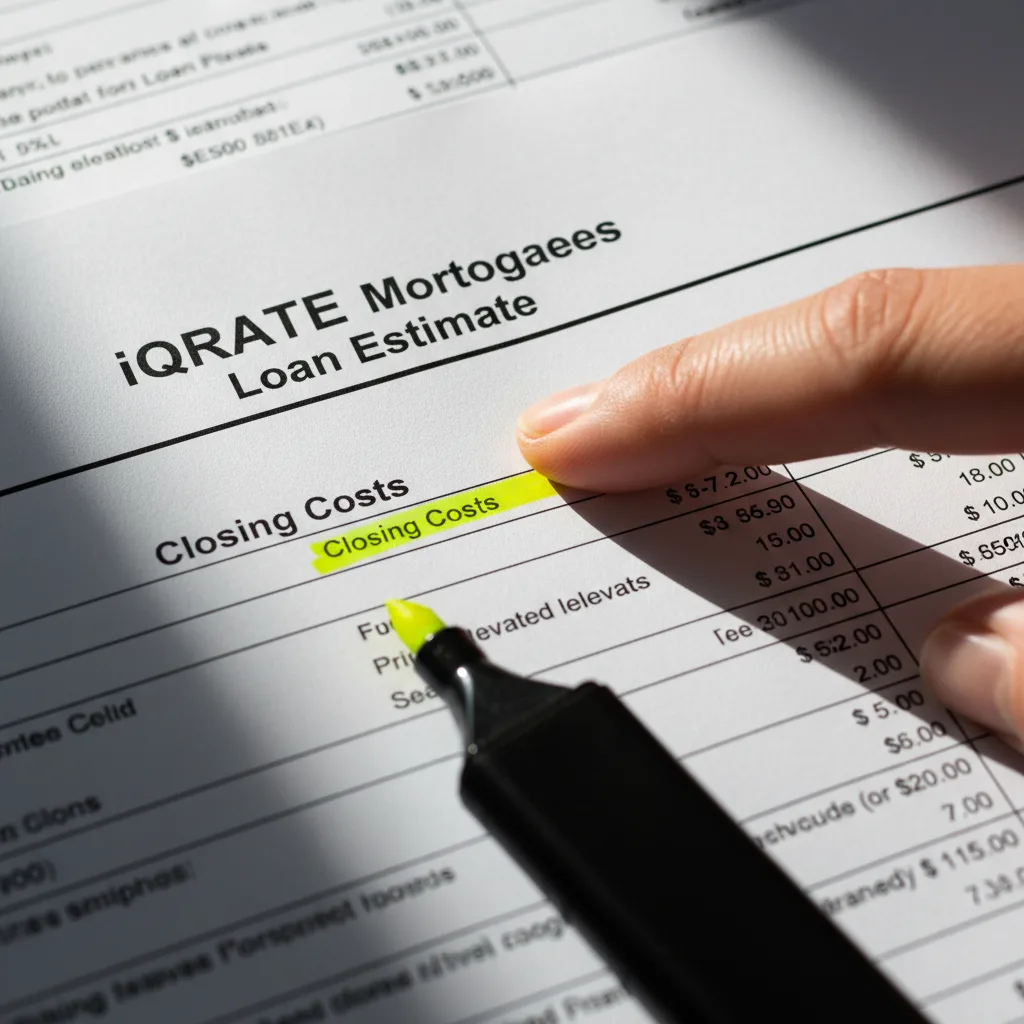
Scrutinize the Loan Estimate Side-by-Side
Place the Loan Estimates side-by-side and compare these key figures:
- Loan Amount: Is it close to your current payoff, or is it inflated?
- Interest Rate & Monthly Payment: How do they compare?
- Section A: Origination Charges: Are one lender's fees significantly higher? (The data, information, or policy mentioned here may vary over time.)
- Total Closing Costs (J): What is the all-in cost of the loan? (The data, information, or policy mentioned here may vary over time.)
- Lender Credits: Is the lender providing a credit to offset costs in exchange for a higher rate? (The data, information, or policy mentioned here may vary over time.)
Determine Your Financial Break-Even Point
The break-even point tells you how long it will take for your monthly savings to cover the total closing costs. This is the most important calculation you can make.
- Formula: Total Closing Costs / Monthly P&I Savings = Months to Recoup Costs
Example:
- Total Closing Costs: $6,000 (The data, information, or policy mentioned here may vary over time.)
- Current P&I Payment: $2,100
- New P&I Payment: $1,900
- Monthly Savings: $200
- Calculation: $6,000 / $200 = 30 months
In this scenario, it would take you 30 months (2.5 years) just to break even. If you plan to sell your home in Jacksonville or move before that time, the refinance would be a financial loss. A good IRRRL should have a short break-even point, ideally under 24 months.
Confirm the Net Tangible Benefit
Finally, ensure the offer meets the VA's requirements and makes sense for your goals. Is the payment reduction significant? Are you getting out of a risky ARM? Don't let a lender push you into a refinance that only provides a minimal benefit while costing you thousands in fees.
Unsure if your VA IRRRL offer is the real deal? Instead of deciphering confusing terms, get a straightforward analysis from a trusted expert. Start with a transparent process that puts your financial well-being first. Apply now to get a clear, no-obligation Loan Estimate and see the difference an honest lender can make.
Author Bio
David Ghazaryan is the expert mortgage strategist and founder behind iQRATE Mortgages. With a mission to fund home loans that traditional banks won't touch, David specializes in helping clients with unique financial situations, including those recovering from foreclosure or bankruptcy. He expertly crafts smart, strategic, and stress-free mortgages by leveraging a vast network of over 100 lenders to secure competitive rates for investors and homebuyers alike. Praised for exceptional customer service, David has helped hundreds of families with a 97% satisfaction rate, guiding them to the mortgage they deserve.
References









