


Builder Incentives in Houston: What's Really on the Table?
When you walk into a new construction sales office in Houston or San Antonio, the offer is almost always immediate and attractive: use the builder's affiliated lender and receive thousands of dollars in incentives. These aren't just small perks; they are significant financial carrots designed to steer you toward their in-house financing.
Typically, these incentives include:
- Closing Cost Credits: This is the most common offer. The builder might offer to pay $10,000, $15,000, or even more toward your closing costs. For a buyer, this means bringing less cash to the closing table, which is a powerful motivator.
- Interest Rate Buydowns: The builder's lender may offer a temporary (like a 2-1 buydown) or permanent reduction in your mortgage interest rate, lowering your monthly payment.
- Design Center or Upgrade Credits: Some builders offer credit to be used for upgrades like high-end countertops, better flooring, or premium appliance packages.
For example, on a $450,000 new home in a Houston suburb, a builder might offer $15,000 in closing cost credits if you finance with their preferred lender. This offer is often tied specifically to an FHA loan, as it allows the builder to work with buyers who may have lower down payments or credit scores.
FHA vs. Conventional: A Head-to-Head Cost Breakdown
The initial savings from a builder credit can be compelling, but it's crucial to analyze the total cost of the loan over time. Let's compare two realistic scenarios for a $400,000 new home purchase in San Antonio.
Scenario 1: The Builder's FHA Loan with Incentives
- Purchase Price: '$400,000'
- Down Payment (3.5%): '$14,000'
- Base Loan Amount: '$386,000'
- Interest Rate (example): '6.875%'
- Builder Incentive: '$15,000' applied to closing costs.
- Upfront Mortgage Insurance Premium (UFMIP): '1.75%' of the base loan, or '$6,755'. This is typically added to your total loan amount, making it '$392,755'.
- Monthly Mortgage Insurance Premium (MIP): '0.55%' annually on the base loan, which is ~$177 per month. This payment is for the life of the loan.
- Monthly Principal & Interest (P&I): '~$2,572'
- Total Monthly Payment (P&I + MIP): '~$2,749'

Scenario 2: An Independent Conventional Loan
- Purchase Price: '$400,000'
- Down Payment (5%): '$20,000'
- Loan Amount: '$380,000'
- Interest Rate (example): '6.375%'
- Builder Incentive: '$0'. You pay your own closing costs (typically 2-3% of the purchase price). (The data, information, or policy mentioned here may vary over time.)
- Upfront Mortgage Insurance: '$0'
- Monthly Private Mortgage Insurance (PMI): ~$140 per month. This payment can be requested for removal once your loan balance reaches 80% of the home's original value and is automatically terminated when the balance is scheduled to reach 78%.
- Monthly Principal & Interest (P&I): '~$2,370'
- Total Monthly Payment (P&I + PMI): '~$2,510'
The Verdict: In this scenario, the conventional loan is $239 cheaper per month. More importantly, the PMI on the conventional loan will eventually disappear, while the FHA MIP is permanent. The initial $15,000 builder credit is quickly eroded by the higher long-term costs of the FHA loan.
Are Builder Credits Masking Higher Costs?
Yes, often they are. A builder's affiliated lender operates in a captive market. They don't have to compete as aggressively on rates and fees because they have a steady stream of buyers sent directly to them. The builder incentive is a powerful tool to discourage you from shopping around.
Here's how higher costs can be hidden:
- Higher Interest Rates: As shown in the example, even a half-point difference in the interest rate results in a significantly higher monthly payment and tens of thousands of dollars more paid over the life of the loan.
- Inflated Lender Fees: Carefully scrutinize Section A: Origination Charges on the Loan Estimate. A builder's lender may charge higher application, processing, or underwriting fees, knowing that the builder's credit will absorb them. You might not feel the sting directly at closing, but it's money you could have saved with a more competitive lender.
- The APR: Always compare the Annual Percentage Rate (APR), not just the interest rate. The APR includes both the interest rate and lender fees, giving you a more accurate picture of the loan's true cost.
The Long-Term Equity Impact of FHA Mortgage Insurance
The single biggest financial drawback of a builder-pushed FHA loan is the mortgage insurance. With a down payment of less than 10%, the FHA MIP is permanent. It does not go away unless you sell the home or refinance into a different loan type.
Let's revisit our San Antonio example:
- FHA MIP: '$177' per month. Over ten years, that's $21,240 paid just for mortgage insurance, with no end in sight.
- Conventional PMI: '$140' per month. Assuming normal appreciation and payments, this PMI could be gone in 7-9 years, at which point your monthly payment drops by $140. Refinancing isn't required.
Every dollar spent on permanent MIP is a dollar that could have gone toward your principal, building equity faster. This delayed equity growth can impact your ability to leverage your home for future investments or a move-up purchase.
Negotiating with San Antonio Builders and Outside Lenders
A common fear among buyers is that using an outside lender will anger the builder and ruin their chances of negotiating the home's price. This is largely a myth.
The home's purchase agreement and your financing are two separate transactions. While the builder wants you to use their lender, their primary goal is to sell the house. A strong pre-approval from a reputable independent lender demonstrates that you are a serious, well-qualified buyer.
You can, and should, still negotiate on:
- The base price of the home.
- The lot premium.
- The cost of structural or design upgrades.
Politely inform the sales agent that you are exploring all financing options to ensure you get the best long-term deal. A good builder will respect this decision. If they pressure you excessively, it may be a red flag about their business practices.
How to Accurately Compare Loan Estimates
To make an informed decision, you must get an official Loan Estimate (LE) from both the builder's lender and at least one independent mortgage broker or bank. Request them on the same day, as interest rates change daily.
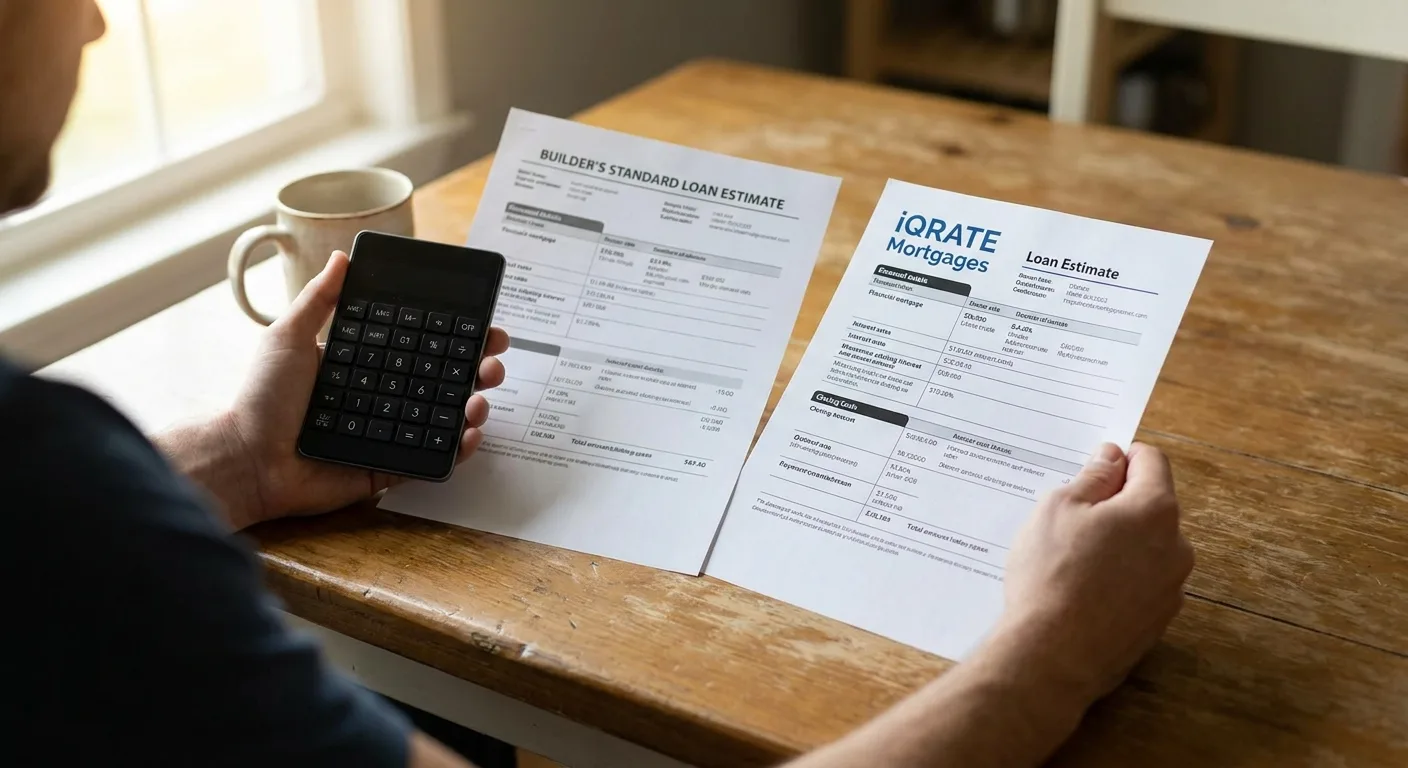
When comparing, focus on these key areas:
- Page 1 - Loan Terms: Compare the Loan Amount, Interest Rate, and Monthly Principal & Interest. Is the FHA loan amount inflated by the UFMIP?
- Page 1 - Projected Payments: Look at the full PITI (Principal, Interest, Taxes, Insurance) payment, paying close attention to the mortgage insurance line item.
- Page 2 - Closing Cost Details: Compare Section A: Origination Charges. This is where a lender's direct fees are listed. A lower number here is better.
- Page 2 - Cash to Close: The builder's LE will show their credit being applied, reducing your cash to close. Remember to weigh this one-time benefit against the higher monthly payment and total loan cost.
Weighing the Pros and Cons of a Builder's Lender
Pros
- Streamlined Process: The builder and lender are in constant communication, which can lead to a smooth, on-time closing.
- Significant Incentives: The closing cost credits can be substantial and genuinely helpful for cash-strapped buyers.
- Builder Knowledge: The lender is familiar with the project, timelines, and appraisal process for that specific community.
Cons
- Higher Long-Term Costs: Potentially higher rates and permanent MIP often outweigh the initial incentives.
- Limited Loan Options: They will almost always push the FHA loan that benefits them, even if a conventional or other program is better for you.
- Lack of Competition: With no need to compete for your business, they have less incentive to offer the best possible terms or service.
Future Flexibility: Selling or Refinancing Your New Build
Your first home is rarely your forever home. Consider your financial flexibility in 5 to 7 years.
With a Conventional Loan: As you pay down your loan, you can request to have your PMI removed. It will also terminate automatically once your loan balance reaches a certain threshold, typically 78% of the original property value. You build equity faster, giving you more options when it's time to sell.
With an FHA Loan: To get rid of the monthly MIP, your only option is to refinance into a conventional loan. This means paying thousands of dollars in new closing costs, essentially giving back a portion of the original builder incentive you received. If interest rates have risen since your purchase, refinancing might not even make financial sense, trapping you with the MIP payment indefinitely. Making the right choice on a new construction loan in Texas can save you tens of thousands. To get a clear, no-obligation comparison for your Houston or San Antonio home, it's wise to consult with an independent mortgage strategist who can shop over 100 lenders for you.
Don't let a tempting builder incentive obscure the long-term financial picture. By comparing a transparent offer from an independent lender, you can confidently choose the best path for your future. Ready to see the real numbers for your new Texas home? Apply now for a clear, no-obligation loan comparison.
Author Bio
David Ghazaryan is the expert mortgage strategist and founder behind iQRATE Mortgages. With a mission to fund home loans that traditional banks won't touch, David specializes in helping clients with unique financial situations, including those recovering from foreclosure or bankruptcy. He expertly crafts smart, strategic, and stress-free mortgages by leveraging a vast network of over 100 lenders to secure competitive rates for investors and homebuyers alike. Praised for exceptional customer service, David has helped hundreds of families with a 97% satisfaction rate, guiding them to the mortgage they deserve.
References
Consumer Financial Protection Bureau - What is a Loan Estimate?
Consumer Financial Protection Bureau - What is an FHA loan?
Consumer Financial Protection Bureau - What is private mortgage insurance?









