


What is the FHA 203(h) mortgage insurance program?
After a natural disaster strikes, the path to recovery can feel overwhelming. For residents whose homes have been severely damaged or destroyed, the Federal Housing Administration (FHA) offers a crucial lifeline through its Section 203(h) Mortgage Insurance for Disaster Victims program. It’s important to understand that this is not a direct loan from the government. Instead, the FHA provides mortgage insurance to approved lenders, which gives them the confidence to finance a home for a disaster survivor with highly favorable terms.
The primary purpose of the FHA 203(h) program is to help both homeowners and renters get back on their feet by purchasing a new single-family home. The most significant benefit of this program is that it allows for 100% financing, meaning eligible applicants are not required to make a down payment. This feature is incredibly valuable at a time when personal savings may be depleted due to disaster-related expenses.
This insurance can be used to:
- Purchase an existing single-family home.
- Finance the construction of a new single-family home.
It is exclusively for a borrower’s new principal residence and cannot be used for investment properties or vacation homes. For families in areas like Fort Myers and Naples that have faced devastating hurricanes, the FHA 203(h) program provides an immediate and accessible path to securing stable housing.
Who is eligible to apply for a disaster loan in Fort Myers?
Eligibility for an FHA 203(h) loan is specific and directly tied to the disaster event. To qualify, you must meet several key criteria. Lenders will rigorously verify each of these points before approving your mortgage insurance.
Key Eligibility Requirements
- Location in a PDMDA: Your previous home, whether you owned it or rented it, must have been located in a Presidentially-Declared Major Disaster Area. You cannot use this loan if your home was damaged by a storm or fire that did not result in an official federal disaster declaration.
- Destruction of Primary Residence: Your primary residence must have been destroyed or damaged to such an extent that reconstruction or replacement is necessary. This doesn't mean a few shingles are missing; it typically refers to structural damage that makes the home uninhabitable. Evidence from insurance adjusters or FEMA inspectors is often used to prove this.
- You Must Be the Borrower: The applicant for the loan must be the owner-occupant who was displaced by the disaster. Non-occupant co-borrowers are generally not permitted.
- Credit and Income Qualification: You must still meet the standard FHA credit and income requirements to demonstrate you can afford the new mortgage payments. The program provides financing assistance but does not bypass the need for financial qualification.

Both homeowners and renters are eligible. For example, if you were renting an apartment in Naples that was rendered uninhabitable by a hurricane, you could use an FHA 203(h) loan to purchase your first home without a down payment, provided the area was declared a PDMDA.
Do I need a down payment for a Section 203(h) loan?
No, you do not need a down payment for a Section 203(h) loan. This is the program’s most powerful feature. The FHA insures 100% of the home's value, which allows lenders to offer a loan with a zero down payment requirement. This maximum financing, also known as a 100% loan-to-value (LTV) ratio, is designed to remove the biggest barrier to homeownership for families trying to rebuild their lives after a catastrophe.
However, it's critical to distinguish between a down payment and closing costs. While you won’t need to provide a down payment, you will still be responsible for closing costs. These can include appraisal fees, title insurance, lender fees, and other expenses, typically totaling 2% to 5% of the loan amount. (The data, information, or policy mentioned here may vary over time.)
Fortunately, there are ways to manage these expenses:
- Seller Concessions: The FHA allows the seller to contribute up to 6% of the home's sales price toward your closing costs.
- Gift Funds: You can use gift funds from a family member, employer, or charitable organization to cover closing costs.
- Disaster Aid: Funds received from other sources, such as FEMA grants or insurance settlements, can often be used for this purpose.
How do I prove my previous residence in Naples was in a disaster area?
Proving your eligibility requires clear and specific documentation. Your lender will need to build a case file that confirms your previous home was your primary residence and was located within the disaster area boundaries. Be prepared to provide the following:
- Proof of the Disaster Declaration: The lender will verify that your property's address falls within a PDMDA. You can find this information on the official FEMA website, which lists all active and past disaster declarations by state and county.
- Proof of Previous Residency: You need to show that the damaged property was indeed your primary home. Acceptable documents include:
- A valid driver's license with the property's address.
- Utility bills (electric, water, gas) in your name for the months leading up to the disaster.
- Mortgage statements or a deed if you were the homeowner.
- A signed lease agreement if you were a renter.
- Evidence of Damage: This is the most critical piece of documentation. You must prove the home was destroyed or damaged so severely that it requires complete replacement. Strong evidence includes:
- Reports from your homeowner’s or flood insurance company.
- A damage assessment report from a FEMA inspector.
- Photos of the damage.
- A written report or estimate from a licensed contractor or structural engineer.
Gathering these documents promptly is essential for a smooth application process, especially for residents in high-impact zones like Naples or Fort Myers following a major storm.
Can I use this loan to rebuild on my existing lot?
Yes, the FHA 203(h) program allows you to rebuild a home on the lot where your previous residence stood. This is a common choice for families who want to remain in their neighborhood. However, the original structure must be completely demolished and removed before the new construction can begin.
When you choose to rebuild, the loan process is slightly different. The 203(h) loan essentially becomes a construction loan. The funds are placed in an escrow account and disbursed to your builder in stages as construction milestones are met. This process requires more oversight from the lender to ensure the project stays on track and within budget.
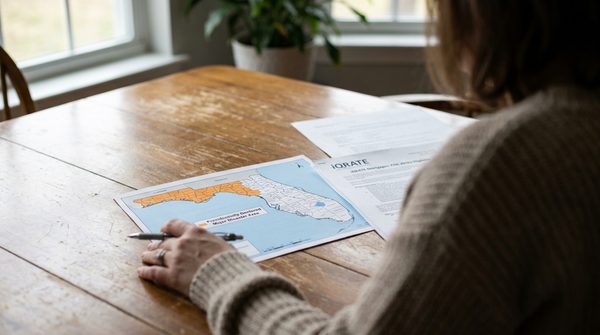
Alternatively, you can use the loan to purchase a different home in a new location. The new property does not have to be in the same city or even the same state, as long as you intend to occupy it as your primary residence.
What are the credit score and income requirements?
While the FHA 203(h) program is designed to be flexible for disaster victims, it does not eliminate the standard financial underwriting requirements. Lenders still need to ensure you have the ability to repay the new mortgage.
Credit Score
The FHA's absolute minimum credit score is 500, but nearly all FHA-approved lenders require a minimum score of 580 to 620. (The data, information, or policy mentioned here may vary over time.) Lenders may show some leniency for disaster victims, such as overlooking late payments on other accounts that occurred immediately after the disaster. However, a history of responsible credit use before the event is still very important.
Income and Debt-to-Income (DTI) Ratio
You must have stable, documented income that is likely to continue. Lenders will calculate your debt-to-income (DTI) ratio, which compares your total monthly debt payments (including the new mortgage) to your gross monthly income. The FHA generally prefers a DTI ratio of 43% or lower, though exceptions can be made with compensating factors. (The data, information, or policy mentioned here may vary over time.)
Example: A family in Fort Myers wants to buy a new home for $350,000. Their proposed monthly mortgage payment (including taxes, insurance, and FHA mortgage insurance) is $2,800. They also have $700 in other monthly debts (car payments, credit cards). Their total monthly debt is $3,500. To qualify with a 43% DTI, their gross monthly income would need to be at least $8,140 ($3,500 / 0.43 = $8,139.53).
How long after a disaster declaration do I have to apply?
There is a strict deadline for this program. You must submit your loan application to an FHA-approved lender within one year from the date the President officially declares the Major Disaster Area. This one-year window is firm, so it is crucial to act quickly once you have determined that you need to find a new permanent home.
Given the complexities of insurance claims and other aid applications, this deadline can approach faster than expected. It is wise to start conversations with a mortgage professional as soon as possible to understand your options and begin gathering the necessary documentation.
Can I combine this with other types of disaster aid?
Yes, absolutely. The FHA 203(h) loan is designed to work in conjunction with other forms of disaster assistance. It is not intended to replace aid from other sources but rather to fill the gap in financing a new home.
You can and should apply for all aid you are eligible for, including:
- FEMA Grants: These funds can be used for temporary housing, repairs, and other immediate needs, and can also be applied toward closing costs.
- SBA Disaster Loans: The Small Business Administration offers low-interest loans to homeowners and renters to repair or replace damaged property and personal belongings.
- Insurance Proceeds: Payouts from your homeowner's, flood, or windstorm insurance policies are a primary source of recovery funds.
These funds can be used to pay off the remaining balance of your old mortgage, cover your closing costs on the new loan, or even reduce the principal amount of your new 203(h) loan if you choose to make a voluntary down payment. Navigating the FHA 203(h) loan process after a disaster can be complex. If you've been affected in Fort Myers or Naples, working with a mortgage expert who understands disaster recovery programs can provide clarity and support. Reach out to a qualified professional to discuss your specific situation and confirm your eligibility.
Feeling overwhelmed by the recovery process? You don't have to navigate it alone. Take the first step toward securing a new home with the help of a knowledgeable expert. Apply now to discuss your situation and get clear guidance on your eligibility for an FHA 203(h) loan.
Author Bio
David Ghazaryan is the expert mortgage strategist and founder behind iQRATE Mortgages. With a mission to fund home loans that traditional banks won't touch, David specializes in helping clients with unique financial situations, including those recovering from foreclosure or bankruptcy. He expertly crafts smart, strategic, and stress-free mortgages by leveraging a vast network of over 100 lenders to secure competitive rates for investors and homebuyers alike. Praised for exceptional customer service, David has helped hundreds of families with a 97% satisfaction rate, guiding them to the mortgage they deserve.
References
HUD Section 203(h) Mortgage Insurance for Disaster Victims









