


How a United States Department of Agriculture Loan Works
Many homebuyers in Florida believe that a 20% down payment is an unavoidable hurdle to owning a home. The United States Department of Agriculture (USDA) loan program directly challenges that assumption by offering a path to homeownership with zero down payment. This program, formally known as the Section 502 Guaranteed Rural Housing Loan Program, is designed to populate and develop communities in suburban and rural areas.
It's not a direct loan from the government. Instead, the USDA guarantees the loan, which is issued by a private lender like a bank or mortgage company. This guarantee acts as a form of insurance for the lender, significantly reducing their risk. Because the risk is lower, lenders are willing to offer incredible terms, most notably 100% financing. This means you can finance the entire purchase price of the home without putting any money down.
The primary goal is to help moderate-to-low-income households purchase homes in eligible areas. It makes homeownership accessible for families who have stable income and good credit but may not have substantial savings for a large down payment, a common scenario for many renters in the competitive Tampa market.
Key Features of a USDA Loan
- Zero Down Payment Required: This is the program's most significant benefit. You can buy a home with no initial investment in the purchase price.
- Competitive Interest Rates: Because the loans are government-backed, lenders can offer interest rates that are often competitive with or even lower than conventional loans.
- Flexible Credit Guidelines: While not a 'bad credit' loan program, USDA guidelines can be more lenient than those for conventional financing.
- Closing Cost Assistance: The program allows you to finance closing costs into the loan amount if the appraised value is higher than the purchase price. Additionally, sellers can contribute up to 6% of the sale price toward your closing costs.
What Are the Income Limits to Qualify for This Mortgage?
To ensure the program serves its intended audience, the USDA sets income limits for applicants. These limits are not a single national number; they vary based on the county the property is in and the size of your household. The program evaluates your total annual household income, which is a critical distinction. This includes the income of all adults who will be living in the home, even if they are not co-borrowers on the mortgage loan.
Your household income must not exceed 115% of the median income for that area. Lenders will review your pay stubs, W-2s, and tax returns to calculate this figure.
Income Limit Example for the Tampa Area
Let's consider Hillsborough County, where both Tampa and Brandon are located. For 2024, the USDA income limits are:
- 1–4 Member Household: $110,650
- 5–8 Member Household: $146,050
So, if you are a family of three looking to buy a home in a USDA-eligible area near Brandon, your total combined household income cannot exceed $110,650. If you are a family of five, that limit increases to $146,050. These limits are updated periodically, so it's essential to check the current figures with your lender when you apply. (The data, information, or policy mentioned here may vary over time.)
How Do I Find Eligible Properties Near Tampa?
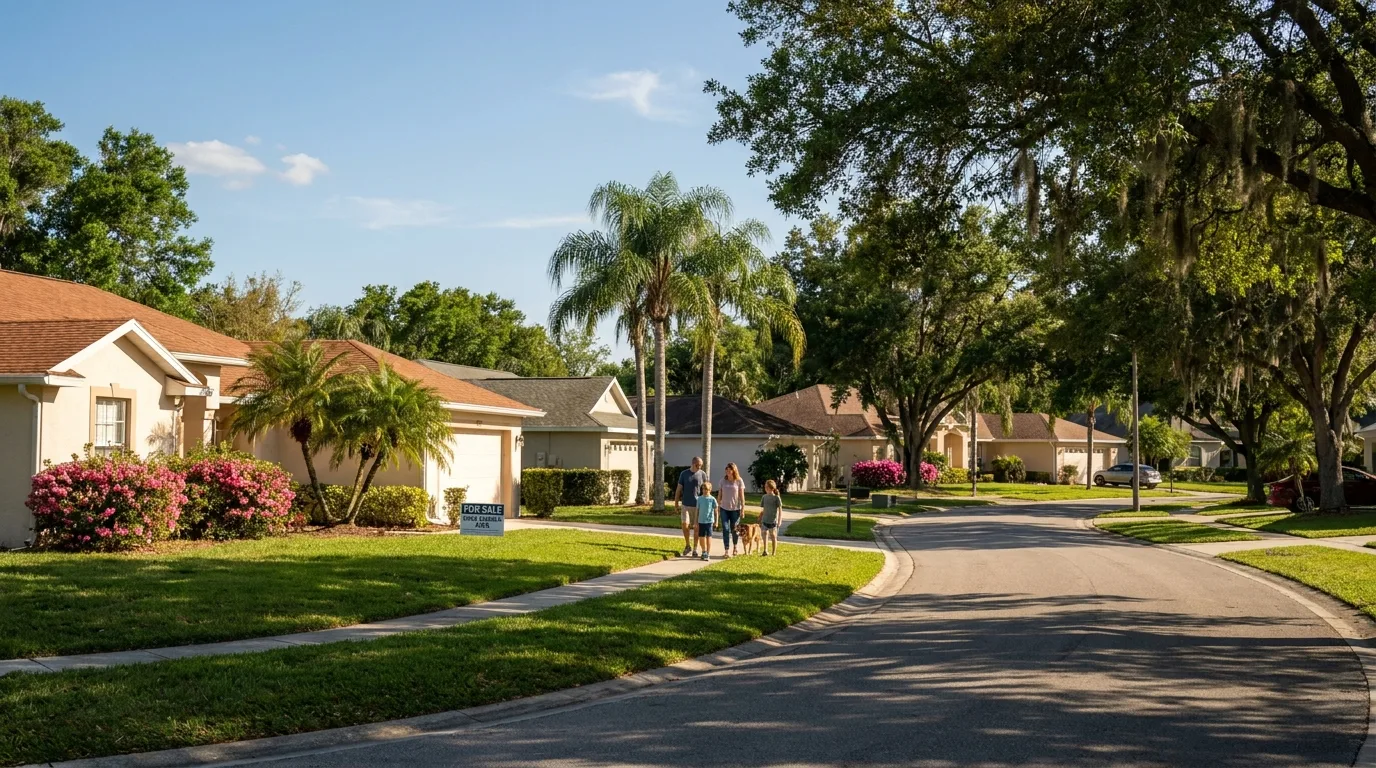
One of the biggest myths about USDA loans is that you must move to a remote, undeveloped area. In reality, 'rural' for the USDA can include many suburban towns and small cities just outside of major metropolitan hubs. Many communities on the outskirts of Tampa and Brandon, Florida, fall into eligible zones.
You can find qualifying homes in areas that offer a quieter lifestyle while still providing a reasonable commute to city centers. For example, towns like Plant City, Ruskin, and parts of Riverview have eligible properties that are a short drive from the economic opportunities in Tampa.
The only definitive way to know if a specific property qualifies is to use the official USDA Property Eligibility Map. This free online tool is simple to use:
- Visit the USDA eligibility website.
- Select 'Single Family Housing Guaranteed' as the program.
- Enter the full address of the property you are interested in.
- The map will immediately tell you if the address is located in an eligible area.
Working with a real estate agent who is familiar with USDA-eligible zones around Brandon can save you significant time and effort in your property search.
Are There Special Credit Score Requirements for USDA Home Loans?
While the USDA does not set a hard minimum credit score, lenders who issue the loans do. Most lenders look for a minimum credit score of 640. (The data, information, or policy mentioned here may vary over time.) A score at or above this level allows your application to go through the USDA's Guaranteed Underwriting System (GUS), which enables a more streamlined and automated approval process.
What if your score is below 640? You are not automatically disqualified. However, your application will require manual underwriting. This means an underwriter will perform a more detailed review of your entire financial profile to assess your creditworthiness. They will look for compensating factors, such as:
- A stable employment history (at least two years with the same employer).
- A low debt-to-income (DTI) ratio.
- A history of consistent rent payments for the last 12 months.
- Significant savings or cash reserves.

It's important to remember that a higher credit score generally leads to a better interest rate, which can save you thousands of dollars over the life of your loan.
Does a USDA Loan Have Mortgage Insurance Like an FHA Loan?
Yes, USDA loans have a form of mortgage insurance, but it is structured differently from FHA's Mortgage Insurance Premium (MIP) or a conventional loan's Private Mortgage Insurance (PMI). The USDA calls it a Guarantee Fee.
This fee is what funds the program and protects lenders against losses, allowing them to offer 100% financing. It is broken into two parts:
- Upfront Guarantee Fee: This is a one-time fee calculated as a percentage of the total loan amount. Currently, it is 1.0%. For a $300,000 loan, this would be $3,000. The best part is that this fee can almost always be financed directly into your loan balance, so you don't need to pay it out of pocket at closing.
- Annual Fee: This is a recurring fee paid in monthly installments as part of your mortgage payment. It is calculated as 0.35% of the remaining principal balance each year. This is often significantly lower than the annual mortgage insurance on an FHA loan, which can make the monthly payment on a USDA loan more affordable.
For that same $300,000 loan, the annual fee would start at around $87.50 per month, and this amount decreases slightly each year as you pay down your loan principal. (The data, information, or policy mentioned here may vary over time.)
Can I Use This Program if I Am Not a First-Time Homebuyer?
Absolutely. This is a common misconception about the USDA program. You do not have to be a first-time homebuyer to qualify for a USDA loan. Repeat buyers are welcome to use the program as long as they meet all other eligibility criteria.
The primary restriction is that the home you purchase with the USDA loan must become your primary residence. You cannot use this program to buy a vacation home or an investment property. Additionally, you typically cannot own another adequate home within the local commuting area at the time of closing. If you currently own a home in Tampa and want to use a USDA loan to buy a new primary residence in Plant City, you will likely need to sell your current home first.
What Types of Property Can I Purchase With This Loan?
USDA loans can be used to purchase a variety of property types, provided they are modest for the area, in good condition, and used as a primary residence. Eligible properties include:
- Single-family homes (detached houses).
- New construction homes.
- Condominiums (must be in a USDA-approved project).
- Townhouses or homes in a Planned Unit Development (PUD).
Properties that are generally not eligible include:
- Investment properties or multi-unit homes.
- Homes with an in-ground swimming pool (in some cases, this can be a gray area).
- Properties that are primarily used for commercial income, such as a large-scale farm.
What Are the Closing Costs for a USDA Loan in Brandon?
Even with a zero down payment loan, you will still need to have funds available for closing costs. These are the fees associated with finalizing the mortgage and transferring ownership of the property. Closing costs typically range from 2% to 5% of the home's purchase price. (The data, information, or policy mentioned here may vary over time.)
For a $350,000 home in Brandon, Florida, your closing costs could be between $7,000 and $17,500. These costs cover services such as:
- Lender Fees: Application, processing, and underwriting fees.
- Appraisal Fee: To confirm the home's value.
- Title Search and Insurance: To ensure the property has a clear title.
- Home Inspection: Highly recommended to check the property's condition.
- Recording Fees: To record the sale with Hillsborough County.
- Prepaid Items: Such as homeowners insurance and property taxes.
Fortunately, USDA loans offer great flexibility for covering these costs. You can pay them with your own savings, use gift funds from a family member, or negotiate for the seller to pay them. Seller concessions on a USDA loan can be up to 6% of the purchase price, which is often enough to cover all or most of your closing costs. A zero down payment USDA loan could be your key to owning a home in the Tampa Bay area. If you're ready to see what you qualify for, take the next step and Apply now to connect with a mortgage strategist.
A zero down payment USDA loan could be your key to owning a home in the Tampa Bay area. If you're ready to see what you qualify for, take the next step and Apply now to connect with a mortgage strategist.
Author Bio
David Ghazaryan is the expert mortgage strategist and founder behind iQRATE Mortgages. With a mission to fund home loans that traditional banks won't touch, David specializes in helping clients with unique financial situations, including those recovering from foreclosure or bankruptcy. He expertly crafts smart, strategic, and stress-free mortgages by leveraging a vast network of over 100 lenders to secure competitive rates for investors and homebuyers alike. Praised for exceptional customer service, David has helped hundreds of families with a 97% satisfaction rate, guiding them to the mortgage they deserve.
References









