


Why Qualifying for a Mortgage with 1099 Income is Difficult
For the thriving community of gig workers, freelancers, and independent contractors in Las Vegas, the freedom of self-employment is a major benefit. However, when it comes to buying a home, that same freedom can become a significant hurdle. Lenders are trained to favor predictability. They love the simplicity of a W-2 employee with a steady paycheck from a single employer. Your income, derived from multiple sources, fluctuating month-to-month, and detailed on 1099-NEC forms, doesn't fit neatly into their standard underwriting box.
The primary challenge is the lender's method for calculating your qualifying income. The industry standard is to request two full years of tax returns and average your net income (after business expenses) over a 24-month period. This formula often penalizes growth. Imagine you're a freelance web developer in Las Vegas who earned a net income of $55,000 in your first year but grew your business to $95,000 in your second year. Instead of qualifying based on your current, higher earnings, many lenders will average the two years, calculating your monthly income based on a $75,000 salary. This can drastically reduce your purchasing power, preventing you from affording the home you can genuinely manage.
What Documents Do I Need to Prove My Gig Worker Income in Las Vegas?
To overcome the lender's skepticism, you need to provide a fortress of documentation that proves your income is stable and likely to continue. A disorganized application is the fastest path to denial. Before you even speak to a lender, gather the following documents to present a professional and complete financial picture:
- Personal and Business Tax Returns (Two Years): This is non-negotiable for most conventional loans. Lenders will focus heavily on your Schedule C (Profit or Loss from Business) to determine your net income after all expenses. If you operate as an S-Corp or partnership, have your business returns and K-1s ready.
- Year-to-Date Profit and Loss (P&L) Statement: This is your secret weapon. A P&L statement shows your income and expenses for the current, incomplete year. A professionally prepared P&L demonstrates that your income is stable or, even better, growing since your last tax filing.
- Business Bank Statements (12-24 Months): Provide statements for all accounts where you deposit business income. Underwriters use these to verify the cash flow reported on your P&L and tax returns. Consistent, regular deposits are key to proving stability.
- 1099 Forms: While your tax returns summarize this income, having the individual 1099-NEC or 1099-MISC forms from your clients can help paint a clearer picture of your revenue sources.
- Business License and Registration: This confirms your business is legitimate and properly registered to operate in Henderson or elsewhere in Nevada.
- Letter of Explanation: Sometimes, a simple letter explaining a large one-time expense or the nature of your business can clear up underwriter confusion before it becomes a problem.
How Lenders Average Income From Multiple Inconsistent Sources
The standard formula lenders use for self-employed income is straightforward but often unforgiving:
(Year 1 Net Income + Year 2 Net Income) / 24 Months = Qualifying Monthly Income
Let's apply this to a rideshare driver in Henderson who works for multiple platforms.
- Year 1 Net Income (after gas, maintenance, etc.): $48,000
- Year 2 Net Income: $62,000
The lender's calculation would be: ($48,000 + $62,000) / 24 = $4,583 per month.
While this seems simple, a major red flag for underwriters is declining income. If the driver's income was $62,000 in Year 1 and dropped to $48,000 in Year 2, the lender might refuse to use the average. They may use only the lower, more recent income ($48,000 / 12 = $4,000/month) or deny the loan altogether out of concern that the business is failing.
This is where a strong year-to-date P&L and a letter of explanation become vital. If you can show your income has rebounded in the current year, a skilled loan officer can argue your case with the underwriter.
Can I Get a Mortgage in Henderson with Only One Year of Self-Employment History?
This is a common question, and the answer is a cautious 'maybe'. While the two-year rule is standard, Fannie Mae and Freddie Mac guidelines allow for exceptions in specific circumstances. You may be able to qualify for a conventional loan with only one year of self-employment tax returns if you can demonstrate:
- A Strong History in a Similar Field: The most common exception is for someone who was previously a W-2 employee in the same or a related industry. For example, a nurse who worked at a Las Vegas hospital for five years and has now been a successful independent nursing contractor for 14 months has a strong case.
- Sufficient and Stable Income: Your income for that one year must be thoroughly documented, stable, and appear likely to continue. The underwriter will scrutinize your business structure, client base, and cash flow to make this determination.
It's important to note that government-backed loans like FHA are typically much stricter and almost always require a full two-year history of self-employment. Getting approved with a one-year history requires working with a mortgage broker who has access to lenders comfortable with these exceptions.
Are Bank Statement Loans a Better Option for Gig Economy Workers?
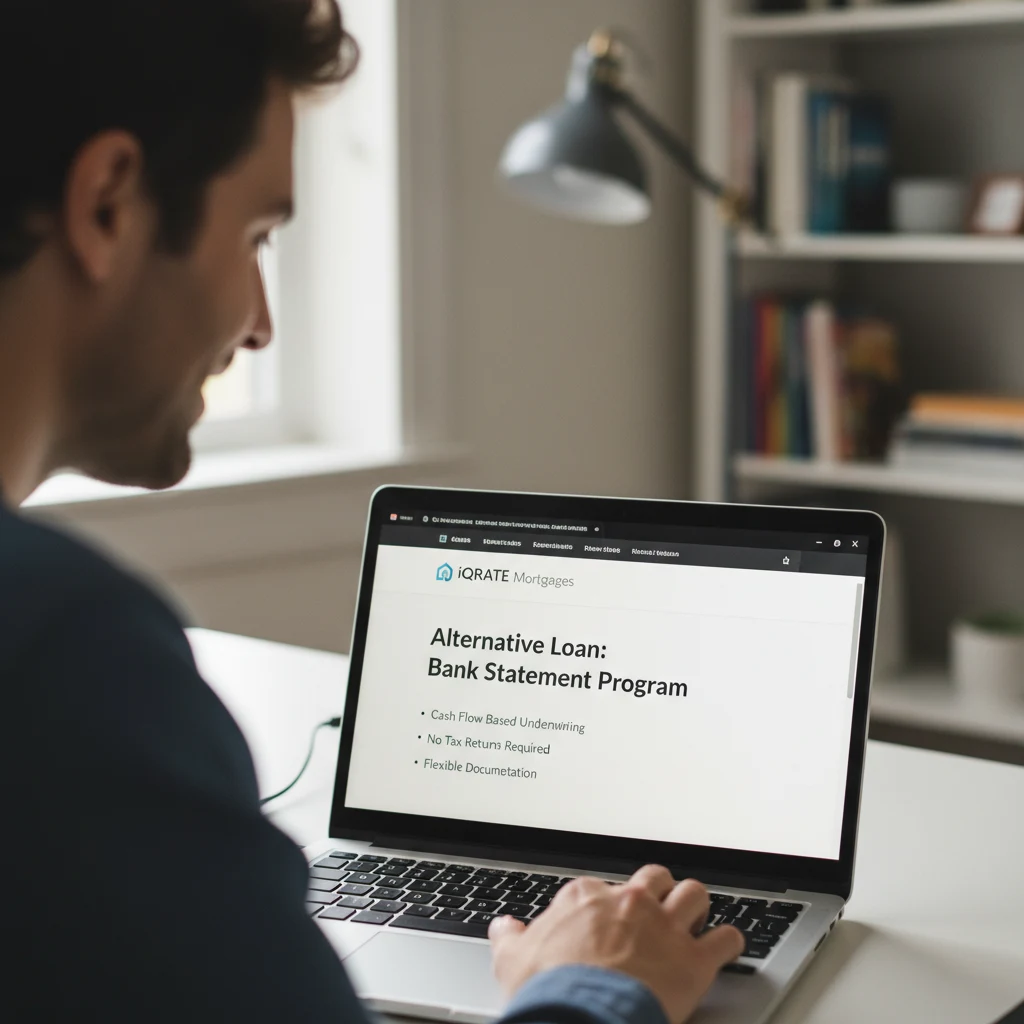
For many gig workers, bank statement loans are a game-changer. These are Non-Qualified Mortgages (Non-QM) designed for borrowers with non-traditional income. Instead of using your tax returns, underwriters analyze your business bank statement deposits to determine your qualifying income. This is the perfect solution if you take advantage of legitimate tax write-offs that reduce your net income on paper.

How Bank Statement Loan Income is Calculated
The calculation ignores your tax returns entirely. Instead, lenders total all your eligible business deposits over a 12 or 24-month period and apply a standard 'expense factor' (typically 50%, but it varies by industry) to arrive at your qualifying income. (The data, information, or policy mentioned here may vary over time.)
- Example: A freelance marketing consultant in Las Vegas deposits $200,000 into her business account over 12 months. On her tax return, she wrote off $120,000 in expenses, leaving a net income of only $80,000.
- Conventional Loan Qualification: Based on $80,000/year, or $6,667/month.
- Bank Statement Loan Qualification: Using a 50% expense factor, the lender calculates her income as
($200,000 * 0.50) / 12 = $8,333/month.
That difference of nearly $1,700 a month in qualifying income can mean the difference between buying a small condo and the single-family home you really want.
Pros and Cons of Bank Statement Loans
- Pros: Ideal for borrowers with high gross revenue but also high business expenses. Your tax strategy doesn't hurt your home buying power. The documentation process is focused on cash flow, not tax filings.
- Cons: These loans typically come with slightly higher interest rates and require a larger down payment (often 10-20% minimum) compared to conventional loans. (The data, information, or policy mentioned here may vary over time.)
How Do I Account for Business Expenses and Write-Offs?
Business write-offs are fantastic for reducing your tax liability but devastating for your mortgage application. Every dollar you write off as a business expense is a dollar subtracted from the income used to qualify you for a loan. A good accountant's goal is to get your taxable income as low as possible; a loan officer needs that income to be as high as possible. This creates a fundamental conflict.
If you plan to buy a home in the next two years, you must shift your mindset. Work with your CPA to be strategic about your deductions. It may be worthwhile to pay more in taxes for a year or two in order to show a higher net income and qualify for the mortgage you need. Delaying large equipment purchases or choosing to take a smaller home office deduction can significantly boost your qualifying income.
Will Forming an S-Corporation Help or Hurt My Mortgage Chances?
Structuring your business as an S-Corporation can be a smart move, but its impact on your mortgage application depends entirely on how you manage it. In an S-Corp, you typically pay yourself a 'reasonable' W-2 salary and can also take owner distributions from the company's profits.
- How it can help: A lender can use both your W-2 salary and the distributions (documented on your K-1) to qualify you, potentially increasing your total income. It presents a more formal and stable business structure.
- How it can hurt: If you pay yourself an artificially low W-2 salary to minimize payroll taxes, you are gutting your primary source of qualifying income. Furthermore, if the business doesn't show consistent profit and have enough cash reserves after you take distributions, an underwriter will not count that distribution income.
The key is clean bookkeeping. Never commingle personal and business funds, maintain a healthy business bank account balance, and work with a CPA to ensure your salary and distributions are defensible.
How a Profit and Loss Statement Strengthens Your Application
For a gig worker with growing income, the P&L statement is the single most important document beyond your tax returns. It bridges the time gap between your last tax filing and your application date. If you filed your taxes for last year showing $70,000 in net income, but your P&L for the first six months of this year shows you're on track to earn $100,000, this is your proof.
A well-prepared P&L, especially one signed by a CPA, gives the underwriter the confidence to look beyond the simple 24-month average. It allows your loan officer to build a narrative that your business is not just stable but thriving, justifying a loan amount based on your more recent, higher earnings. It turns a backward-looking calculation into a forward-looking approval. If you're a gig worker in Las Vegas or Henderson struggling to navigate the mortgage process, don't let confusing income calculations stop you. A mortgage strategist can analyze your unique financial picture and connect you with lenders who understand self-employed borrowers, including those offering flexible bank statement loan programs.
Ready to translate your hard-earned 1099 income into a new home? Our experts specialize in mortgages for gig workers and can guide you through the process. Apply for a Mortgage today to discover your options.
Author Bio
David Ghazaryan is the expert mortgage strategist and founder behind iQRATE Mortgages. With a mission to fund home loans that traditional banks won't touch, David specializes in helping clients with unique financial situations, including those recovering from foreclosure or bankruptcy. He expertly crafts smart, strategic, and stress-free mortgages by leveraging a vast network of over 100 lenders to secure competitive rates for investors and homebuyers alike. Praised for exceptional customer service, David has helped hundreds of families with a 97% satisfaction rate, guiding them to the mortgage they deserve.
References
Fannie Mae: Self-Employed Borrower Requirements








