


What is Payment Shock and Why It Stops Houston Buyers?
Payment shock is the financial and psychological stress that occurs when your monthly housing expense dramatically increases, typically when moving from renting to owning a home. For many aspiring homebuyers in Houston, it's not the mortgage qualification that's the problem; it's the mental hurdle of committing to a payment that might be 50%, 75%, or even 100% higher than their current rent. You've been approved for the loan, but the new number feels impossibly large, causing you to freeze.
Imagine you're paying $1,500 per month for an apartment in Pasadena. After meeting with a lender, you discover that the mortgage for a modest starter home you like will be closer to $2,700 per month. Even if your income supports it on paper, that $1,200 monthly jump feels like a leap off a cliff. This anxiety is a major barrier, preventing qualified individuals from building long-term wealth through real estate simply because the initial financial adjustment seems too severe.
How to Budget for a Mortgage Payment That's Double Your Rent
Transitioning from a renter's mindset to a homeowner's budget requires a shift in perspective. The key is to stop thinking about a single housing number and start planning for a complete financial picture. This proactive approach turns fear into a manageable plan.
Break Down Your PITI Payment
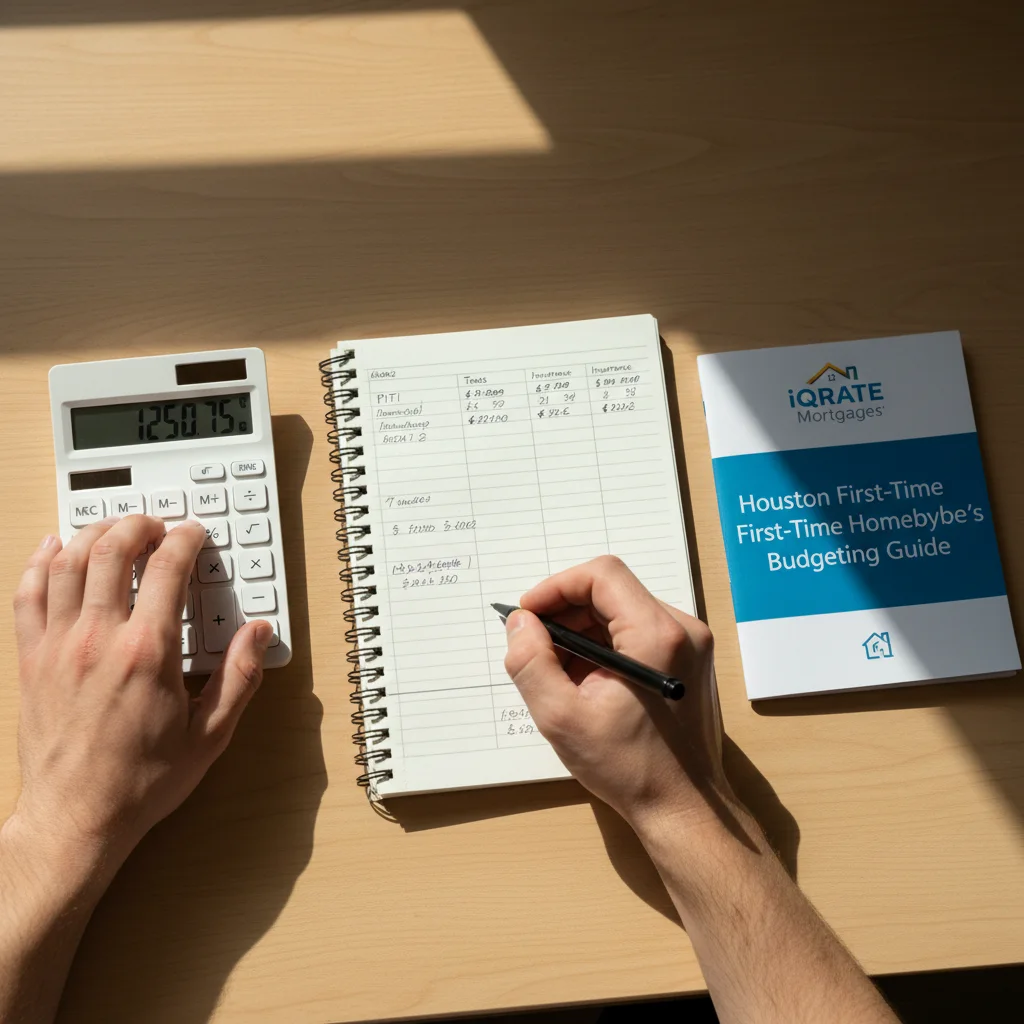
First-time buyers often make the mistake of looking only at principal and interest (P&I). Your actual mortgage payment, known as PITI, includes four components:
- Principal: The portion of your payment that goes toward paying down your loan balance.
- Interest: The cost of borrowing the money, paid to the lender.
- Taxes: Property taxes, which are collected by the lender and paid to local authorities like Harris County on your behalf. These can be substantial in Texas.
- Insurance: Homeowner's insurance, which protects your property against damage, and potentially Private Mortgage Insurance (PMI) if your down payment is less than 20%.
Example in Houston: Let's say you're buying a $325,000 home with a 5% down payment and a 6.75% interest rate.
- Principal & Interest (P&I): Approximately $1,995
- Estimated Property Taxes (Harris County): Approximately $600/month
- Estimated Homeowner's Insurance: Approximately $200/month
- Estimated Private Mortgage Insurance (PMI): Approximately $150/month
Your actual monthly payment isn't $1,995; it's $2,945. Understanding this full PITI payment is the first and most critical step in creating a realistic budget and avoiding a nasty surprise.

Adopt a 'Future Homeowner' Budget Today
Don't wait until you have the keys to your new home in Sugar Land to adjust your spending. Start living on your projected 'homeowner budget' right now. Create a spreadsheet or use a budgeting app to track every dollar. Calculate your estimated PITI and other homeownership costs, subtract that from your take-home pay, and see what's left for all other expenses. This exercise immediately reveals which discretionary spending categories, like dining out, subscriptions, or entertainment, will need to be adjusted. It's a low-risk way to test-drive your new financial reality.
Factoring in the Hidden Costs of Houston Homeownership
Your PITI payment is the biggest piece of the puzzle, but it's not the only one. True financial readiness means accounting for the other expenses that come with owning property. These 'hidden' costs are what often catch new homeowners by surprise.
- Maintenance and Repairs: A common guideline is the 1% rule, which suggests setting aside 1% of your home's value each year for maintenance. For a $325,000 Houston home, that's $3,250 a year, or about $270 per month. This fund covers things like servicing your HVAC system (a must-have in Texas heat), fixing a leaky faucet, or touching up exterior paint.
- Utilities: Your electricity and water bills will likely be higher in a larger single-family home than in an apartment. Air conditioning a 2,000-square-foot house costs significantly more than cooling a 900-square-foot apartment.
- Homeowners Association (HOA) Fees: Many master-planned communities in areas like Sugar Land and Pasadena have mandatory HOA fees. These can range from $50 to over $200 per month and typically cover the maintenance of common areas, pools, and parks. Make sure you know this fee before making an offer.
- Lawn Care and Pest Control: Unless you plan to do it all yourself, you may need to budget for regular lawn maintenance and pest control services, which are common necessities in the Houston climate.
- Initial Furnishings and Equipment: You'll need more than just your current furniture. Factor in one-time costs for a lawnmower, tools, window coverings, and potentially new appliances.
How Houston Lenders Verify Your Ability to Handle a Higher Payment
Lenders are also keenly aware of payment shock. They don't want to approve a loan for someone who will struggle to make payments. To mitigate their risk, they look for specific indicators in your financial profile that demonstrate you can handle the increased responsibility.
- Cash Reserves: This is a crucial factor. Lenders want to see that you have a savings cushion after you've paid your down payment and closing costs. Typically, they look for at least two to six months' worth of your full PITI payment in a liquid account. (The data, information, or policy mentioned here may vary over time.) A strong savings history shows you are a disciplined financial planner.
- Debt-to-Income (DTI) Ratio: Your DTI compares your total monthly debt payments (including your new estimated PITI) to your gross monthly income. While guidelines vary, a DTI below 43% is often preferred. (The data, information, or policy mentioned here may vary over time.) A low DTI indicates you have sufficient income to manage all your obligations without strain.
- Demonstrated Savings History: If you can show your lender bank statements with consistent, significant monthly savings transfers that equal or exceed the proposed payment increase, it serves as powerful evidence. You're proving you already have the capacity and discipline to manage the higher payment.
Smart Savings Strategies to Build Your Financial Cushion
Actively building a savings buffer is the best way to combat payment shock anxiety. It provides both the funds you need and the confidence that you're prepared. Here are two effective strategies.
The 'Forced Savings' Account
This is the most direct way to simulate your mortgage. Calculate the difference between your estimated PITI and your current rent. Then, set up an automatic, recurring transfer for that exact amount from your checking account to a separate high-yield savings account each month.
Example: Your estimated PITI is $2,700 and your rent is $1,500. The difference is $1,200. Every payday, you automatically transfer the corresponding portion of that $1,200 into savings. This strategy accomplishes two goals: it painlessly builds your cash reserves and forces you to live on your post-mortgage budget, proving you can do it.
Windfall and Bonus Allocation
Treat any unexpected income as a direct-to-savings event. This includes work bonuses, tax refunds, commissions, or side-hustle income. Instead of letting it get absorbed into your regular spending, create a rule that 100% of this money goes directly into your 'home fund'. This discipline can accelerate your savings progress significantly.
Does Paying Off Small Debts Reduce Payment Shock Anxiety?
Yes, absolutely. Tackling smaller, high-interest debts before you buy a home delivers a powerful one-two punch against payment shock, providing both financial and psychological benefits.
- Financial Impact: Eliminating debts like a $400 car payment, a $100 student loan payment, and $150 in credit card minimums frees up $650 in your monthly cash flow. This directly lowers your DTI ratio, making you a stronger borrower. More importantly, it reduces the net increase of your housing payment. If your PITI is $1,200 more than your rent but you've eliminated $650 in other debts, the 'shock' you feel is only a $550 increase, a far more manageable number.
- Psychological Impact: A cleaner financial slate is less stressful. Managing one large mortgage payment is mentally simpler than juggling five or six other debt payments on top of it. Reducing your obligations creates a feeling of control and makes the commitment to a mortgage feel less overwhelming.
How to Simulate Your Future Mortgage Payment
This final exercise combines everything we've discussed into a real-world trial run. By simulating your homeownership life for three to six months before you buy, you can eliminate nearly all fear of the unknown.
- Step 1: Calculate Your All-In Monthly Cost. Work with a mortgage advisor to get a precise PITI estimate for a home in your target Houston-area neighborhood. Then, add your budgeted amounts for utilities, the 1% maintenance rule, and any HOA fees. This is your total 'cost of living' number.
- Step 2: Live the Budget for 3-6 Months. For the next few months, you will operate as if you already own the home. Pay your rent as usual. On the same day, transfer the difference between your 'all-in cost' and your rent payment to a dedicated savings account. Do not touch this money.
- Step 3: Analyze the Results. At the end of the trial period, review your experience. Were you able to make the payments without stress? Did you have to cut back on spending more than you thought? Did unexpected expenses force you to dip into other savings? This test provides undeniable proof of your readiness. You'll either confirm you're prepared to buy or identify specific areas in your budget that need adjustment before you move forward.
Feeling more prepared to handle your first mortgage payment? The next step is to replace estimates with firm numbers. Take control of your homebuying journey by understanding your real purchasing power. Apply now for a detailed mortgage analysis, and let our experts help you build a confident plan to transition from renting to owning in Houston.
Author Bio
David Ghazaryan is the expert mortgage strategist and founder behind iQRATE Mortgages. With a mission to fund home loans that traditional banks won't touch, David specializes in helping clients with unique financial situations, including those recovering from foreclosure or bankruptcy. He expertly crafts smart, strategic, and stress-free mortgages by leveraging a vast network of over 100 lenders to secure competitive rates for investors and homebuyers alike. Praised for exceptional customer service, David has helped hundreds of families with a 97% satisfaction rate, guiding them to the mortgage they deserve.
References









