


What is the first step I should take after receiving orders?
Receiving Permanent Change of Station (PCS) orders while you are under contract to buy a home in San Antonio can feel like a devastating blow to your plans. The key is to act immediately and strategically, not to panic. Your mortgage is not automatically doomed. The first 24 hours after you receive your orders are the most critical for keeping your home purchase on track.
Your primary goal is to control the narrative and provide clarity to the two most important parties involved in your transaction: your loan officer and your real estate agent. Proactive, transparent communication can solve nearly every issue that a mid-process PCS creates.
Follow this immediate action plan:
- Do Not Delay Notification: The worst thing you can do is wait, hoping the problem resolves itself or that you can close before anyone finds out. This can lead to a last-minute denial and potentially put your earnest money at risk. As soon as you have official, written orders in hand, start making calls.
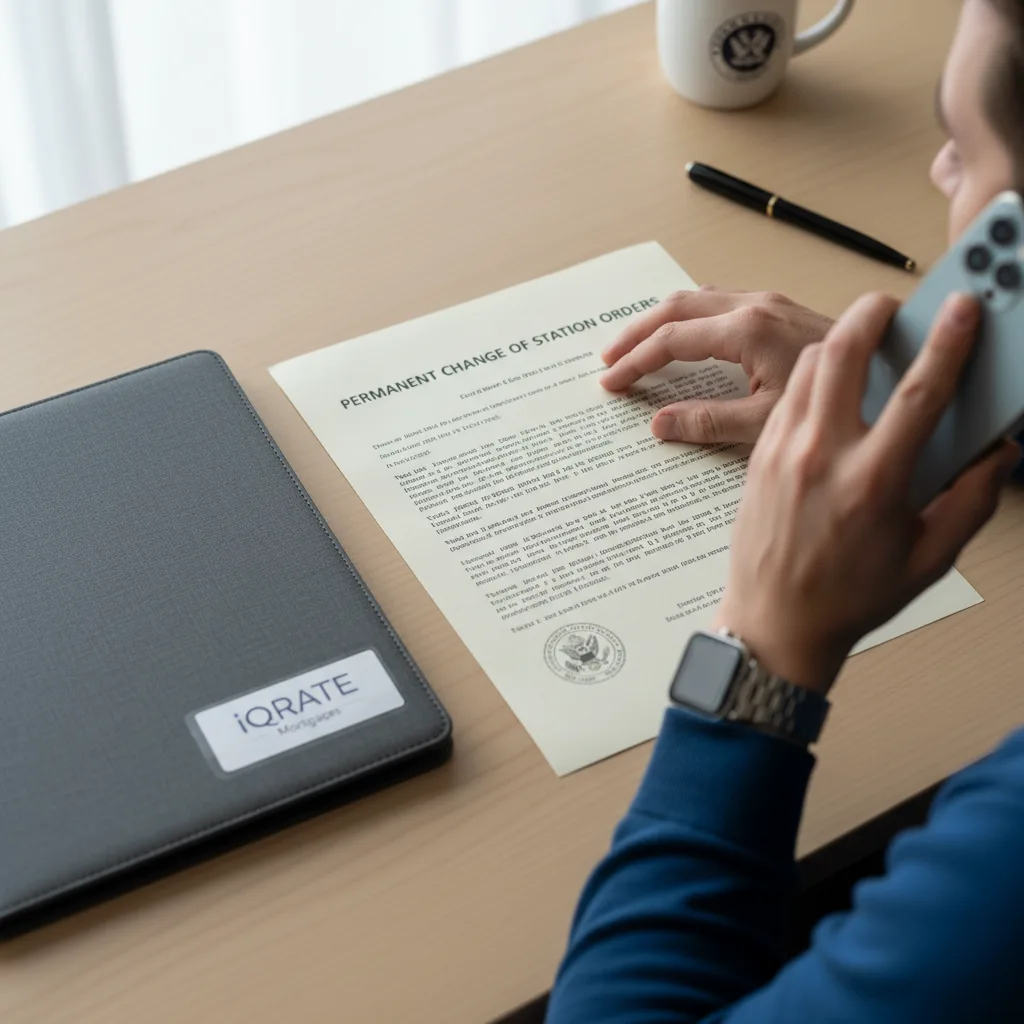
- Contact Your Loan Officer First: Your lender is the one who ultimately approves or denies the loan. Call and email them immediately. Be prepared to forward a complete, legible copy of your orders. This allows them to begin reassessing your file based on the new information, such as your report date and new duty station's Basic Allowance for Housing (BAH).
- Inform Your Real Estate Agent: Your agent is your advocate on the ground. They need to know about the PCS to communicate with the seller's agent. They can begin negotiating potential changes to the contract, such as an earlier closing date or access for a remote final walkthrough.
Taking these steps immediately demonstrates responsibility and allows the professionals you hired to do their jobs effectively. It shifts the situation from a crisis into a logistical challenge with clear solutions.
How do I properly notify my lender about a Permanent Change of Station?
Properly notifying your lender is more than just a quick phone call. It requires providing formal, official documentation that allows them to re-verify your eligibility for the VA loan under the new circumstances. Lenders operate on paperwork, and providing them with exactly what they need prevents delays and misunderstandings.
When you contact your loan officer, state clearly that you have received PCS orders and need to provide the documentation for your loan file. You will need to send a complete copy of your official orders via a secure email or the lender's document portal. Do not send partial documents or a summary.
The lender needs this information to confirm three critical loan components:
- Continued Employment and Income Stability: The orders serve as proof that your employment with the military is continuous. They will use the information on the orders to verify your new income, specifically by calculating the Basic Allowance for Housing for your new duty station.
- Report-By Date: The date you are required to report to your new station is crucial. It directly impacts the closing timeline and determines whether you will need to close remotely using a Power of Attorney.
- Intent to Occupy: The VA loan program requires that the veteran, their spouse, or a dependent child intends to occupy the home as their primary residence. Your orders create a potential conflict with this rule that must be addressed.
By providing the official orders promptly, you give the underwriting team the necessary information to re-evaluate your file and provide you with a clear path forward.
Can a lender legally cancel my loan because of new orders?
A lender cannot legally cancel your loan solely because you received PCS orders. However, they are legally obligated to ensure you still meet all the VA loan requirements after this significant change in circumstances. If the PCS makes it impossible for you to meet a core requirement, the loan can be denied. The most common hurdle is the VA's occupancy rule.
Understanding the VA Occupancy Requirement
The VA requires a borrower to certify that they intend to personally occupy the property as their primary residence within a 'reasonable time', which is typically defined as 60 days after closing. When you receive PCS orders to a different state, it may be impossible for you to physically move into the Killeen home within that 60-day window.
This is where solutions come into play:
- Spouse Occupancy: The VA guidelines have a powerful exception for military families. If your spouse will be occupying the property within the 60-day timeframe, the occupancy requirement is considered met, even if you are already at your new duty station. This is the most common and effective solution for service members with families.
- Delayed Occupancy Due to Military Service: In some cases, a lender may accept a later move-in date if it's clearly due to military service requirements, but this requires strong documentation and is at the underwriter's discretion. You would need to provide a letter explaining the circumstances. (The data, information, or policy mentioned here may vary over time.)

Your loan is at risk only if neither you nor your spouse can occupy the property within the required timeframe. Your lender isn't canceling the loan to be difficult; they are simply following the strict guidelines set by the Department of Veterans Affairs.
How does a power of attorney work for a remote closing?
A Power of Attorney (POA) is a legal document that grants a trusted individual, known as your 'attorney-in-fact', the authority to sign legal documents on your behalf. In a real estate transaction, this is essential if you cannot physically be present at the closing table. However, not just any POA will work.
Lenders and title companies require a Specific Power of Attorney (also called a Special Power of Attorney). This is different from a General POA that a service member might have for other matters. A Specific POA is tailored to a single transaction and explicitly details the powers being granted.
Here is the process to secure a lender-approved POA:
- Contact Your Lender First: Before you do anything else, ask your loan officer for their specific POA requirements. Most lenders have a pre-approved template they will require you to use. Using a generic POA you find online will almost certainly be rejected, causing significant delays.
- Consult Military Legal Assistance (JAG): Take the lender's required form to your installation's Judge Advocate General's (JAG) office. They can review the document, ensure you understand it, and prepare it for you correctly. This service is typically provided free of charge to service members.
- Choose Your Attorney-in-Fact: This person must be someone you trust implicitly, as they will be signing legally binding mortgage documents. Most often, this is a spouse, parent, or very close family friend. They must be physically present at the closing location in Texas.
- Execute and Deliver the POA: You will need to sign the POA in the presence of a notary. The original, notarized document must then be sent to the title company well in advance of the closing date for their legal review.
Will my new station's Basic Allowance for Housing affect my loan?
Yes, absolutely. Your Basic Allowance for Housing (BAH) is a significant part of the income your lender uses to calculate your debt-to-income (DTI) ratio. When you PCS, your BAH rate changes to reflect the cost of living at your new duty station. Your lender must re-underwrite your loan using the new, correct BAH amount.
This can either help or hurt your application.
- Example Scenario: Lower BAH: Imagine you were approved to buy a home in San Antonio with a DTI of 41% based on the local BAH rate. Your new orders are for a base in a lower-cost area, and your BAH will decrease by $400 per month. The underwriter must recalculate your DTI with this lower income. If that $400 reduction pushes your DTI above the lender's maximum threshold (e.g., 45%), your loan could be in jeopardy. (The data, information, or policy mentioned here may vary over time.)
- Example Scenario: Higher BAH: Conversely, if your orders send you to a high-cost area with a significantly higher BAH, this new income can strengthen your loan file, lower your DTI, and make the approval even more solid.
Your lender will use the official DoD BAH Calculator and your PCS orders to verify the new income amount. It's a non-negotiable part of the re-approval process.
What options exist if the closing date is after my report date?
It is very common for a scheduled closing date to fall after your required report date. This is a logistical issue that can be solved with planning.
- Negotiate an Earlier Closing Date: The simplest solution is often to ask for an earlier closing date. Your real estate agent can negotiate with the seller to move the date up. If the sellers have a flexible timeline, they may agree to accommodate your military orders.
- Utilize a Specific Power of Attorney: This is the most reliable and frequently used solution. As detailed above, a POA allows your designated representative to handle the closing in your absence, ensuring the transaction completes on time regardless of where you are.
- Spouse Attends Closing: If your spouse is a co-borrower on the loan, they can typically attend the closing and sign the necessary documents. This often eliminates the need for a formal POA, but you should confirm the exact requirements with your lender and title company.
How can I manage the final walkthrough and closing from another state?
Managing the final steps of a home purchase from afar requires trust in your team. The final walkthrough and the closing itself can both be handled remotely.
The Final Walkthrough
The final walkthrough is your last chance to inspect the property and ensure it's in the condition you agreed upon. To manage this remotely:
- Your Real Estate Agent is Key: Your agent can conduct the walkthrough on your behalf. Ask them to do a live video call with you as they walk through the home, showing you every room, testing appliances, and checking for any agreed-upon repairs. This allows you to see the property in real-time and give your approval.
- Send a Trusted Representative: If you have a family member or your designated attorney-in-fact in the Killeen or San Antonio area, they can attend the walkthrough for you.
The Remote Closing
- Closing with a POA: Your attorney-in-fact will attend the closing at the title company, sign all documents, and receive the keys on your behalf.
- Remote Online Notarization (RON): Depending on the state, lender, and title company policies, you may be able to use RON. This technology allows you to digitally sign documents and have them notarized over a secure video conference. This is becoming more common but is not yet universally available, so you must confirm if it's an option for your specific transaction. (The data, information, or policy mentioned here may vary over time.)
What specific clauses protect military members in San Antonio purchase contracts?
Standard real estate contracts do not always contain protections specific to the unique challenges of military life. To protect yourself, you must ensure a Military Clause (sometimes called a PCS Clause or Military Rider) is added to your purchase agreement from the very beginning.
This clause is a contingency that gives you the right to terminate the contract without penalty if you receive official military orders that force you to move. This means you would be entitled to a full refund of your earnest money deposit.
The language should be specific, stating that if the buyer receives official orders for a Permanent Change of Station or deployment to a location more than a certain number of miles away from the property, they may cancel the contract by providing a copy of said orders to the seller.
Do not assume this clause is automatically included. When you are making an offer on a home, explicitly instruct your real estate agent to add a robust military clause to the purchase agreement. It is one of the most important protections a military homebuyer can have. Navigating a PCS during a home purchase requires expert guidance and a proactive lender. If your situation feels complex, a mortgage strategist specializing in VA loans can help you explore all your options to ensure a smooth, successful closing.
A sudden PCS adds another layer to the home buying process, but you don't have to handle it alone. Our team of VA loan specialists is ready to help you navigate these changes with confidence and secure your home loan. If you're ready for a smoother process, apply for a mortgage with our expert team today.
Author Bio
David Ghazaryan is the expert mortgage strategist and founder behind iQRATE Mortgages. With a mission to fund home loans that traditional banks won't touch, David specializes in helping clients with unique financial situations, including those recovering from foreclosure or bankruptcy. He expertly crafts smart, strategic, and stress-free mortgages by leveraging a vast network of over 100 lenders to secure competitive rates for investors and homebuyers alike. Praised for exceptional customer service, David has helped hundreds of families with a 97% satisfaction rate, guiding them to the mortgage they deserve.
References
CFPB: Servicemember financial tools and resources
U.S. Department of Veterans Affairs: VA Loan Occupancy Requirements









