

What is a specific Power of Attorney for a real estate transaction?
A Power of Attorney (POA) is a legal document that grants a trusted individual the authority to act on your behalf in certain matters. For a real estate transaction, you cannot use a generic or 'general' POA. You need a 'Specific' or 'Limited' Power of Attorney. This document is narrowly focused and strictly defines the powers you are granting to your representative, known as the 'attorney-in-fact'.
Unlike a general POA that might cover broad financial and legal decisions, a specific POA for a home purchase will explicitly state the following:
- The Property Address: It must list the full legal address of the property you are purchasing in, for example, San Diego, California.
- The Transaction Details: It will reference the specific mortgage loan, including the lender's name and loan amount.
- Authorized Actions: The document outlines the exact actions your attorney-in-fact can take, such as signing the promissory note, deed of trust, and all other necessary closing documents.
- Time Limitation: The authority granted is typically effective only for the duration of the real estate transaction and may have a specific expiration date.
Lenders and title companies require this level of specificity to ensure the transaction is legally sound and that your representative is not overstepping their granted authority. They must review and approve the document's language well before the closing date to prevent any last-minute delays.
Why Lenders Reject General POAs
A general POA gives broad, sweeping powers to an individual. In a high-value transaction like a home purchase, this creates significant risk for the lender. A title insurance company may refuse to insure the title if a general POA is used, as it could be challenged later. A specific POA, drafted for the sole purpose of closing on your Oceanside home, provides a clear, legally defensible instrument that protects you, the lender, and the title company.
Who can I appoint as my attorney-in-fact for my San Diego home purchase?
Choosing your attorney-in-fact is a decision built on trust. This person will be signing legally binding documents that commit you to a mortgage for hundreds of thousands of dollars. They must be reliable, responsible, and physically available to attend the closing appointment in California.
Common choices for an attorney-in-fact include:
- Your Spouse: This is the most frequent and often the simplest choice, especially if your spouse is also on the loan or will be living in the home while you are away.
- A Parent or Sibling: A close family member who understands the gravity of the responsibility can be a solid option.
- A Trusted Friend: A long-time, reliable friend can also serve, provided they are fully briefed on their duties.
- A Real Estate Attorney: While less common for this specific role, hiring an attorney can provide an extra layer of professional oversight, though it comes at an additional cost.
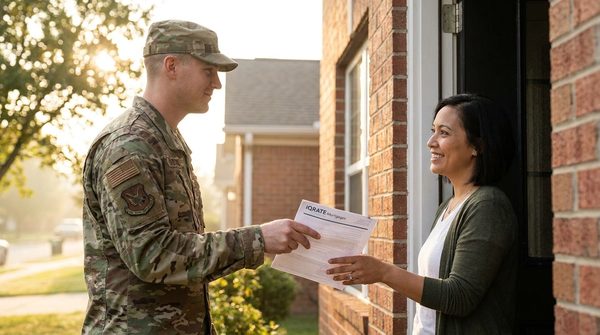
It is critical to note that your attorney-in-fact cannot be someone who has a financial interest in the transaction. This means you generally cannot appoint your real estate agent, the seller's agent, or your loan officer. Lenders prohibit this to avoid any potential conflict of interest. Your chosen representative should be someone whose only goal is to act in your best interest.
Does the Department of Veteran Affairs have special rules for this?
Yes, the Department of Veteran Affairs (VA) has specific guidelines regarding the use of a Power of Attorney and occupancy requirements. The core principle of the VA loan program is that the veteran intends to personally occupy the home as their primary residence. A deployment complicates this, but the VA has provisions in place for active-duty service members.
Key VA rules include:
- Intent to Occupy: You, the veteran, must certify that you intend to move into the property and occupy it as your primary residence upon your return from deployment. This certification is a standard part of the VA loan process.
- Spousal Occupancy: The VA's occupancy requirement can be satisfied if your spouse moves into the home within a reasonable time after closing (typically within 60 days) and lives there while you are deployed. (The data, information, or policy mentioned here may vary over time.) If your spouse is your attorney-in-fact and will be occupying your new home in San Diego, this is the most straightforward way to meet the rule.
- Lender Verification: The lender is responsible for ensuring the POA meets all VA and legal requirements. The VA gives lenders the discretion to approve the POA document, but it must be a 'specific' POA, not a general one. The lender will keep a copy of the executed POA in your loan file.
It's crucial to be transparent with your VA lender about your deployment from the very beginning. This allows them to prepare for a POA closing and ensure all VA-specific guidelines are met without issue.
How do I get the Power of Attorney documents notarized overseas?
Getting a legal document notarized while stationed overseas is a standard procedure with clear steps. You cannot use a local notary from the country you are in. The notarization must be done by an official with authority recognized under U.S. law.
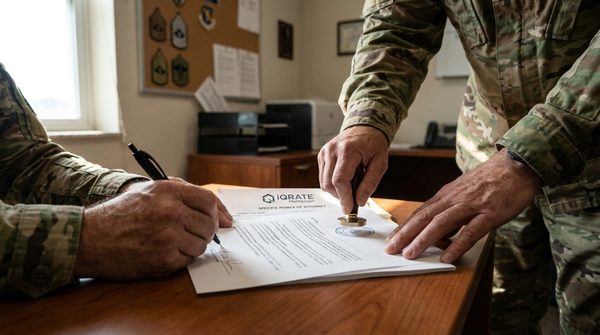
Your options for notarization include:
- Military Legal Assistance Office (JAG): Most military installations have a Judge Advocate General's (JAG) office that provides free legal services, including notarization. A military legal assistance attorney can often draft or review the POA for you and have it notarized by a commissioned officer authorized to act as a notary under federal law.
- U.S. Embassy or Consulate: U.S. consular officers at any embassy or consulate are authorized to perform notarial services for U.S. citizens. You will likely need to schedule an appointment in advance and pay a small fee.
The Process:
- Obtain the POA Draft: Your lender or a real estate attorney will provide the specific POA document. Do not sign it yet.
- Schedule an Appointment: Contact the nearest JAG office or U.S. embassy to schedule a notarial service appointment.
- Present Valid ID: You will need to present your valid military ID or U.S. passport.
- Sign in Person: You must sign the Power of Attorney document in the physical presence of the notarizing officer.
- Send the Original: Once notarized, you must send the original physical copy of the POA to your attorney-in-fact or title company in California. Scans or copies are not acceptable for closing. Use a reliable, trackable international shipping service to ensure it arrives safely and on time.
What are the common mistakes to avoid in this process?
Navigating a remote closing for your Oceanside property requires careful attention to detail. A single mistake can delay or even jeopardize your home purchase. Here are the most common pitfalls to avoid:
- Using a General Power of Attorney: As mentioned, this is the number one reason for rejection. Lenders and title companies will not accept a general POA. Insist on a document that is specific to your real estate transaction.
- Waiting Until the Last Minute: The process of drafting, reviewing, approving, notarizing, and shipping a POA takes time. Do not wait until a week before closing to start. This process should be initiated the moment you have a signed purchase agreement.
- Failing to Get Lender and Title Approval: Before you go through the hassle of getting the POA notarized, send a draft to your loan officer and the title company. They must approve the specific wording to ensure it meets their legal requirements. Getting their sign-off first saves you from having to repeat the process.
- Incorrect Information on the Document: Double-check that the property address, your legal name, your attorney-in-fact's legal name, and all other details are 100% correct. A simple typo can render the document invalid.
- Losing the Original Document: The original, 'wet-signed' notarized POA is required at closing. Make a digital copy for your records, but ensure the physical document is sent via a secure, trackable courier.
Can my spouse sign the closing documents for me in Oceanside?
Yes, absolutely. Appointing your spouse as your attorney-in-fact is the most common and practical solution for deployed service members. With a properly executed specific Power of Attorney, your spouse has the full legal authority to sign all necessary closing documents on your behalf.
Even if your spouse is a co-borrower on the VA loan, they will still need the POA. This is because they can sign for themselves, but they cannot legally sign for you without this specific authorization. At the closing table, your spouse will sign their own name for their portion of the documents and then sign your name, followed by 'by [Spouse's Name], as Attorney-in-Fact'. The title company will guide them through the exact signature process.
This arrangement is highly beneficial because it also helps satisfy the VA occupancy requirement, creating a smooth path to closing while you serve overseas.
How do I coordinate with the lender and title company from abroad?
Clear and proactive communication is the key to a successful remote closing. Your team in California—your loan officer, real estate agent, and the escrow officer at the title company—needs to be fully aware of your situation and how to best reach you.
Follow these steps for seamless coordination:
- Inform Everyone at the Start: The moment you begin the homebuying process, inform your entire team that you are an active-duty service member who may be deployed during closing. This sets expectations early.
- Establish Communication Channels: Determine the best way to communicate across time zones. Email is often most reliable. If possible, schedule one or two video calls for critical conversations. Provide them with your best contact information and inform them of any potential communication blackouts.
- Appoint Your POA as the Local Contact: Your attorney-in-fact will be the primary point person on the ground. Ensure they are included in all important communications and have the contact information for everyone involved.
- Request Digital Document Review: Ask the title company to send you a full digital copy of the closing package for your review before your scheduled closing. This allows you to check all the numbers and terms yourself before your attorney-in-fact signs the final papers.
When should I start this process if I know I will be deployed?
You should start the Power of Attorney process immediately after your offer on a home is accepted. The standard California escrow period is 30 days, which doesn't leave much room for error, especially with international shipping involved.
Here is a recommended timeline:
- Week 1 (Under Contract): Notify your lender you need a POA. Work with them or an attorney to get a draft prepared. Send the draft to the lender and title company for approval.
- Week 2: Once approved, make an appointment at your nearest JAG office or U.S. embassy for notarization. Sign and notarize the document.
- Week 2/3: Immediately ship the original notarized POA to your attorney-in-fact using a trackable service like FedEx or DHL. This can take several days to a week.
- Week 4: Your attorney-in-fact confirms receipt of the document. The title company now has the original in hand, well ahead of the closing date.
By starting early, you build in a buffer for unexpected delays, ensuring your dream of owning a home in San Diego or Oceanside stays securely on track, no matter where in the world you are serving. Navigating a VA loan closing from overseas requires careful planning and expert guidance. If you are an active-duty service member with questions about using a Power of Attorney for your home purchase, connect with a mortgage strategist to ensure every detail is handled correctly.
Ready to navigate your VA loan closing from overseas? Our mortgage strategists specialize in helping active-duty service members secure their homes. Let us handle the details so you can focus on your mission. Apply now to start the process with a team you can trust.
Author Bio
David Ghazaryan is the expert mortgage strategist and founder behind iQRATE Mortgages. With a mission to fund home loans that traditional banks won't touch, David specializes in helping clients with unique financial situations, including those recovering from foreclosure or bankruptcy. He expertly crafts smart, strategic, and stress-free mortgages by leveraging a vast network of over 100 lenders to secure competitive rates for investors and homebuyers alike. Praised for exceptional customer service, David has helped hundreds of families with a 97% satisfaction rate, guiding them to the mortgage they deserve.
References
Consumer Financial Protection Bureau - What is a power of attorney?
Military OneSource - Signing a Power of Attorney
VA.gov - Lenders Handbook, Chapter 7, Section 8: Power of Attorney