


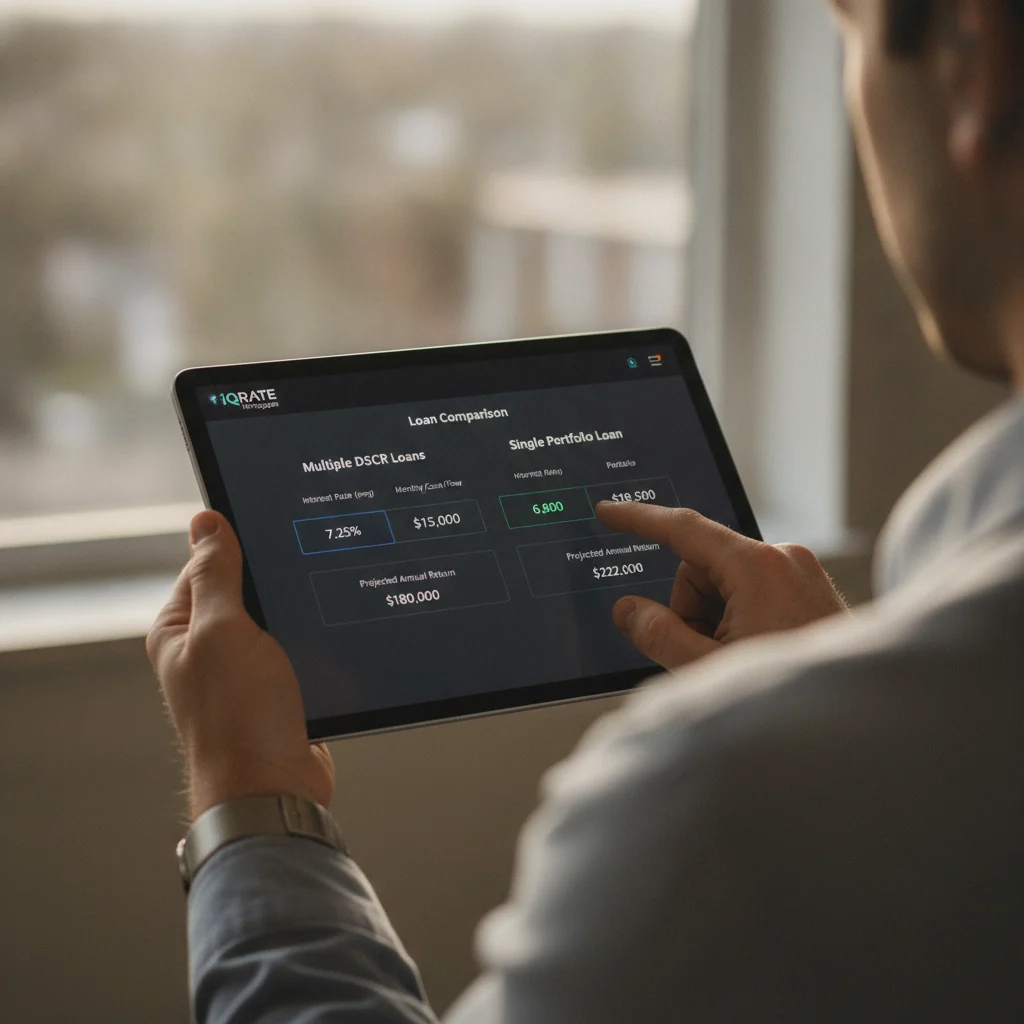
Multiple DSCR Loans vs. One Portfolio Loan
As a Texas real estate investor, the way you structure your debt is just as important as the properties you buy. Initially, many investors in markets like Austin and Houston use Debt Service Coverage Ratio (DSCR) loans. A DSCR loan is a powerful tool that qualifies you based on a single property's rental income rather than your personal W-2 earnings. Each property gets its own loan, its own payment, and is evaluated on its own merits.
In contrast, a portfolio loan is a single, 'blanket' mortgage that covers multiple properties. Instead of juggling several individual loans, you have one lender, one monthly payment, and one set of terms. The lender underwrites the loan based on the performance of your entire rental portfolio, not just one property. This consolidation can be a strategic move, but it fundamentally changes your financial structure.
Key Differences at a Glance
- Underwriting Focus: DSCR loans are hyper-focused on one property's income-to-debt ratio. A portfolio loan looks at the aggregate cash flow, equity, and risk across all included properties.
- Collateral: With DSCR loans, only the specific property secures its loan. In a portfolio loan, all properties are typically cross-collateralized, meaning they all collectively secure the single, larger loan.
- Simplicity: Managing three DSCR loans means three payments and three sets of paperwork. A portfolio loan consolidates this into one, simplifying your bookkeeping and financial oversight.

When Does It Make Financial Sense to Consolidate?
Consolidating your rental property loans isn't just about convenience; it's a strategic financial decision. It becomes a viable option when the benefits of aggregation outweigh the flexibility of individual loans. The tipping point often arrives when you own three or more properties and your goals shift from acquisition to optimization and growth.
Triggers for Consolidation
- Management Overload: As your portfolio grows, managing separate loans for each property in Austin or Dallas can become a significant administrative burden. Consolidating reduces complexity.
- Equity Access: You may have significant equity trapped across several properties. A portfolio loan allows you to pool this equity for a cash-out refinance to fund your next acquisition or major renovations.
- Maturing Loans: If you have several loans with balloon payments or adjustable rates coming due, consolidating them into a new fixed-rate portfolio loan can provide stability and predictable cash flow.
- Strengthening Your Position: If some properties are strong performers and others are weaker, combining them can create a more attractive package for a lender. The high-performing assets can bolster the overall portfolio's metrics.
How a Portfolio Loan Affects Your Interest Rate and Cash Flow in Austin
Consolidating your Austin rentals can have a direct impact on your two most important metrics: interest rate and cash flow. The outcome isn't always straightforward and depends heavily on the current market and the specifics of your existing loans.
Your portfolio loan's interest rate will be a blended average based on the risk profile of all included properties. It might be higher than the rate on your best individual DSCR loan but potentially lower than the rate on your riskiest one. Lenders assess the combined Loan-to-Value (LTV) and DSCR of the entire group.
Example: Austin Investor Cash Flow Analysis
Let's imagine an investor with three Austin rental properties:
Property A: Loan balance $250k at 7.5%, Monthly P&I: $1,748
Property B: Loan balance $300k at 7.8%, Monthly P&I: $2,160
Property C: Loan balance $275k at 7.2%, Monthly P&I: $1,874
Total Monthly Payment (3 DSCR Loans): $5,782
Now, let's say they consolidate these into a single portfolio loan of $825,000. Because the lender is taking on a larger, more complex loan, they might offer a rate of 7.6%.
- New Monthly Payment (1 Portfolio Loan): $5,862
In this scenario, the monthly payment is slightly higher, resulting in a minor reduction in cash flow. However, the investor now has one simplified payment and may have unlocked other benefits, like access to cash out, which could make the trade-off worthwhile.
Can I Get Cash Out When Refinancing Multiple Houston Properties?
Yes, one of the most compelling reasons for investors in a high-appreciation market like Houston to use a portfolio loan is to execute a cash-out refinance. By consolidating, you can tap into the collective equity of all your properties at once, rather than refinancing them one by one.
Lenders will typically allow you to borrow up to a certain LTV, often 70-75%, of the combined appraised value of the properties. (The data, information, or policy mentioned here may vary over time.) The process involves appraising each property in the portfolio, calculating the total value, and then determining the maximum new loan amount.
Example: Houston Cash-Out Scenario
An investor owns four Houston properties with the following details:
- Total Combined Value: $1,600,000
- Total Existing Loan Balances: $950,000
- Total Equity: $650,000
The investor wants to pull cash out to buy another property. A lender offers a portfolio cash-out refinance at 75% LTV.
- Maximum New Loan Amount: $1,600,000 (Total Value) x 0.75 (LTV) = $1,200,000
- Pay Off Existing Loans: $950,000
- Cash to Investor: $1,200,000 - $950,000 = $250,000
This provides a significant amount of capital for expansion without the hassle of refinancing four separate properties.
What Are the Qualification Requirements for a Portfolio Mortgage?
Qualifying for a portfolio mortgage is different from a standard home loan. Lenders are more concerned with the health of your investments than your personal income. While requirements vary by lender, they generally focus on these key areas:
- Experience: Most lenders want to see that you have a track record as a successful real estate investor, often requiring at least two years of experience managing rental properties. (The data, information, or policy mentioned here may vary over time.)
- Portfolio Performance: The lender will calculate a combined DSCR for all properties. This ratio must typically be 1.20 or higher, meaning the total rental income is at least 20% more than the total mortgage expenses. (The data, information, or policy mentioned here may vary over time.)
- Combined LTV: The loan-to-value ratio across the entire portfolio must meet the lender's guidelines, usually not exceeding 75%. (The data, information, or policy mentioned here may vary over time.)
- Credit Score: While the focus is on the properties, the investor's personal credit is still a factor. A minimum credit score, often 680 or higher, is typically required. (The data, information, or policy mentioned here may vary over time.)
- Liquidity: You'll need to show you have cash reserves, often equal to 3-6 months of total principal, interest, taxes, and insurance (PITI) for all properties in the portfolio. (The data, information, or policy mentioned here may vary over time.)
Does a Portfolio Loan Make It Easier to Buy More Properties?
A portfolio loan can absolutely streamline future acquisitions. By consolidating your existing properties, you establish a strong relationship with a lender who understands your investment strategy. This can create a more efficient path to financing your next deal.
Instead of applying for a new DSCR loan from scratch every time you buy, you may be able to add a new property to your existing portfolio loan through a modification. This is often faster and involves less paperwork than a full refinance. It allows you to use the strength and equity of your entire portfolio to secure financing for a new purchase, which can be a significant competitive advantage in fast-moving markets like Austin.
What Are the Primary Risks of Cross-Collateralizing My Assets?
The biggest drawback to a portfolio loan is cross-collateralization. This legal clause means that all properties in the portfolio serve as collateral for the entire loan balance. If one property underperforms and you default, the lender can foreclose on all the properties in the portfolio to satisfy the debt, not just the problematic one.
Risks to Consider:
- Loss of Flexibility: Selling a single property becomes more complicated. To sell one, you must get a partial release from the lender, which may require paying down a significant portion of the loan balance.
- Concentration Risk: If all your best-performing assets are tied up in one loan, a problem with a single property jeopardizes everything. With individual loans, a default on one property does not directly affect the others.
- Financing Limitations: While it can make buying easier, having all your properties with one lender could also limit your options if that lender changes its guidelines or if you want to seek financing elsewhere for a specific type of deal. Deciding between individual DSCR loans and a consolidated portfolio loan requires a careful analysis of your long-term investment goals. If you're ready to explore how restructuring your debt could unlock equity and simplify your management, contact a mortgage professional who specializes in financing for real estate investors.
Ready to see if a portfolio loan is the right strategy for your Texas properties? Take the next step to optimize your portfolio and see what's possible for your investments. Apply now to get a clear picture of your options.
Author Bio
David Ghazaryan is the expert mortgage strategist and founder behind iQRATE Mortgages. With a mission to fund home loans that traditional banks won't touch, David specializes in helping clients with unique financial situations, including those recovering from foreclosure or bankruptcy. He expertly crafts smart, strategic, and stress-free mortgages by leveraging a vast network of over 100 lenders to secure competitive rates for investors and homebuyers alike. Praised for exceptional customer service, David has helped hundreds of families with a 97% satisfaction rate, guiding them to the mortgage they deserve.
References









